
AI is rapidly becoming a staple in modern recruitment. For companies scaling fast, time is money, especially when it comes to sifting through hundreds of applications. But how much trust should you really put in AI-only screening decisions?
The short answer: You can be reasonably confident, but not blindly so. AI screening tools can reliably filter out poor-fit candidates and highlight strong matches, particularly in resume reviews and structured questions. Yet there’s still critical value in keeping human oversight for nuanced decisions. Let’s break down where you can—and can’t—trust AI in your hiring process.
Why This Matters
For fast-growing, founder-led businesses, hiring has to move fast without dropping your standards. Automating the screening stage feels like the holy grail: It promises to cut through time-consuming, inconsistent, and often subjective first cuts. Here’s why AI screening grabs recruiters’ attention:
- Speed: Filter hundreds of applicants in minutes instead of hours.
- Consistency: Apply the same rubric to every applicant, reducing bias.
- Focus: Free up your team to engage with the best-fit candidates sooner.
But the pressing question remains: How much trust should you place in these automated results, and where do humans still need to weigh in?
What the Numbers Say
Recent tests with Discovered’s AI models showed promising results:
| Scenario | Agreement with Human Reviewers |
|---|---|
| Overall Candidate Review | 80% |
| Identifying Poor-Fit Resumes | 92% |
When AI flags a candidate as a poor fit, it’s in sync with human reviewers about 92% of the time. That’s a major time saver for most roles, allowing hiring teams to skip over non-starters with confidence.
But precision drops slightly for “gray area” candidates—those with unusual backgrounds or borderline matches. These are candidates who might have unconventional career paths or hard-to-classify skills, where human judgment can spot hidden gems that AI may overlook.
When AI Screening Works Best
AI is strongest when applied to objective, repetitive tasks where the rules are clear:
- Resume Filtering: Flagging candidates missing essential qualifications or with clear dealbreakers.
- Structured Question Scoring: Grading written responses on clarity and coherence, plus basic logic and tone.
- Initial Ranking: Creating a prioritized list of candidates who meet or exceed key baseline criteria for review.
These steps help focus your hiring team’s efforts, so you spend less time on resume overload and more on meaningful conversations with top talent.
Where You Still Need a Human Touch
Even the best AI can’t yet interpret the nuance behind every candidate. Here are key areas where humans still lead:
- Culture Add & Team Fit: AI can’t fully read interpersonal dynamics, soft skills, or the unique communication style that best matches your team.
- Unique or Complex Role Requirements: If the position needs a rare blend of skills or heightened judgment, AI may not adequately grasp the context.
- Nontraditional Career Paths: Gaps in employment or pivoting between industries might be wrongly penalized unless a person assesses intent and potential.
- High-Stakes Hires: For leadership or client-facing roles, a human review is crucial before making a final decision.
Put plainly: AI is ideal for telling you whom to spend time on. Deciding who gets hired, however, should always have a human hand.
What’s the Risk in Going AI-Only?

Let’s look at where total reliance on AI can hurt your hiring:
- Overtrust: Blindly trusting scores without regular spot-checks may cause you to miss exceptional candidates who don’t fit the usual mold, sometimes referred to as “unicorns.”
- Undertraining: An AI built on data from flawed past hiring will simply repeat the same mistakes, potentially embedding bias or outdated criteria.
- Oversimplification: Complex jobs and nuanced work environments require context and interpretation that AI is not yet equipped to provide.
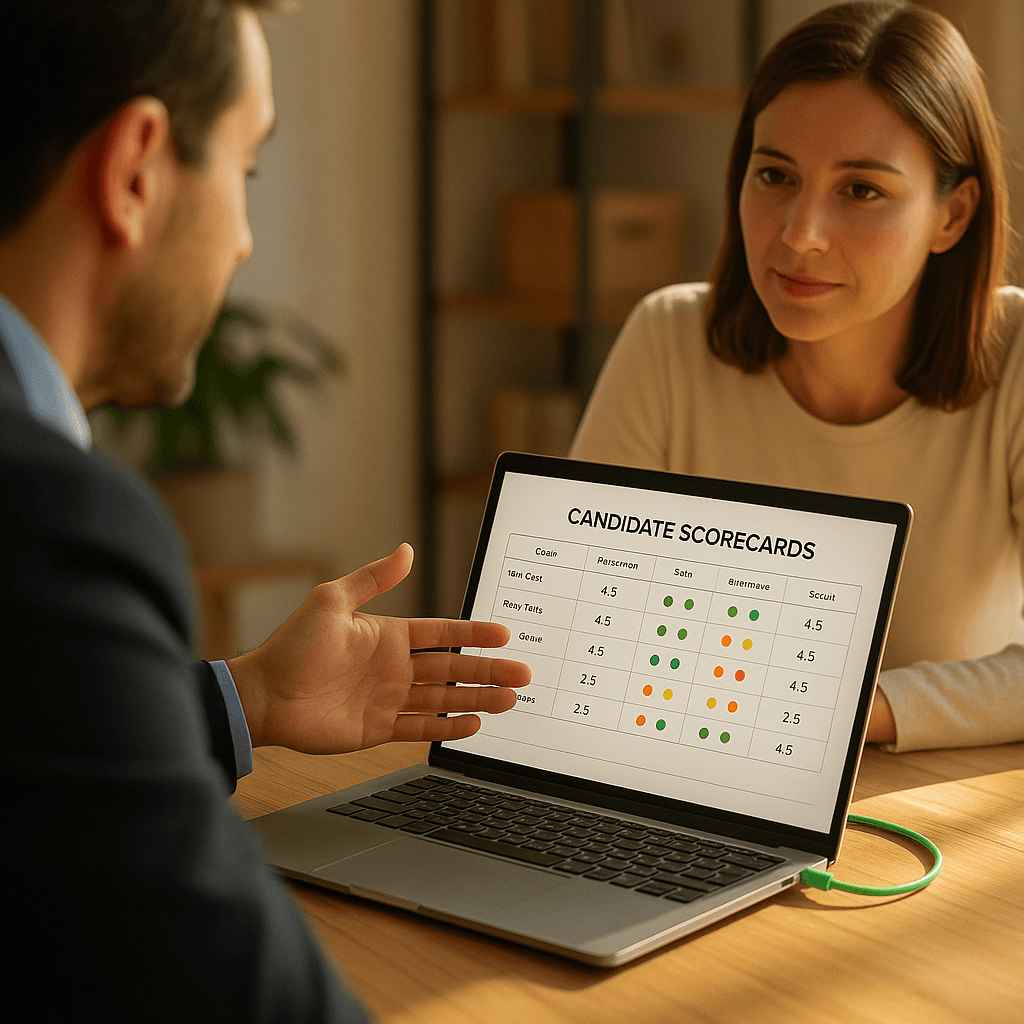
The good news: With the right supporting processes, you can confidently use AI to handle the repetitive part of screening while keeping your standards high. Combining AI with custom scorecards and one-way video interviews, for example, ensures that a nuanced, human perspective isn’t lost (One-Way Video Interview).
A Real Example from the Field
Consider a Discovered client who rolled out AI-powered screening across 12 different roles. Here’s what happened after just 60 days:
- Time to First Interview: Dropped by 47%
- Quality of Hires: 72% of those hired had scored in the AI’s top third
- Screening Accuracy: Fewer than 3% of candidates flagged as poor fits were later disputed by human reviewers
While it isn’t perfect, the blend of high speed and accuracy is a lifesaver for teams buried in applications, especially when burnout from endless resume reviews is real.
So, What Should You Do Next?
If you’re considering AI screening—or already using it—here’s a framework to maximize performance and confidence:
- Use AI for Minimums: Configure clear thresholds for required experience, credentials, and dealbreakers.
- Spot-Check Edge Cases: Assign human reviewers to candidates flagged as borderline or with unconventional paths.
- Layer On Other Tools: Blend AI screening with DISC assessments (Leveraging DISC Assessments), structured scorecards, and video interviews for a more holistic view.
- Iterate and Calibrate: Continually review where the AI aligns or misses expectations and adjust prompts, templates, or job analysis accordingly.
| Step | AI’s Role | Human’s Role |
|---|---|---|
| Resume Screening | Initial filter for basics | Spot-check edge or nontraditional profiles |
| Structured Scores | Rank clear answers | Probe grey-area logic/tone in key questions |
| Final Decisions | Support with data | Make hire/no-hire calls |
The Bottom Line: When to Trust AI Screening
- Trust AI: For automating repetitive screening, filtering out clear mismatches, and standardizing your process.
- Add Human Oversight: This is used to interpret nuance, make final calls, and ensure equity and fit.
You’re not just aiming to hire quickly—you want to hire right. AI can help you do both, as long as you keep a human hand on the wheel.
Internal Resources for Enhancing AI Hiring
- Learn about Applicant Tracking Systems for managing candidates efficiently.
- Explore Candidate Scorecards to add structure to your evaluations.
Ready to See AI Screening in Action?
Want to try Discovered’s AI hiring tools live? Schedule a free demo with our hiring experts. See how you can combine speed, accuracy, and a human touch for best-in-class results.
Content