



You post the role. Applications come in. You send the email. And then — nothing. The candidate doesn’t respond. Doesn’t schedule the interview. Just disappears.
This kind of candidate drop-off in hiring is frustratingly common, and most hiring teams either accept it as inevitable or try to fix it with more emails. Neither works particularly well.
The silence isn’t random. There are specific, well-documented reasons it happens — and when you understand them, you can address them directly instead of watching qualified candidates slip out of your pipeline.
The Candidate Drop-Off in Hiring Problem Is Bigger Than It Looks
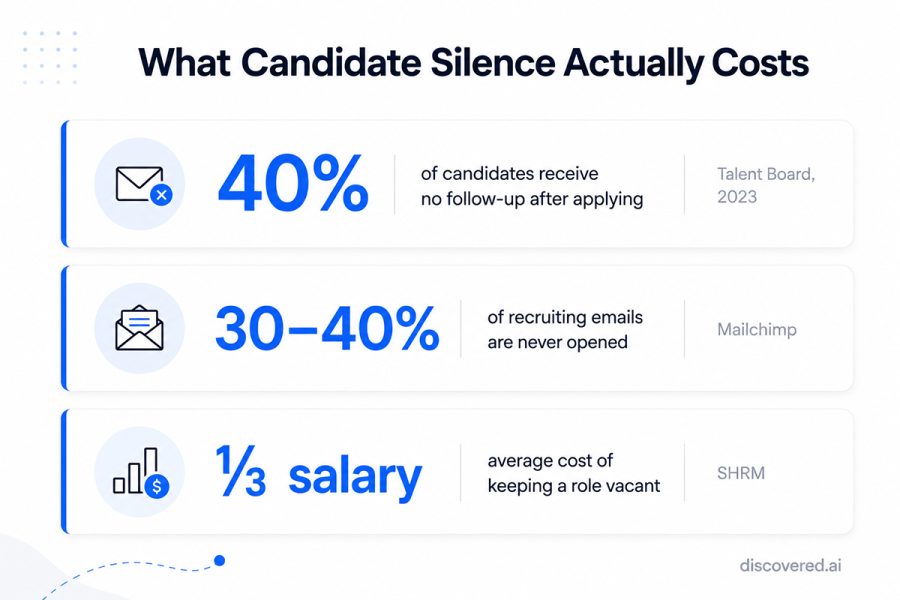
Research from the Talent Board’s Candidate Experience Research consistently finds that a large portion of candidates disengage after initial application — not because they lost interest, but because communication slowed or stopped entirely. In a 2023 survey, over 40% of candidates reported receiving no follow-up after submitting an application.
For hiring teams, this creates a compounding problem. You invest time reviewing applications, shortlisting candidates, and setting up outreach — and then a significant portion of those candidates simply don’t move forward because the follow-up wasn’t fast or consistent enough.
The cost isn’t just the time wasted. It’s the role that stays open longer, the team that operates short-staffed, and the revenue impact of delayed productivity. Research from SHRM estimates the average cost of a vacant position at roughly one-third of that role’s annual salary — not counting what it costs to restart the search if strong candidates have moved on.
Over 40% of candidates reported receiving no follow-up after applying — not because the company lost interest, but because no one reached out in time.
Why Candidates Go Quiet: Three Real Reasons
Candidate drop-off tends to get blamed on candidate behavior — they’re flaky, they’re fielding multiple offers, they’re not serious. Sometimes that’s true. But the data points to something more structural:
1. Speed matters more than most teams realize
A study published in the Journal of Applied Psychology found that response time significantly affects candidate engagement. Candidates who receive same-day or next-day follow-up are substantially more likely to complete the next step in the hiring process. When response time stretches to several days — common for stretched-thin HR teams — engagement drops sharply.
This is especially true in high-volume hiring environments, where candidates apply to multiple positions simultaneously. The company that reaches out first, consistently, tends to get the candidate.
2. Email alone has a reach problem
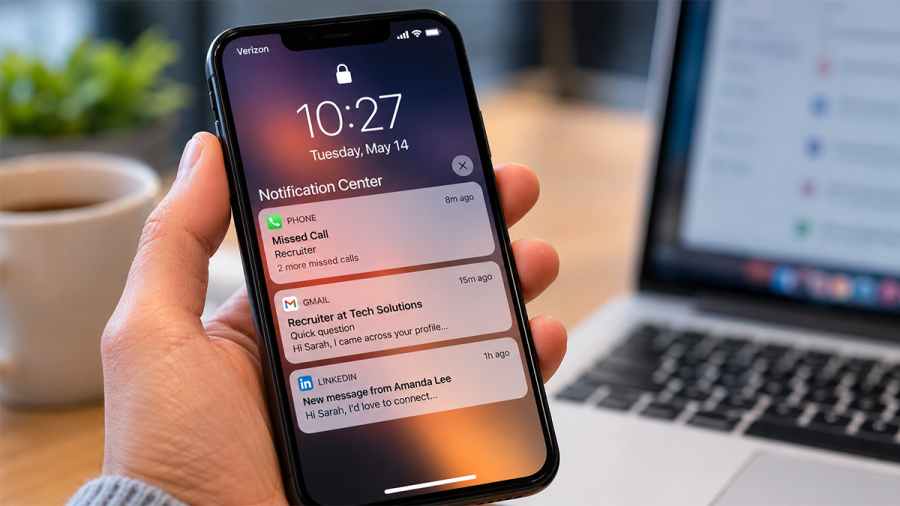
Email open rates in recruitment hover around 30–40% according to Mailchimp’s industry benchmarks. That means for every 10 candidates you contact by email, three to four never see your message. Candidates who are actively job hunting often manage multiple inboxes, spam filters, and competing notifications.
Phone contact reaches a different channel — one where the message is harder to miss. According to SHRM, phone calls remain one of the most effective outreach methods for time-sensitive hiring actions like interview scheduling, precisely because they cut through the noise that email accumulates.
3. Scheduling friction is underestimated
Even motivated candidates sometimes stall at the scheduling step. If the process requires back-and-forth emails to find a time, many candidates simply don’t prioritize it — especially if they’re already employed and managing a busy schedule. Research from Calendly’s 2022 State of Scheduling survey found that 63% of professionals say scheduling meetings is one of their biggest time-wasters. That friction affects candidates too.
When scheduling requires effort, completion rates drop. When it’s made simple and the prompt comes via a direct phone call with clear next steps, completion rates improve.
The Hidden Cost of Manual Follow-Up
For most recruiting teams, the response to candidate drop-off is to add manual steps: assign someone to call candidates, send additional reminder emails, flag unresponsive candidates for follow-up later in the week.
This approach has two problems:
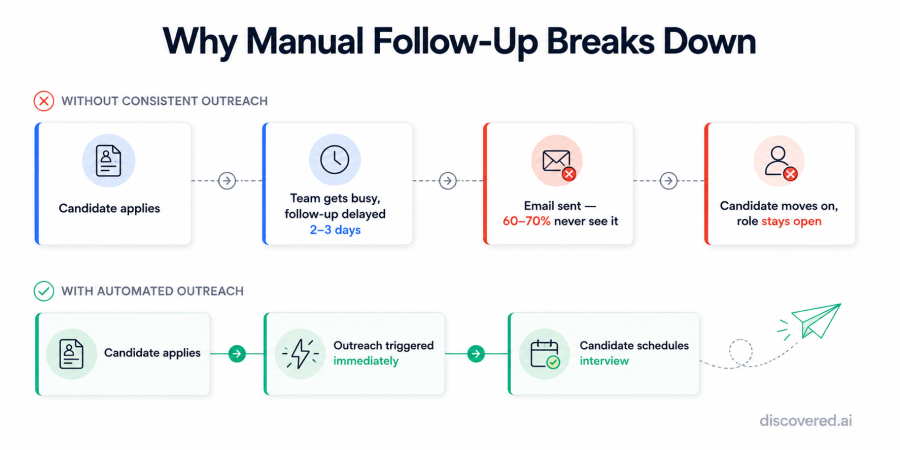
First, it’s inconsistent. Manual processes depend on someone remembering to do them, having the bandwidth to do them, and doing them at the right moment. In reality, follow-up calls get delayed or skipped entirely when the team is overwhelmed — which tends to be whenever hiring volume is highest, exactly when consistent follow-up matters most.
Second, it scales poorly. Following up with five candidates manually is manageable. Following up with fifty simultaneously — each at a different stage, each requiring a different action — is a different problem. Teams that grow their hiring volume without changing their hiring workflow find that candidate drop-off rates grow proportionally.
Manual follow-up processes break down precisely when hiring volume is highest — which is exactly when consistent outreach matters most.
What Consistent Phone Outreach Changes
The core insight behind automated phone outreach isn’t about technology — it’s about timing and consistency. A candidate who receives a direct phone call shortly after entering the pipeline, with a clear and specific ask (schedule your interview, complete your assessment, confirm your availability), is significantly more likely to take that action than a candidate who receives an email three days later.
When that outreach happens automatically, triggered by where the candidate is in your pre-employment assessment platform, a few things change:
- Response rates increase because the prompt is direct and timely
- Scheduling completion rates improve because the call can guide the candidate to book immediately
- Drop-off decreases because candidates who might have drifted are re-engaged before they fully disengage
- Recruiter time shifts away from chasing responses toward evaluating the candidates who do engage
This is what makes phone outreach particularly effective for high-volume environments. When hundreds of candidates are moving through the pipeline, the difference between a 50% scheduling completion rate and a 75% completion rate translates directly into more qualified candidates reaching the interview stage — without anyone on the team making individual calls.

One More Thing Worth Saying
A lot of the conversation about candidate drop-off focuses on the candidate — are they serious, are they a good fit, are they worth chasing. But the more honest conversation is about the hiring process itself.
If qualified candidates are consistently going quiet after applying, the question worth asking is: what are we doing — or not doing — in those first 24 to 48 hours that’s letting them slip away?
Most of the time, the answer is simpler than it seems. Nobody called. The email got lost. The scheduling step had too much friction. These are solvable problems, and the teams that solve them stop treating candidate drop-off as an inevitable feature of hiring and start treating it as a process problem with a process solution.
Stop chasing candidates. Start converting them.
If your team is losing qualified candidates because follow-up is slow, inconsistent, or just not happening — that’s a process problem with a direct fix.
Discovered’s AI-powered candidate follow-up calls automate phone outreach directly inside your hiring workflow. Candidates get contacted at the right moment, with a clear next step, without anyone on your team picking up the phone manually. Every call is logged, recorded, and summarized — so you always know what happened and what comes next.
Content