

Employee performance management for growing teams requires a different approach than what most businesses currently have in place. You are adding roles, managing more people, and moving faster than a once-a-year review cycle can track — and that gap has real consequences.
The result is predictable. Feedback arrives too late to be useful. Goals set in January are irrelevant by July. Employees who were drifting quietly are flagged as problems only when the damage is already done.
This guide breaks down why the annual review model fails growing businesses, what a more useful approach looks like in practice, and how to build a lightweight system that actually drives accountability — without turning employee performance management into a second full-time job.
Why Annual Reviews Fail at Employee Performance Management
The annual performance review was built for a different kind of organization — one with stable roles, predictable output, and enough time between cycles to observe and evaluate without urgency.
Growing businesses do not operate that way. Roles evolve mid-year. Teams restructure. Projects run on weeks, not quarters. By the time the annual review arrives, the conversation is already outdated.
There are three structural problems with the annual model:
- Recency bias skews the entire conversation. Managers remember the last 60 days, not the full year. A strong Q1 gets forgotten if Q4 had a rough patch. An employee who improved significantly over twelve months may still leave the review feeling like they underperformed.
- Feedback arrives too late to change anything. If a team member has been underdelivering for six months, the annual review is not the right moment to surface it. The cost has already been absorbed — in missed targets, team friction, or quiet disengagement.
- Values drift goes undetected. An employee who gradually disengages from the company’s values — how they treat the team, whether they hold themselves accountable — is difficult to spot in a single annual snapshot. It needs to be observed over time.
The problem with waiting to give feedback is that by the time you do, it is no longer feedback. It is a record of what already went wrong.

The Real Cost of Delayed Feedback
Delayed feedback is not just a management inconvenience. It has measurable business consequences, and for companies where employee performance management for growing teams is still largely informal, those consequences compound quickly.
According to Gallup’s State of the Global Workplace report, only 23% of employees strongly agree that they receive meaningful feedback at work. Among those who do not, disengagement rates are significantly higher — and disengaged employees cost organizations an estimated 18% of their annual salary in lost productivity.
For growing businesses, the cost shows up in four specific ways:
- Turnover in the first 12–18 months. Employees who do not receive consistent feedback early in a role are more likely to leave before their full contribution is realized. SHRM estimates replacement costs at 50–200% of the departing employee’s annual salary, depending on role complexity.
- Misaligned effort. Without regular check-ins, employees optimize for what they think matters, not what actually does. This gap compounds over months and is expensive to correct once visible.
- Delayed coaching. A skill gap caught at three months is a training investment. The same gap caught at twelve months is a performance problem that may require a difficult conversation that could have been avoided.
- Top performer attrition. High performers leave environments where their contributions are not recognized in a timely way. Research from Deloitte’s Human Capital Trends Report found that organizations with continuous feedback practices see 14.9% lower voluntary turnover than those relying on annual reviews alone.
A skill gap caught at three months is a training investment. The same gap caught at twelve months is a performance problem.
What Ongoing Clarity Actually Looks Like
Replacing annual reviews does not mean scheduling weekly meetings or building a complex documentation system. It means creating a rhythm of small, structured touchpoints that keep performance visible between formal cycles.
The goal is not more process. It is better signal. You want to know, at any point in the year, where each person stands on two dimensions: how effectively they are doing the work, and how well they are aligned with the values your business is built on.
These two dimensions matter for different reasons. Effectiveness is what gets measured. Values alignment is what gets felt — in team culture, in customer relationships, in how people show up when things get hard. Both need to be tracked separately.
A Simple Framework for Growing Teams
The following four-step framework is designed for businesses with 10 to 150 employees — where the team is big enough that informal tracking breaks down, but lean enough that heavyweight HR processes are not practical.
Step 1: Define What Good Looks Like
Before you can evaluate performance, you need a shared definition of what strong performance means in each role — both in terms of output and conduct. Without this foundation, performance conversations are subjective. Two managers in the same company can reach opposite conclusions about the same employee because they are measuring different things.
- Write down 3–5 effectiveness criteria for each role. Be specific: “Responds to client messages within 24 hours”, not “Good communication.”
- Define your core values in behavioral terms, not abstract nouns.
- Share these definitions when employees start — not when they are being reviewed.
Step 2: Check In on a 90-Day Cycle
Quarterly check-ins hit the right frequency for most growing businesses. According to research published in the Harvard Business Review, employees whose managers hold regular check-in conversations are three times more likely to be engaged than those who do not.
A structured 30-minute check-in covers three questions:
- What has gone well in the last 90 days, and why?
- What has been difficult or unclear, and what support would help?
- What are the one or two most important things to focus on in the next 90 days?
The conversation is documented — even a short written summary creates a record that makes every subsequent check-in more useful.
Step 3: Keep Goals Visible and Time-Bound
Goals that exist only in a review document are not goals. They are intentions. According to SHRM, goal alignment is one of the strongest predictors of employee engagement — but only when goals are visible, measurable, and reviewed regularly.
- Specific and measurable: “Reduce response time on complaints from 48 to 24 hours by June 30” — not “Improve customer satisfaction.”
- Deadline-bound: Without a due date, goals compete with everything urgent and lose.
- Reviewed at the next check-in: If goals are set and not revisited until the following year, the system has already broken down.
Step 4: Document Context, Not Just Scores
Numbers without context are easy to misread. Every time a rating changes — up or down — attach a note explaining what drove the change. A single sentence makes the score meaningful and protects the employee from being evaluated on data that does not reflect their full performance.
This practice also makes leadership conversations easier. When an exec asks why someone is underperforming or whether a promotion is warranted, the documentation provides a clear, evidence-based answer.
Numbers without context are easy to misread. A drop in an effectiveness score means something different if the employee just absorbed a team restructure or took on a stretch assignment.

Making the System Work Over Time
The biggest risk with any performance management approach is that it starts strong and then quietly stops. A few practices help sustain it:
- Automate review reminders. Do not rely on managers to remember when check-ins are due. Set review dates and let the system prompt them automatically.
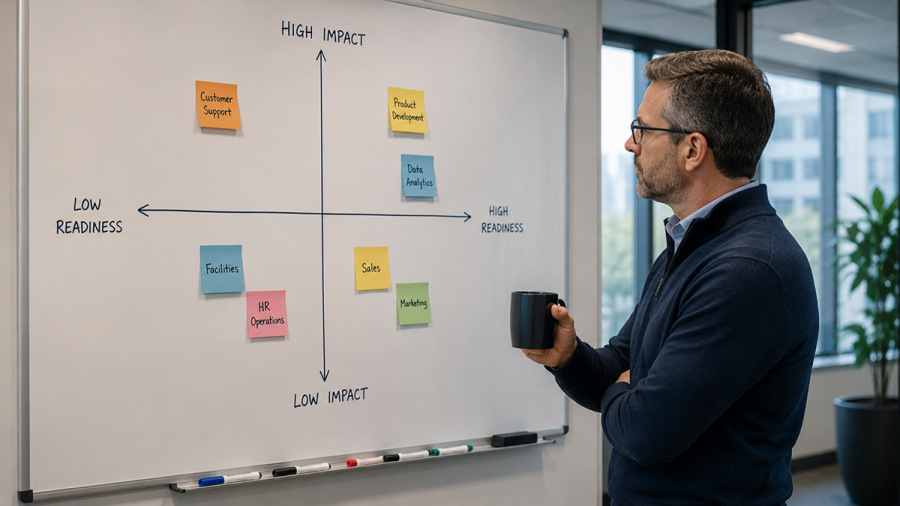
- Review the team chart quarterly. When you can see every employee plotted on a single view — effectiveness on one axis, values on the other — patterns emerge that are invisible in one-on-one conversations.
- Calibrate across managers. Two managers using the same criteria differently produce scores that cannot be compared. A short quarterly calibration session keeps the system honest across teams.
- Connect performance to development. Every time someone lands outside the top-right quadrant, the next action should be a goal or a support plan. Performance management without development is just documentation.
How Discovered Helps You Build This System
Putting a continuous performance management system in place requires the right tools — ones that are visual, easy to update, and built into the same platform you use to hire.
The Talent Grader inside Discovered is designed exactly for this. It replaces scattered spreadsheets, missed review cycles, and informal feedback with a single, structured view of your entire team’s performance.
One Visual Dashboard for the Whole Team
Every employee is plotted on a two-axis chart — job effectiveness on the horizontal axis, core values alignment on the vertical. At a glance, you can see who is thriving, who needs coaching, and where a performance or values gap is forming before it becomes a larger issue.
The four-quadrant view makes team-wide conversations faster and more objective. Instead of relying on a manager’s impression, you have a visual that the entire leadership team can see, discuss, and act on together.
Goals, Review Dates, and Score History — All in One Place
Inside each employee profile, you can:
- Set the next review date and let Discovered send automated reminders — no calendar management required
- Assign time-bound goals with descriptions and deadlines, and track completion between check-ins
- Update effectiveness and values ratings using sliders or by dragging the employee’s position directly on the chart
- Add comments with context each time a rating changes, and tag teammates using @mentions for collaborative feedback
- Review a full score history to understand how each person has trended over time, not just where they stand today
Export, Archive, and Scale as You Grow
When you need to present performance data to leadership, you can export any employee profile to PDF in one click — including metrics, goals, and comments. As your team grows, the Talent Grader scales with you: departments can be created and updated to keep the org structure current, and archived employees retain their full performance history for future reference.
For growing businesses currently managing performance through informal conversations and annual snapshots, the Talent Grader provides a practical path to something better: a system that is lightweight enough to maintain, visual enough to act on, and structured enough to produce consistent results across teams and managers.
To see how it works, explore the Talent Grader overview or read more about building a talent-first approach to growing your business.
Ready to Replace the Annual Review with Something That Actually Works? Discovered’s Talent Grader gives you a live, visual snapshot of your entire team’s performance — effectiveness and values alignment, all in one place. Set goals, track progress, automate review reminders, and make performance conversations data-driven instead of reactive.
Content