



The interview is on the calendar. The recruiter has reviewed the application, the hiring manager has blocked time, and everyone joins the meeting expecting the candidate to appear. Five minutes pass. Then ten. Eventually, the team realizes the candidate is not coming.
Interview no-shows are frustrating because the cost is larger than one unused calendar slot. The recruiter may have spent time screening and preparing the candidate, the hiring manager has interrupted their workday, and another applicant may have been waiting for the same opportunity. When missed interviews become frequent, they can also extend time to hire and make the pipeline harder to predict.
It is tempting to treat every no-show as evidence that the candidate was never serious. Sometimes that conclusion is correct, but repeated no-shows can also reveal problems in the recruiting process itself. Candidates may forget an appointment booked days earlier, misunderstand the time zone, lose the meeting link, experience a work conflict, accept another opportunity, or decide that rescheduling is more difficult than simply disappearing.
Knowing how to reduce interview no-shows therefore requires more than sending another reminder. Hiring teams need a scheduling process that keeps candidate interest high, removes uncertainty, makes attendance convenient, and gives people an easy alternative when their availability changes.
Interview Attendance Starts Before the Calendar Invitation
A calendar invite cannot fix a candidate who has already lost interest in the opportunity. Before scheduling an interview, the candidate should understand enough about the role to make a meaningful decision about continuing. Basic details such as work location, schedule, major responsibilities, interview format, compensation expectations when available, and remote or on-site requirements should not emerge for the first time after the interview has already been booked.
This matters because a scheduled interview can create the appearance of candidate commitment without confirming whether that commitment actually exists.
Imagine that someone applies to what they believe is a standard Monday-through-Friday role. After scheduling, they discover that the position requires every weekend. Another candidate may assume the job is remote before learning that it requires four days on-site. Both candidates now have a reason to withdraw after recruiter and manager time has already been reserved.
Clear expectations earlier in the process reduce that mismatch. The same principle appears throughout the broader candidate journey. Our guide to the recruitment marketing funnel explains how candidates continuously evaluate whether an opportunity matches what they expected from the job posting and employer message. Interview scheduling should continue that clarity rather than introduce new uncertainty.
Recruiters do not need a lengthy pre-interview conversation for every role. They simply need enough confirmation to know that both sides are still interested before putting the meeting on the calendar.
Reduce the Distance Between Interest and Interview
Candidate interest has momentum. When someone completes a screening conversation and both sides agree to continue, the strongest time to schedule the next step is usually while that interest is still active. Allowing several days to pass before sending available times creates an unnecessary gap where other employers can move ahead.
The problem becomes even larger when scheduling itself requires multiple rounds of email. A recruiter asks whether Tuesday works. The candidate offers Wednesday afternoon instead. The hiring manager is unavailable, so another option is proposed for Friday morning. By the time everyone agrees, what should have been a simple administrative step has become several days of coordination.
Candidate self-scheduling removes much of that friction by allowing applicants to choose from times the hiring team has already approved. Discovered’s Automated Interview Scheduling connects scheduling links with real-time availability, time-zone handling, reminders, and candidate workflow steps so candidates can choose an appropriate appointment without waiting for repeated recruiter coordination.
That flexibility is particularly valuable for candidates who are already employed. Someone working a shift, caring for family members, commuting, or managing another interview process may have limited availability during normal recruiting hours. Giving them approved options allows the candidate to solve the scheduling problem without having to explain every personal constraint.
Faster scheduling does not mean rushing candidate evaluation. It means eliminating the administrative waiting that happens after the organization has already decided it wants to interview someone.
A Confirmation Should Remove Every Practical Reason to Miss the Interview

Once the interview is booked, the confirmation should answer the questions a candidate would otherwise need to search for later. They should know when the interview starts, which time zone applies, how long it is expected to take, whether it is virtual or in person, who they will meet, how to join or arrive, and what they should prepare.
That information may sound obvious, yet small omissions create real friction. For a virtual interview, a candidate may discover five minutes before the appointment that the meeting platform requires an installation or account. For an in-person interview, the address may lead to a large campus without explaining which entrance to use. A candidate in another time zone may place the interview on their own calendar incorrectly.
Indeed’s current guidance on handling candidate no-shows recommends reviewing communication and the circumstances around a missed meeting before assuming the applicant intentionally abandoned the interview.
That same logic should be applied before the interview happens. If the employer can remove ambiguity in advance, fewer candidates have opportunities to make an avoidable mistake. A useful confirmation should therefore make three things immediately clear: when the interview happens, how the candidate attends, and what they should do if something changes.
The final part is often overlooked. A candidate who sees an obvious rescheduling option is more likely to communicate a conflict than someone who believes changing the meeting requires an uncomfortable conversation with the recruiter.
Reminders Work Best as Part of the Scheduling System
A confirmation is useful when the appointment is created, but its visibility decreases as other messages arrive and the interview date approaches. That is where reminders become useful.
The goal is not to repeatedly ask candidates whether they still plan to attend. A well-designed reminder simply brings the essential appointment information back into view at the moment when it becomes useful.
A practical sequence might include the booking confirmation, a reminder approximately one day before the interview, and a short same-day reminder for roles where missed appointments are common. The exact timing should reflect the role, candidate population, and length of time between scheduling and interviewing rather than becoming a universal rule for every opening.
Each reminder should preserve the important logistics rather than force the candidate to find the original message. Date, time, time zone, meeting location or link, and the option to change the appointment should remain easy to locate.
Discovered supports automated scheduling and candidate reminders so these communications can happen without recruiters manually monitoring every upcoming interview.
Automation matters here because the action is predictable. The recruiter does not add meaningful judgment by remembering to send the same logistical reminder to every candidate.
That does not mean communication should become excessive. Several unnecessary messages can create the opposite effect and make candidate communication feel noisy or impersonal. The better approach is a small number of messages that each have a clear purpose.
| Moment | Purpose of the communication |
|---|---|
| Immediately after booking | Confirm that the interview is officially scheduled |
| Before the interview | Return important logistics to the candidate’s attention |
| Close to start time when appropriate | Make the meeting link, location, and time easy to access |
| If availability changes | Give the candidate a simple path to reschedule |
The strongest reminder strategy makes attendance easier rather than simply increasing message volume.
Make Rescheduling Easier Than Disappearing
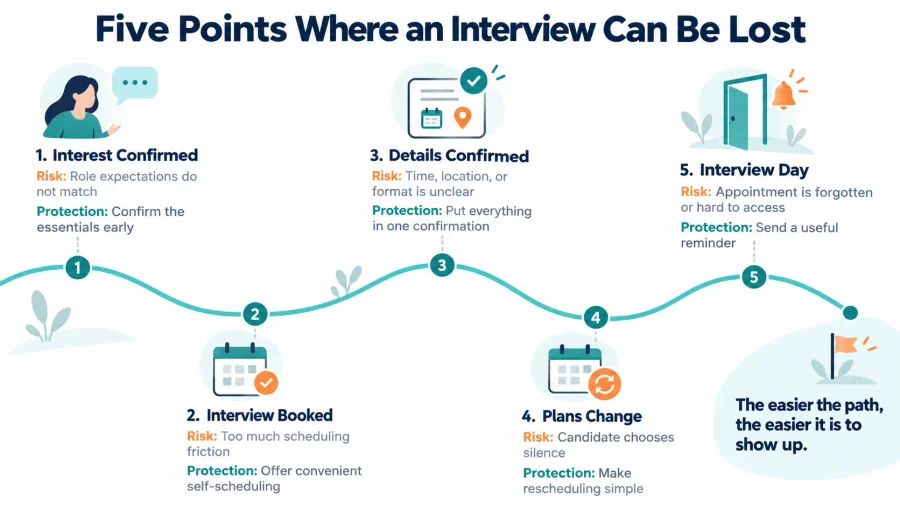
A candidate can be genuinely interested in a job and still become unavailable for an interview. Their employer may change their shift. A meeting may run late. Transportation can fail. A child may become sick. Another interview may move unexpectedly. None of those situations necessarily tells the employer whether the candidate would be a strong hire.
The recruiting process should make communicating that conflict easier than avoiding it. This is where rescheduling becomes part of no-show prevention rather than merely an administrative convenience.
When candidates can choose another approved time without restarting a long email exchange, the organization converts some potential no-shows into rescheduled interviews. Recruiters also gain better information because cancellation, rescheduling, and unexplained absence are no longer treated as the same behavior.
That distinction matters. A candidate who contacts the employer in advance and moves the interview to another available time has handled the situation differently from someone who repeatedly misses confirmed appointments without communication. A useful workflow should preserve that context.
Easy rescheduling also improves the candidate experience because it acknowledges that applicants often have jobs and responsibilities outside the hiring process. Flexibility does not require unlimited accommodations; it simply gives candidates a clear way to tell the employer when the original time no longer works.
Interview Reliability Depends on the Employer, Too
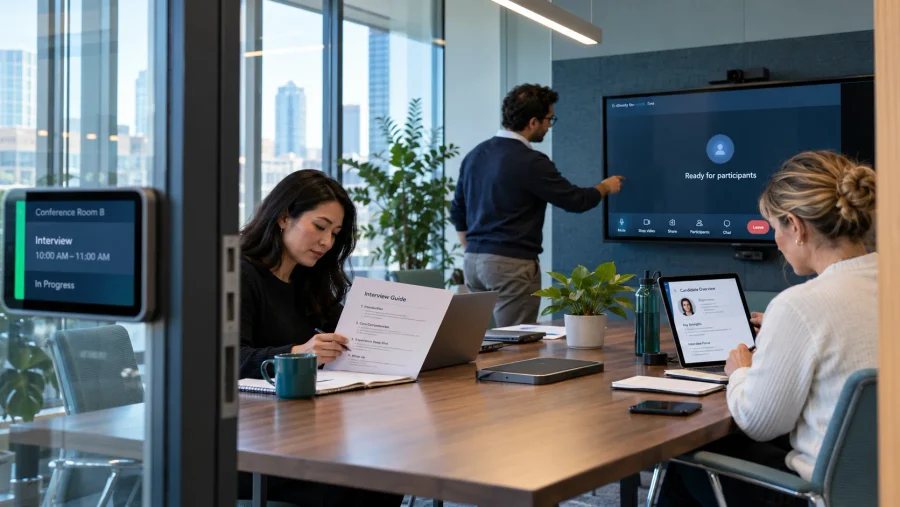
No-show prevention is often discussed entirely as a candidate problem, but the organization can also create failed interview experiences.
A candidate arrives at the correct time and discovers that the hiring manager was never added to the invitation. Someone receives an old video link. An interviewer reschedules internally without confirming that the candidate received the change. A person arrives at a facility where reception does not know who they are meeting.
From the candidate’s perspective, these failures communicate the same thing as an applicant no-show communicates to an employer: my time was not treated as important.
Interview readiness should therefore apply to both sides. The interviewer needs the correct appointment, candidate context, interview format, and evaluation criteria before the meeting begins. If multiple people are participating, the organization also needs clear ownership of who will open the conversation, what each interviewer should evaluate, and what happens if one participant becomes unavailable.
Discovered’s reusable Interview Guide Templates can help teams standardize the questions and evaluation structure interviewers use once the candidate arrives. This connects no-show reduction with the broader recruiting workflow. Scheduling successfully is not enough if the internal team is unprepared when the candidate appears. A reliable interview process protects the appointment from both directions.
Keep Candidates Connected When the Interview Is Several Days Away
The risk of candidate disengagement increases when significant time passes between scheduling and the interview. The solution is not to fill that gap with promotional emails. It is to provide information that makes the upcoming conversation easier or more relevant.
For example, candidates might receive a concise overview of what the interview will cover, a current job description, information about the interviewer, or a realistic look at the role. Our guide to recruitment marketing videos explains how short candidate-facing video can answer specific questions about the workplace, manager, role, or hiring process without asking candidates to work through another long block of recruiting copy.
The timing matters. A manager introduction sent shortly before an interview has a clear purpose. A realistic job preview can help the candidate confirm that they remain interested. Preparation guidance can reduce uncertainty about what kind of conversation to expect.
What candidates do not need is a stream of generic content simply because the company has it available. The communication between scheduling and interviewing should reinforce the candidate’s understanding of the opportunity, not restart the employer-branding campaign.
Measure More Than the No-Show Rate
Teams cannot improve interview attendance effectively if all missed interviews are treated as isolated incidents. The basic calculation is straightforward:
Interview no-show rate = missed interviews ÷ scheduled interviews × 100
Its inverse is the interview show rate:
Attended interviews ÷ scheduled interviews × 100
The more useful work begins when those numbers are segmented. A company may have a reasonable overall show rate while one location consistently experiences far more no-shows. Another organization may discover that interviews scheduled more than seven days in advance have lower attendance than those scheduled within two days.
Differences can also appear by job type, interview format, candidate source, recruiter, hiring manager, time of day, or stage in the process. Track cancellations and reschedules separately from unexplained absences. Combining them into one metric hides valuable information about candidate behavior and process quality.
A practical review might look like this:
| Pattern | What to investigate |
|---|---|
| High no-shows for one location | Travel, parking, shift expectations, location instructions |
| More no-shows after long scheduling gaps | Hiring speed and candidate engagement |
| Virtual interviews missed frequently | Meeting links, time zones, platform instructions |
| High rescheduling but low no-shows | Available interview times may be inconvenient |
| One recruiter has a lower show rate | Confirmation or reminder practices may differ |
| Candidates disappear after screening | Role expectations may not be aligned early enough |
Metrics should help the team locate friction rather than simply assign blame.
A No-Show Is Information, Not an Automatic Conclusion
Even a strong scheduling process cannot eliminate every missed interview. When a candidate does not attend, the first step should be verifying that the employer did not cause the problem. Confirm the correct appointment time, time zone, calendar invitation, meeting link, interviewer availability, and any recent communication.
After that, a brief neutral follow-up can clarify what happened. Indeed’s recently updated guidance recommends considering the candidate’s previous communication, understanding the circumstances, and deciding whether another interview is appropriate rather than reacting immediately to the absence.
For some roles, reliability and attendance are especially important, so an unexplained no-show may legitimately affect the hiring decision. The important point is that the organization applies a consistent standard and preserves enough context to understand what actually occurred.
One emergency is different from repeated unexplained absences. A broken meeting link is different from candidate ghosting. A candidate who immediately apologizes and requests another time provides different information from someone who disappears completely. The recruiting record should preserve those distinctions.
Better Attendance Comes From a Better Interview Process
Interview no-shows will never reach zero. Candidates will change their minds, accept other offers, experience emergencies, and occasionally fail to communicate. Employers cannot control every circumstance. They can control how much unnecessary friction exists between candidate interest and interview attendance.
A stronger process confirms that the candidate still understands and wants the opportunity before scheduling, moves quickly while interest is active, offers convenient interview times, communicates every practical detail, sends useful reminders, makes rescheduling straightforward, and prepares the internal team to be ready when the candidate arrives.
Technology supports that process by handling the repetitive coordination around the interview. Discovered’s automated interview scheduling combines candidate self-scheduling, calendar availability, time-zone handling, reminders, and workflow automation so recruiting teams can spend less time coordinating appointments and more time preparing for the conversations themselves.
The goal is not simply to persuade more candidates to keep appointments. It is to build an interview process where attending, rescheduling, and communicating are all easier than disappearing.
Frequently Asked Questions
What is an interview no-show?
An interview no-show occurs when a candidate fails to attend a confirmed interview without notifying the employer beforehand. It is different from a cancellation or reschedule because the candidate does not communicate the change before the scheduled appointment.
How can employers reduce interview no-shows?
Employers can reduce avoidable no-shows by confirming candidate interest early, scheduling quickly, offering convenient times, sending complete confirmations, using strategic reminders, making rescheduling easy, and ensuring the interview team is prepared.
When should interview reminders be sent?
There is no single cadence for every hiring process. A booking confirmation followed by a reminder before the interview is a common starting point, with an additional same-day reminder when the role, candidate population, or scheduling pattern makes it useful.
Does automated scheduling help reduce interview no-shows?
It can remove several common sources of friction. Discovered’s Automated Interview Scheduling allows candidates to select from available times while the system manages time-zone conversion, calendar syncing, reminders, and related workflow actions. Discovered.ai
Should a candidate automatically be rejected after missing an interview?
Not necessarily. Employers should first confirm that the appointment details and meeting access were correct, review prior candidate communication, and understand the circumstances. Repeated unexplained absences may justify a different response from a one-time emergency or employer scheduling error.
How do you calculate interview no-show rate?
Divide the number of candidates who missed scheduled interviews without advance notice by the total number of scheduled interviews, then multiply by 100. Cancellations and reschedules should ideally be tracked separately so they do not distort the no-show metric.
Ready to make interview coordination easier? Explore Discovered’s scheduling tools or meet with our team.
Content