



A candidate reaches the end of your hiring process after several interviews, conversations, and internal reviews. The team agrees that they are the right person, compensation is approved, and the recruiter sends the offer expecting the search to be almost finished. A few days later, the candidate declines.
At that point, most of the recruiting investment has already been made. The organization has spent time sourcing, screening, interviewing, evaluating, coordinating schedules, and getting internal agreement. Losing the candidate means more than losing one offer; it may mean returning to another finalist, reopening the search, extending the vacancy, or starting part of the process again.
This is why job offer acceptance rate matters. It measures how effectively an organization converts the candidates it has already decided to hire into people who actually accept the opportunity.
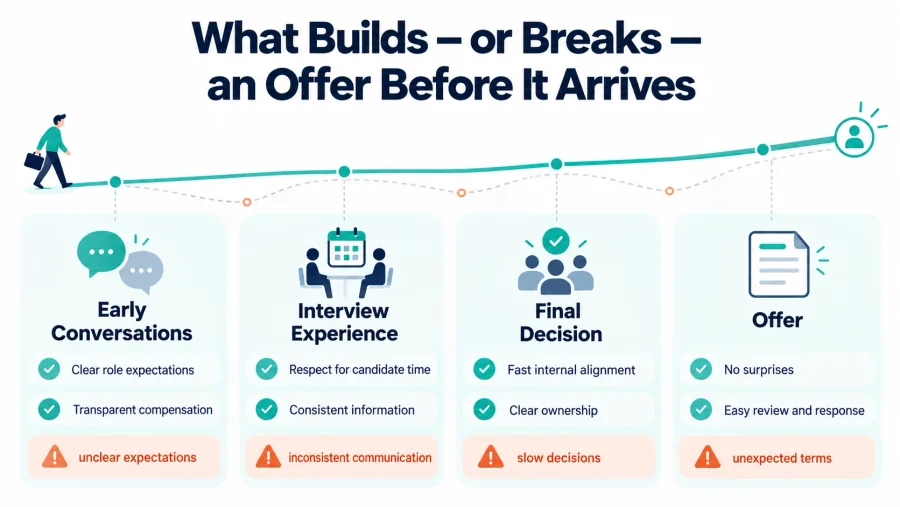
Compensation has a major influence, but it is only one part of the decision. Candidates also evaluate how quickly the company moved, whether the role remained consistent throughout the process, how they were treated, what they learned about the manager and team, whether important terms were clear, and how confident they feel about joining the organization. A strong offer should therefore feel like the natural conclusion of the hiring experience rather than a new negotiation that begins after several weeks of recruiting.
What Does Job Offer Acceptance Rate Tell You?
Job offer acceptance rate measures the percentage of formal offers that candidates accept during a given period. The standard calculation is:
Accepted offers ÷ total offers extended × 100
If an organization extends 20 offers and 16 candidates accept, the acceptance rate is 80%.
The calculation is straightforward, but the interpretation requires more context. A lower acceptance rate does not automatically mean compensation is below market. Candidates may be declining because another company moved faster, the schedule was different from what they expected, flexibility was unclear, the manager relationship raised concerns, or important details changed late in the process. For that reason, acceptance rate is most useful when viewed alongside candidate feedback and other recruiting data rather than treated as an isolated percentage.
A useful way to analyze the metric is to separate it by job, department, location, recruiter, hiring manager, candidate source, or compensation band. An organization with an 85% overall acceptance rate may still have one department where only half of its offers are accepted, and that difference can point to a problem that a company-wide average hides.
| What you see | What it may indicate |
|---|---|
| Acceptance falling across most roles | Compensation, market conditions, or overall candidate experience may need review |
| Low acceptance in one department | Manager experience, expectations, or role positioning may be contributing |
| Candidates accept competitors before your offer | Hiring speed may be too slow |
| Candidates decline after seeing the written offer | Earlier conversations may not match the final terms |
| Offers are accepted but candidates never start | Preboarding and post-acceptance engagement may need attention |
The rate becomes much more valuable when recruiting teams can explain what is changing underneath it.
Acceptance Is Built Before the Offer Is Written

The final offer is not the first time a candidate decides whether they want the job. That decision starts when they first encounter the opportunity and continues through recruiter conversations, interviews, scheduling, assessments, employer research, and interactions with the hiring team. According to Indeed’s current guidance on candidate experience, candidates form opinions throughout the process based on factors such as job clarity, responsiveness, communication, and how easily they can evaluate whether the opportunity fits their expectations.
This connection is important because employers sometimes try to solve an offer-acceptance problem only at the final stage. They increase the salary slightly, rewrite the offer email, or add urgency to the acceptance deadline without examining what happened during the previous two or three weeks.
If a candidate has experienced repeated scheduling delays, inconsistent descriptions of the role, slow communication, or uncertainty about the manager, a polished offer letter may not be enough to repair that experience.
The same principle applies to attraction. Our article on the recruitment marketing funnel explains how candidate expectations begin forming before the application itself. The closer those expectations remain to the reality candidates experience throughout hiring, the less likely the final offer is to introduce a completely different version of the opportunity. Improving acceptance therefore begins with consistency, not persuasion.
Compensation and Expectations Should Be Clear Before the Final Stage
One of the easiest ways to lose a strong finalist is to wait until the written offer to reveal important information. Compensation, schedule, work location, remote or hybrid expectations, major benefits, start-date expectations, and other material conditions should generally be discussed before the organization reaches the final decision. This does not require negotiating every detail during the first recruiter screen, but candidates should have enough information to know whether the opportunity remains viable.
When the offer introduces a salary below what the candidate expected or a schedule that was never discussed, the problem is not simply that the candidate disliked the offer. The hiring process allowed both sides to invest significant time without confirming whether a fundamental condition aligned.
Indeed recommends giving job seekers clear information about factors such as pay, location, schedule, and working conditions so they can make better-informed decisions earlier in the process. That same transparency should continue as candidates move closer to an offer.
This is also where recruiters should learn which factors matter most to the finalist. Salary may be the top priority for one person, while another is more concerned about schedule flexibility, commute, career growth, leadership, benefits, or the timing of a start date.
Those conversations should happen before the document is generated, because a recruiter who understands the candidate’s priorities has a better chance of identifying a problem while there is still time to address it.
Hiring Speed Matters Most Near the Finish Line
Strong candidates rarely stop considering other opportunities simply because one organization has reached the final interview. While one hiring team is collecting feedback, waiting for approval, scheduling another internal meeting, or trying to determine who can authorize compensation, another employer may already be preparing an offer.
Some delay is unavoidable. The problem is unnecessary delay created by an unclear process. Recruiting teams can reduce that risk by defining ownership before candidates reach the final stage. The organization should already know who recommends the hire, who approves compensation, who handles exceptions, who communicates the verbal offer, and who prepares the formal documentation.
Delays earlier in the hiring process matter as well. Our guide to automating interview scheduling without losing the human touch explains how repetitive scheduling coordination can create avoidable pauses between stages when candidates and hiring teams are already ready to move forward.
Technology can remove some of that administrative friction, but hiring speed ultimately depends on decision discipline. Automating scheduling or document generation will not solve a process where nobody knows who has authority to approve the hire.
| Common delay | Better preparation |
|---|---|
| Interview feedback arrives late | Set a clear feedback deadline |
| Compensation requires last-minute approval | Establish ranges and exception rules earlier |
| Hiring manager waits for another meeting | Define decision authority before final interviews |
| Recruiter manually prepares every document | Use reusable offer templates |
| Candidate waits for paperwork after verbal approval | Connect the offer stage to the hiring workflow |
The objective is not to rush the decision. It is to prevent completed decisions from sitting idle because the administrative next step is unclear.
Make the Offer Personal Before Making It Administrative

Receiving a job offer is different from receiving a routine recruiting update. A direct conversation before the formal document gives the recruiter or hiring manager an opportunity to tell the candidate that the team wants them, review the main terms, answer questions, confirm the intended start date, and understand the candidate’s initial reaction.
Indeed’s guidance on making a job offer recommends communicating the offer personally and discussing the terms before following up with formal documentation. The written letter can then confirm information the candidate has already heard rather than introducing the decision through an unexpected attachment or automated message.
That conversation can also reveal hesitation that would otherwise appear later as a decline. A candidate may be excited about the opportunity but concerned about the start date. Another may want clarification about the bonus structure or remote expectations. Someone else may be comparing the offer with a competing opportunity and need more information about career progression.
Those concerns are easier to address when recruiters hear them directly rather than trying to infer the reason after the candidate declines.
Automation still has an important role after the conversation. Once the hiring decision and main terms are confirmed, offer letter automation in Discovered can generate and send the appropriate offer when a candidate enters the selected workflow status, reducing the administrative gap between verbal agreement and formal documentation. Discovered
The human interaction delivers the offer; automation helps make sure the paperwork does not slow it down.
The Written Offer Should Confirm, Not Surprise
A strong offer letter makes the decision easier to understand. Candidates should be able to identify the job title, compensation, start date, work location, schedule, important employment conditions, acceptance deadline, and any other terms necessary to evaluate the position. Indeed’s current job offer letter guidance similarly recommends documenting important employment details clearly so candidates understand what they are being asked to accept.
The document also needs to remain consistent with previous conversations. If the recruiter described one schedule, the hiring manager discussed another, and the written offer introduces a third version, the problem is larger than a documentation error. The candidate now has a reason to question which parts of the process can be trusted.
Reusable templates can reduce this risk when they are managed correctly. Discovered’s Offer Letters feature allows teams to use templates while inserting candidate-specific information such as compensation, job title, start date, and signature details. This creates consistency in the parts of the document that should remain stable without preventing the offer from reflecting the actual candidate and position.
Offer templates still need periodic review. Compensation structures, policies, legal language, benefits, and role requirements can change, so automation should repeat a current process rather than preserve an outdated one.
Give Candidates Space to Evaluate the Decision
Employers understandably want answers quickly, particularly when another finalist may still be available. Candidates, however, may be evaluating one of the most significant professional decisions they will make that year.
A defined acceptance deadline gives both sides clarity, but the timeframe should be reasonable for the role and circumstances. Creating unnecessary urgency can make an otherwise strong offer feel transactional.
Candidates should also know what they can do during that decision period. The offer process should make it obvious who can answer questions, whether negotiation is possible, how to accept or decline, when the offer expires, and what happens after acceptance.
This becomes especially important when a candidate makes a counteroffer. Recruiters should not have to discover their negotiation boundaries in real time.
Before the offer is sent, the hiring team should understand the approved compensation range, what flexibility exists, which benefits or terms may be negotiable, and who can approve an exception. Indeed’s guidance on candidate counteroffers notes that employers may be able to maintain candidate interest by discussing compensation limitations and other available terms openly rather than treating every counter as the end of the process.
Preparation does not mean every candidate request should be accepted. It means the organization can respond deliberately instead of allowing an otherwise viable hire to stall while internal approvals begin again.
Make the Offer Easy to Review, Sign, and Track
Even when the candidate is ready to accept, unnecessary administrative friction can slow the process. A workflow that requires downloading a document, printing it, signing it manually, scanning it, attaching it to an email, and waiting for someone internally to confirm receipt creates several opportunities for delay.
An integrated digital process shortens the distance between candidate intent and completed documentation. With Offer Letters in Discovered, candidates can review and electronically sign their offer through a browser link, while the hiring team can track whether the document is pending, signed, awaiting countersignature, completed, declined, revoked, or expired from the candidate profile.
That visibility matters because the period after an offer is sent should not depend on recruiters repeatedly checking inboxes or asking whether someone has signed. A centralized offer record also makes follow-up more intentional. A recruiter can distinguish between a candidate who has not opened the document, one who has questions, a completed candidate signature awaiting internal action, and an offer that has expired.
The technology does not increase acceptance by itself. Its value is that it removes avoidable friction from a stage where the candidate has already decided whether they are leaning toward yes.
A Signed Offer Is Not the End of the Risk
An accepted offer is an important milestone, but the candidate is not an employee until they actually start. There may be days or weeks between signing and the first day. During that time, candidates can receive another offer, reconsider their decision, or receive a counteroffer from their current employer.
Silence during this period can create unnecessary uncertainty. Preboarding communication should make the organization feel prepared for the candidate’s arrival. Depending on the role, that might include a welcome note from the manager, first-day instructions, an orientation schedule, equipment information, introductions to future teammates, or any documentation the candidate needs to complete.
The communication does not need to be constant. It should simply make the transition feel intentional. Indeed’s candidate-experience guidance treats hiring as a continuous experience in which responsiveness and clear next steps influence how candidates perceive the employer. That principle remains relevant after the signature because the candidate is still forming expectations about what working for the organization will be like.
Tracking an accepted-offer-to-start rate alongside offer acceptance can help reveal whether the organization is winning candidates at the offer stage but losing them before day one.
Declined Offers Should Become Recruiting Data
Every declined offer contains information, even when the candidate chooses not to provide a detailed explanation. Recruiting teams should record the reason whenever possible and review those patterns periodically. Compensation, another offer, a current-employer counteroffer, flexibility, location, schedule, job responsibilities, career growth, hiring speed, or manager concerns can all point toward different problems.
One individual decline may not mean much. Repeated declines for the same reason deserve attention. If finalists consistently accept other jobs before your organization reaches the offer stage, hiring speed may be the problem. If the compensation in the written letter repeatedly surprises candidates, expectations are being set too late. If candidates frequently withdraw after meeting one team or manager, the interview experience may need review.
The same logic applies to recruiting metrics more broadly: data becomes useful when it changes the next decision.
What to Track Alongside Offer Acceptance Rate
| Metric | What it can help explain |
|---|---|
| Time from final interview to offer | Whether internal decision-making is slowing the close |
| Time from offer to decision | How long candidates need to evaluate the opportunity |
| Decline reasons | Why finalists are saying no |
| Counteroffer frequency | How often original terms require reconsideration |
| Accepted-offer-to-start rate | Whether candidates remain committed after signing |
| Acceptance rate by job or department | Where problems are concentrated |
Tracking these together creates a more useful view than one company-wide percentage.
Better Offer Acceptance Starts With a Better Hiring Experience
Improving job offer acceptance rate is not primarily about becoming more persuasive at the end of the process. Candidates are easier to close when they already understand the compensation, trust what recruiters and hiring managers have told them, know what the job will involve, feel that the organization has respected their time, and receive the formal offer without unnecessary delay.
The offer itself still matters. It should be clear, easy to review, consistent with previous conversations, and simple to sign. Technology can support that by connecting templates, workflow automation, electronic signatures, and offer tracking, but it cannot repair a hiring experience that created uncertainty for several weeks.
A healthier acceptance rate is therefore one sign that the different parts of recruiting are working together. The organization attracted someone who understood the opportunity, evaluated them efficiently, communicated consistently, reached a decision without unnecessary delay, and made it easy for the candidate to commit.
When that happens, the offer letter becomes confirmation of a decision both sides have already been moving toward.
Frequently Asked Questions
What is job offer acceptance rate?
Job offer acceptance rate is the percentage of formal employment offers that candidates accept. It is calculated by dividing accepted offers by total offers extended and multiplying the result by 100.
What is a good job offer acceptance rate?
There is no universal benchmark that applies to every employer. Industry, labor market, location, role type, compensation, and hiring volume can all influence acceptance, so organizations should track their own baseline and investigate meaningful changes over time.
Why do candidates reject job offers?
Candidates may decline because of compensation, competing offers, current-employer counteroffers, flexibility, schedule, location, career growth, management concerns, slow hiring, changed expectations, or an unsatisfactory candidate experience.
Should recruiters call candidates before sending the written offer?
A direct conversation is often useful because it lets the recruiter present the decision personally, confirm major terms, answer questions, and understand the candidate’s initial reaction before the formal document is sent. Indeed also recommends a personal verbal conversation as part of the offer process.
How can automation help improve the offer process?
Automation can reduce the administrative delay between final approval and completed documentation. Discovered’s offer letter workflow can connect reusable offer templates with candidate statuses, electronic signing, and offer tracking while recruiters remain responsible for the actual candidate conversation.
What should teams track besides acceptance rate?
Time from final interview to offer, offer decision time, decline reasons, counteroffer frequency, accepted-offer-to-start rate, and acceptance by department or job can provide more context about why the overall rate changes.
Content