


Two candidates can have nearly identical resumes. Both have the right years of experience, list the same software, and describe similar responsibilities. They may even interview equally well, yet none of those signals fully answers the question that matters most: how will each person perform the work the job actually requires?
Resumes are useful for understanding experience, and interviews help hiring teams explore that experience in more depth. However, both depend heavily on how candidates describe what they have done. For roles where technical knowledge, writing, problem-solving, software proficiency, or practical judgment matter, employers may need another source of evidence.
Custom skill tests give candidates an opportunity to demonstrate relevant capabilities before a hiring team makes its final decision. Instead of relying only on broad assessments or self-reported experience, employers can create tests around the actual tasks, tools, and situations candidates are likely to encounter on the job.
That does not mean every position needs another assessment. The value comes from identifying situations where a job-specific exercise can answer a question that resumes, applications, or interviews cannot answer as clearly.
Why Generic Skills Tests Do Not Fit Every Role

Standardized assessments are useful when employers want to measure the same established capability across many candidates. The challenge is that jobs with similar titles can require very different kinds of work.
A customer service representative at a SaaS company might need to write clear technical explanations and navigate a ticketing platform. Someone with the same title at a home services business may spend more time calming frustrated customers, coordinating technicians, and handling scheduling conflicts.
The same problem appears with technical skills. Two companies may both require Excel experience, but one needs someone who can maintain basic spreadsheets while another expects candidates to work with pivot tables, advanced formulas, and large operational datasets.
A generic skills assessment may establish whether someone understands Excel broadly. A job-specific exercise can show whether the person can complete the kind of spreadsheet task they would actually perform after being hired.
That distinction is important because employment tests should be connected to the work they are intended to evaluate. The U.S. Equal Employment Opportunity Commission’s guidance on employment tests and selection procedures specifically emphasizes that employers should understand what a selection procedure measures, ensure it is appropriate for its intended purpose, and keep it aligned with the requirements of the job.
Custom testing therefore works best when the assessment begins with the job rather than with the testing platform.
What Makes a Custom Skill Test Different?
A Custom Skill Test allows the employer to determine both what candidates should demonstrate and how they should demonstrate it.
In Discovered, hiring teams can build their own assessments around job-specific knowledge and skills rather than relying exclusively on predefined tests. The Custom Skill Tests feature supports multiple question formats, scoring options, templates, and job-specific customization, while the Custom Assessments Knowledge Base guide explains how teams can build skill groups, questions, scoring, instructions, and candidate-facing messages directly in the platform.
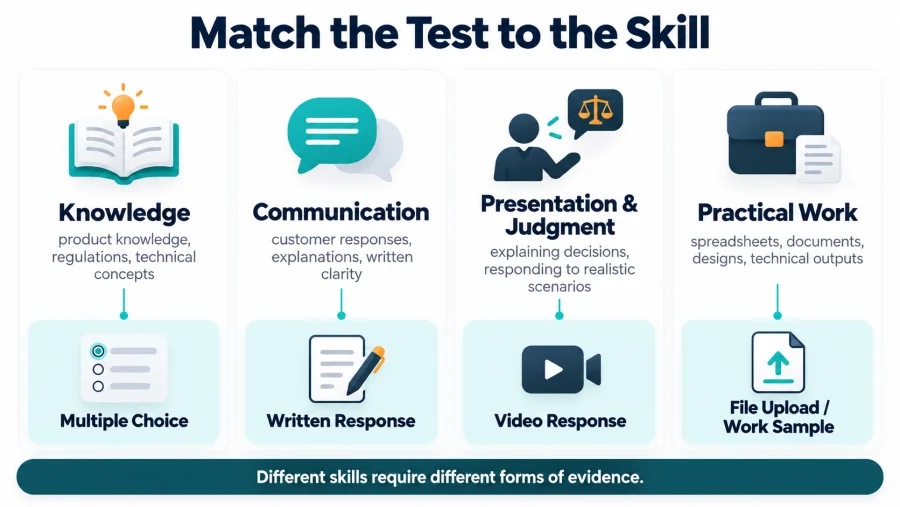
The advantage is not simply customization for its own sake. Different skills produce better evidence through different formats.
A multiple-choice question can work well when there is a clearly correct answer. A written response can reveal how someone communicates or reasons through a problem. A video response can be useful when explaining an idea or handling a realistic scenario matters. A file upload can allow candidates to submit an actual work sample instead of describing what they would do.
The assessment becomes stronger when the question format follows the capability being measured rather than forcing every skill into the same type of test.
| Role | Skill to evaluate | Useful assessment task |
|---|---|---|
| Customer Support | Written communication and judgment | Respond to a realistic customer complaint |
| Accountant | Spreadsheet accuracy | Complete an Excel task and identify errors |
| Operations Manager | Prioritization | Rank several operational problems and explain the approach |
| Administrative Assistant | Scheduling and organization | Resolve a calendar conflict |
| Marketing Specialist | Strategic thinking | Develop a short campaign concept |
| Developer | Technical problem-solving | Debug a sample of code |
| Field Service Technician | Technical knowledge | Diagnose a realistic service scenario |
| Sales Representative | Objection handling | Respond to a realistic prospect concern |
The common thread across these examples is not difficulty. Each task is designed to generate evidence that is directly related to work the employee may perform.
Better Skill Tests Start With the Job, Not the Questions
One of the easiest ways to weaken a custom assessment is to begin by asking what questions should be included before defining what the employer actually needs to learn.
A better starting point is the job itself. Hiring teams should identify the capabilities a successful employee needs on day one, distinguish those from skills that can reasonably be taught after hiring, and determine which of those capabilities are difficult to evaluate through the application or interview alone.
If a customer service role requires strong written communication, for example, a short email response may reveal more than ten multiple-choice questions about customer service theory. If a technician must diagnose problems from incomplete information, a realistic troubleshooting scenario may be more relevant than asking candidates to memorize definitions.
This approach also prevents assessments from becoming unnecessarily long. Every question should produce information that can influence a hiring decision. If removing a question would not change how the candidate is evaluated, that question may not belong in the test.
The same principle applies to difficulty. An assessment should resemble the level of work expected from someone entering the position, not the most complicated task an experienced employee could possibly encounter.
A test that is unnecessarily difficult may create a different problem from the one it was intended to solve: instead of identifying job readiness, it begins measuring whether candidates can overcome an artificial testing challenge.
Custom Skill Tests and Standard Assessments Answer Different Questions
Custom Skill Tests do not need to replace every other type of assessment.
Discovered’s broader Screening and Assessments tools include different evaluation approaches because each one provides a different kind of information. Standardized ability or behavioral assessments may help employers evaluate broader patterns consistently, while a custom skill test can focus on a specific task, tool, or scenario required by one job.
The distinction becomes clearer when the assessment type is matched to the question the hiring team is trying to answer.
| Hiring question | Better source of evidence |
|---|---|
| Can this candidate perform a specific Excel task? | Custom Skill Test |
| How does this person approach a realistic customer issue? | Custom scenario or work sample |
| What broad cognitive ability does the candidate demonstrate? | Standardized ability assessment |
| What workplace tendencies or behavioral patterns appear? | Behavioral assessment |
| How does the candidate explain prior experience? | Structured interview |
| How consistently did interviewers evaluate the candidate? | Candidate scorecard |
Using several sources of relevant information can produce a more complete picture than expecting one test to answer every hiring question.
Use Skill Tests Before Interviews When They Can Save Interview Time
Custom Skill Tests become particularly valuable when many candidates appear qualified on paper but only some have the capability required for the work.
Without an earlier skills check, recruiters may schedule interviews with candidates whose resumes look strong only to discover during the conversation that they lack a critical technical skill. The interview becomes the first time the organization verifies something that could have been evaluated earlier.A short, relevant assessment can change that sequence.
For example, if every candidate for an accounting role needs to work with a specific type of spreadsheet analysis, employers can evaluate that capability before scheduling lengthy interviews. Candidates who demonstrate the required skill can move forward with more confidence, while recruiters spend less time interviewing applicants whose experience does not translate into the required task.
This does not mean assessments should automatically become the first step for every applicant. When the exercise requires significant time or effort, employers should consider where in the process it provides enough value to justify that investment from candidates.A good assessment strategy balances the employer’s need for evidence with the candidate’s time.
The Candidate Experience Still Matters
A custom test may be useful to the employer while still creating unnecessary friction for the candidate if it is too long, poorly explained, or disconnected from the job. Candidates should understand why they are completing the exercise and what kind of task they are being asked to perform. Clear instructions, realistic expectations, and an appropriate time commitment make the assessment feel connected to the hiring process rather than like an arbitrary obstacle.
This is especially important because assessments are part of the broader candidate experience. A candidate who completes a thoughtful, job-relevant exercise may feel that the employer is taking the evaluation seriously. Someone asked to complete a long series of unrelated questions may reach the opposite conclusion.
The same thinking behind our job application form best practices applies here: every additional requirement should earn its place in the process. The objective is to collect useful hiring evidence without creating unnecessary candidate effort.
Scoring Should Be Defined Before Results Arrive
A custom test becomes less consistent when hiring managers decide what a good answer looks like only after reviewing submissions.
Before candidates begin the assessment, teams should identify the criteria that matter, determine which answers can be scored automatically, and establish how subjective responses will be reviewed.
Objective questions may have a clear correct answer. Written exercises, videos, and work samples usually need a defined rubric so that reviewers evaluate the same qualities across candidates.
For example, a customer-response exercise might be scored on accuracy, tone, clarity, problem resolution, and whether the response follows company policy. Defining those criteria in advance makes it easier to compare candidates consistently instead of allowing the strongest writing style or most confident presentation to dominate the evaluation.
This is also where assessments can complement structured evaluation later in the process. Discovered’s broader candidate assessment environment allows teams to manage different evaluation types from a central area, while Candidate Assessments in Discovered provide additional context on using assessments for different hiring questions.
A Skill Test Should Be One Piece of the Hiring Decision
A candidate who performs well on a job-specific exercise has provided useful evidence, but that evidence should not automatically become the entire hiring decision. A practical exercise may show that someone can perform a particular task. It does not necessarily reveal how that person collaborates, communicates with a manager, responds to feedback, or performs other responsibilities that were not included in the test.
For that reason, Custom Skill Tests work best as one part of a broader evaluation process that may include application information, structured interviews, other relevant assessments, references, and hiring-manager review.
The EEOC also recommends that employers understand both the effectiveness and limitations of selection procedures rather than adopting tests casually or treating one score as universally predictive of success. The goal is to add relevant evidence to the hiring process, not replace human judgment with a single result.
Keep Custom Skill Tests Aligned With the Work
Jobs change over time, which means custom assessments should change with them. Software gets replaced, responsibilities move between teams, manual processes become automated, customer expectations evolve, and tasks that were critical two years ago may no longer be performed.
An assessment that once mirrored the job can gradually become disconnected from it if nobody reviews the content. The EEOC’s guidance on employment testing specifically recommends keeping selection procedures current as job requirements change so that they continue to measure capabilities relevant to successful performance.
A practical review can look at whether the task is still performed, whether the difficulty reflects the current role, whether candidates regularly misunderstand the instructions, and whether the assessment is measuring something employees actually need before they are hired.
Discovered’s Custom Skill Tests make that type of iteration easier because employers can build assessments around their own requirements rather than waiting for a generic test to match every change in the role.
Better Hiring Evidence Starts With Better Questions
Resumes tell hiring teams where candidates have worked and what they say they have done. Interviews add context by allowing candidates to explain that experience in more detail. Custom Skill Tests add another layer by giving people an opportunity to demonstrate capabilities that matter for the job. The strongest assessment strategy does not begin with the desire to test candidates more often. It begins with a specific hiring question that the existing process is not answering well.
If the organization needs to know whether someone can analyze a spreadsheet, resolve a realistic customer scenario, write clearly, troubleshoot equipment, or produce a particular type of work, a job-specific assessment can provide evidence before recruiters invest further time in the process. That is the practical value of Custom Skill Tests in Discovered: employers can build the evaluation around the actual job rather than adapting the job to a one-size-fits-all test.
When the exercise is relevant, proportionate, consistently scored, and combined with other hiring evidence, the result is not simply more candidate data. It is a clearer basis for deciding who deserves to move forward.
Frequently Asked Questions
What are Custom Skill Tests?
Custom Skill Tests are job-specific candidate assessments designed around the skills, knowledge, tools, or work scenarios an employer wants to evaluate. Unlike a generic assessment, the employer can tailor the content and question formats to the requirements of a particular role.
When should employers use a Custom Skill Test?
They are most useful when a hiring team needs evidence about a capability that is difficult to verify through resumes or interviews alone. This can include software proficiency, writing, technical knowledge, troubleshooting, job-specific judgment, or work samples.
What types of questions can a Custom Skill Test include?
Discovered’s Custom Skill Tests support formats such as multiple-choice questions, written responses, video responses, and file uploads, allowing the assessment format to match the skill being evaluated.
Should Custom Skill Tests replace interviews?
No. Skill tests provide evidence about particular capabilities, while interviews and other hiring methods provide different information. The strongest process combines relevant sources rather than allowing one assessment to determine the entire decision.
How long should a skills test be?
There is no universal duration because the appropriate length depends on the role and the complexity of the task. Employers should collect enough evidence to support the hiring decision while avoiding unnecessary candidate effort.
Should employers update Custom Skill Tests?
Yes. If job responsibilities, tools, processes, or expectations change, the assessment should be reviewed to ensure it still reflects the work. The EEOC likewise recommends keeping employment selection procedures aligned with changing job requirements.
Content