Posting a job on Indeed should not require recruiters to maintain one version inside their applicant tracking system, another version on the job board, and a separate spreadsheet or dashboard to determine what is actually live.
That fragmented setup creates several opportunities for information to fall behind. A recruiter updates the compensation in the ATS but forgets to change the external listing. A role closes, yet the job remains visible elsewhere. A hiring manager asks why applicant volume is low, but the recruiting team cannot quickly determine whether the posting is active, pending review, flagged, or simply receiving limited traffic.

A deeper Indeed ATS integration reduces that separation by allowing jobs, posting status, campaign controls, and candidate data to move more directly between Indeed and the system where the hiring team already manages its pipeline.
Indeed includes Discovered in its official ATS integration directory, while Indeed’s broader ATS Sync guidance explains that connected systems are intended to automate job and candidate data transfer, reduce duplicate data entry, and help employers keep their ATS current as the system of record.
For employers, the important result is not a partnership label. It is a more connected hiring workflow with less manual reconciliation between job advertising and applicant management.
What the Integration Changes in Practice
The Discovered and Indeed connection is not one isolated feature. It includes several layers that affect different parts of the recruiting process. Some capabilities are available automatically when a job is posted to Indeed from Discovered. Others require the employer to connect its Indeed account. Candidate Sync represents an additional future layer that is still pending Indeed approval and is not currently available to customers in production.
| Integration capability | Availability | How it works | Employer benefit |
|---|---|---|---|
| Job Sync API | Live | Jobs and updates move directly from Discovered to Indeed. | Keep job information current without recreating postings manually. |
| Indeed Apply | Live | Resumes, screening answers, and knockout results flow into Discovered. | Review Indeed applicants inside the same ATS pipeline. |
| Disposition Sync | Live | Candidate status updates move from Discovered back to Indeed. | Help Indeed improve matching and application quality using real hiring outcomes. |
| Live Job Status | Live after account connection | Recruiters can see whether an Indeed job is active, pending, or flagged. | Identify posting issues without relying only on manual searches. |
| Indeed Sponsored Jobs | Live after account connection | Employers manage campaign setup, budgets, dates, and status from the job post. | Keep advertising controls closer to the hiring pipeline. |
Indeed’s official Disposition Sync documentation confirms that ATS status changes can include contacted, interviewing, offered, hired, and not selected. Indeed says this data helps improve matching, job-ad targeting, and the application experience.
Job Sync API Keeps Job Information Closer to the ATS
Discovered now sends jobs to Indeed through the Job Sync API, replacing the older XML feed model previously used by many job-board platforms.
Indeed’s documentation describes Job Sync API as the system approved ATS integrations use to create, update, expire, and check the status of postings. It can carry job details such as qualifications, working hours, salary, benefits, and employer information, while Indeed continues to review submitted jobs for compliance with its marketplace policies.
For the recruiting team, this means the job can be managed from the ATS instead of being manually recreated on Indeed. When important details change in Discovered, the updated information can be delivered directly rather than waiting for a periodic feed cycle.
The benefit becomes more visible when hiring volume grows. Updating one job manually may be manageable, but the same process becomes difficult across dozens of positions, multiple locations, recurring openings, or franchise operations. Direct syncing reduces the risk that recruiters and candidates encounter different versions of the same role.
The integration also allows Discovered to remain the operational center of the hiring process. Indeed creates candidate reach, while the ATS continues managing screening, communication, assessments, interviews, status progression, offers, and final hiring outcomes.
That division is valuable because the job board and the ATS serve related but different purposes. The job board helps candidates discover the opportunity, while the ATS gives the employer one place to manage everything that happens after interest becomes an application.
Disposition Sync Sends Hiring Progress Back to Indeed
The integration does not stop after the application reaches Discovered. As candidates move through the hiring workflow, Disposition Sync sends relevant status updates back to Indeed.
Those updates can reflect milestones such as:
- Candidate received
- Contacted
- Reviewed or screened
- Interviewed
- Offered
- Hired
- Rejected or not selected
This creates a two-way data flow. Job Sync sends current job information from Discovered to Indeed, while Disposition Sync reports what happens after candidates enter the ATS.
Indeed uses aggregated disposition information to improve job matching and the application experience over time. When employers keep candidate statuses current in Discovered, Indeed receives stronger signals about which candidates progressed and which jobs are producing meaningful hiring activity.
Disposition Sync does not replace recruiter judgment or candidate management. It allows the outcomes already recorded in Discovered to contribute to a better-connected Indeed workflow.
Indeed identifies Disposition Sync as one of the core ATS Sync capabilities and states that sharing hiring statuses helps produce better candidate matches in the future.
Connected Accounts Give Recruiters Better Job-Status Visibility

A job can be successfully transmitted to Indeed without appearing exactly where a recruiter expects to find it in a manual search. Indeed personalizes search results and applies its own matching, quality, duplication, content, and marketplace rules when determining visibility.
For that reason, searching for your own job is not the most reliable way to determine whether the posting is active or receiving traffic.
When an employer connects its Indeed account to Discovered, the recruiting team gains access to live posting statuses inside the job workflow. A role may appear as active, pending, or flagged, allowing recruiters to identify problems without waiting several days and guessing why applicant volume is low.
The connected workflow also provides a direct route to the corresponding Indeed job and its performance information. Recruiters can review metrics such as impressions, clicks, and applications before deciding whether a posting needs content changes, troubleshooting, or additional advertising spend.
This visibility does not guarantee that every role will receive organic traffic. It gives the employer better information about what Indeed is doing with the job, which is much more useful than treating a manual search result as the only source of truth.
Job delivery and job visibility are not the same thing
Successful delivery confirms that the integration sent the job to Indeed. Organic visibility describes how Indeed chooses to surface that posting to job seekers.
A job can therefore be delivered correctly while still receiving limited exposure because of competition, duplicate or highly similar content, quality concerns, job-market conditions, or Indeed’s matching rules.
Discovered’s Indeed Organic Visibility and Reposting Guide explains why employers should review job quality, duplication, posting cadence, and campaign performance rather than repeatedly copying and reposting the same opening.
A better integration improves delivery, status visibility, and troubleshooting. It does not override the rules Indeed applies to its marketplace.
Sponsored Jobs Can Be Managed From the Job Post
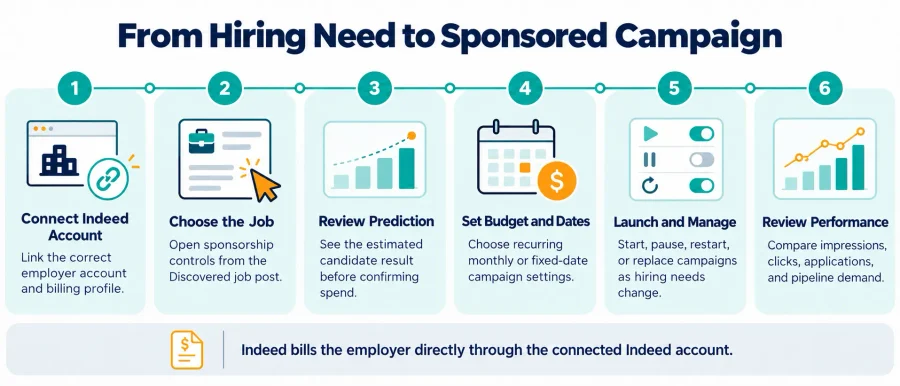
Some jobs need more visibility than organic distribution can reliably provide. An urgent opening may need applicants immediately. A specialized role may have a small candidate pool. A multi-location employer may need more traffic in one particular market, while a high-volume hiring campaign may require a larger flow of candidates than organic reach is producing.
After connecting their Indeed employer account, authorized Discovered users can create and manage Sponsored Jobs directly from the relevant job post. They can define the campaign budget, choose a one-time or recurring structure, set dates, review estimated candidate results before launching, and manage the campaign without creating a separate advertising workflow.
The performance prediction is especially useful because the employer sees an estimate before committing spend. It gives the recruiting team another input when deciding whether the proposed budget matches the urgency and expected applicant need.
Campaigns can use a fixed date range or a recurring budget structure. They can also be paused, restarted, or replaced from the job workflow when hiring needs change. Indeed remains responsible for campaign billing, with the employer’s Indeed account acting as the billing source of truth. Indeed’s Sponsored Jobs API requirements specifically state that employers need an Indeed account with current billing information before a campaign can begin spending.
This arrangement keeps advertising decisions closer to pipeline performance. Recruiters can review how many people are viewing, clicking, and applying to the opening before deciding whether to increase spend, pause the campaign, or change the job itself.
Sponsored Jobs are most useful when tied to a specific hiring problem
A sponsored campaign should not be the automatic response to every low-volume job.
If the job title is unclear, the requirements are unrealistic, compensation is missing, the location is incorrect, or the connected employer account is wrong, additional spend may increase traffic without solving the underlying issue.
Sponsorship is most useful after the recruiting team understands why additional reach is needed. Hard-to-fill jobs, urgent roles, competitive markets, seasonal hiring, and location-specific campaigns are stronger use cases because the campaign is solving a defined visibility or speed problem.
Indeed Apply Supports a Simpler Candidate Journey

ATS integration affects employers, but it also shapes the candidate experience.
Indeed Apply allows job seekers to apply using their Indeed profile and resume while sending application information to the connected recruiting platform. Indeed’s official documentation notes that ATS partners can configure job-specific application metadata and screener questions, then receive the resulting candidate data in the ATS.
Indeed reports that employers using Indeed Apply have received significantly more completed applications than comparable application experiences without it. Those results should not be treated as a guarantee for every job, but they reinforce a broader point: unnecessary redirects, duplicate information, and disconnected application paths can increase candidate drop-off.
The practical benefit of a connected workflow is that candidates can discover and apply on Indeed while the recruiting team continues managing the resulting applicant inside its normal ATS process.
When application information, resumes, and screening responses arrive in the same system recruiters already use, the team can begin reviewing and communicating without manually transferring data between platforms.
Candidate Sync is intended to broaden that coverage further by helping capture applicants who are not already flowing through Indeed Apply. Once approved, it should reduce the possibility that an Indeed applicant exists outside the pipeline the recruiting team is actively monitoring.
The Integration Reduces Reconciliation, but It Still Needs Governance
A connected system does not eliminate the need for good recruiting practices.
Employers still need accurate job titles, complete descriptions, realistic requirements, correct locations, current compensation details, appropriate budgets, and a properly linked Indeed account. A technically strong integration cannot compensate for poor job content or unclear internal ownership.
Administrators should confirm that the connected Indeed account belongs to the correct employer entity, especially when companies manage several brands, locations, or subaccounts. Users responsible for sponsorship should also understand who can authorize spend, pause a campaign, change the budget, or restart an ended campaign.
Recruiting teams should monitor job status and campaign performance rather than assuming the integration makes every decision automatically. The purpose of the connection is to make information and controls more accessible, not to eliminate employer judgment.
| Recruiting question | Where to review it |
|---|---|
| Was the job delivered to Indeed? | Indeed status inside the Discovered job post |
| Is the job active, pending, or flagged? | Connected Indeed status |
| Is the job receiving traffic? | Impressions, clicks, and applications |
| Does the role need additional reach? | Pipeline demand and campaign prediction |
| Is the sponsored campaign spending? | Indeed campaign data and billing account |
| Did applicants reach the ATS? | Discovered candidate pipeline |
The integration becomes most valuable when the team uses those signals together. Job status explains delivery, analytics explain traffic, sponsorship controls explain advertising, and candidate data explains what happened after people applied.
One Connected Workflow From Job Posting to Candidate Progress

The strongest benefit of the Discovered and Indeed integration is not adding another recruiting tool. It is reducing the separation between job distribution, candidate discovery, applicant management, advertising, and hiring outcomes.
Job Sync API keeps jobs and updates moving from Discovered to Indeed. Indeed Apply brings applications and screening information into the ATS. Disposition Sync reports candidate progress back to Indeed, while a connected employer account adds live job status, performance visibility, and Sponsored Jobs management.
Candidate Sync is expected to extend that workflow to Interested Candidates from Indeed Smart Sourcing once the integration receives approval.
Together, these capabilities reduce duplicate work, give recruiters more useful information, and keep more of the Indeed hiring journey connected to the system where the team already manages candidates.
Frequently Asked Questions
What Indeed capabilities are currently available in Discovered?
Job Sync API is currently live and automatically supports direct delivery of jobs and updates from Discovered to Indeed. Employers who connect their Indeed account can also access live posting statuses, direct account posting, performance information, and Sponsored Jobs management.
Do employers need to connect an Indeed account for jobs to be sent to Indeed?
No. Discovered customers who post jobs to Indeed already benefit from Job Sync API without additional setup. Connecting the employer account is required for capabilities such as live job status, direct account posting, analytics access, and sponsorship management.
Who can create and manage Sponsored Jobs?
Once the correct Indeed employer account is connected, authorized Admin and Editor users can manage sponsorship from the relevant job post. The workflow is self-service and does not require Support to create each campaign.
What can employers control in an Indeed Sponsored Job campaign?
Employers can choose the job, set the budget, use a one-time or recurring campaign structure, define dates, review estimated candidate performance before spending, and launch or manage the campaign from the job workflow. Ended or exhausted campaigns may need to be replaced with a new budget and date range rather than reusing the old campaign.
Who bills the employer for Sponsored Jobs?
Indeed bills the customer directly through the connected Indeed employer account. The account must have valid billing information before the sponsored campaign can begin spending, and the Indeed employer dashboard remains the billing source of truth.
What is the performance prediction shown before sponsorship begins?
Before the employer confirms a Sponsored Job campaign, Indeed can display an estimated number of candidates the selected budget may generate. This prediction helps the recruiting team review the expected result before activating spend, although actual performance can vary.
Can an Indeed Sponsored Job be paused or restarted?
Yes. Active campaigns can be managed as hiring needs change. If a campaign has fully ended or exhausted its budget, the recommended workflow may be to delete the completed campaign and create a new one with a fresh budget and date range.
What is Disposition Sync?
Disposition Sync sends candidate status updates from Discovered back to Indeed. These updates may include milestones such as contacted, screened, interviewed, offered, hired, or not selected.
Why does Disposition Sync matter?
Indeed uses aggregated hiring-stage data to improve matching, job-ad targeting, and the application experience. Keeping candidate statuses current in Discovered gives Indeed stronger information about which candidates and jobs are producing meaningful progress.
Do recruiters need to send these updates manually?
No. Disposition Sync reports the relevant status changes recorded through the Discovered hiring workflow.
Where can employers verify Discovered’s official Indeed integration?
Indeed lists Discovered in its official ATS integration directory. Employers can review the listing on the Discovered integration page in Indeed’s directory.
Content