



A candidate sees one of your jobs while comparing several opportunities. The title is relevant, the location works, and the compensation looks competitive enough to earn a click. For the employer, that interaction may feel like progress, but for the candidate, the decision has only started.
Before submitting an application, that person may search your company name, visit your website, look for employee reviews, browse LinkedIn, explore your careers page, or watch recruiting content. By the time they reach the application form, they may have interacted with several pieces of information that influence whether the opportunity feels credible and worth pursuing.
A recruitment marketing funnel helps hiring teams understand everything that happens between first discovering a job and becoming an applicant. Instead of treating job boards, employer branding, career pages, recruiting content, and application forms as unrelated activities, it connects them as parts of one candidate experience.
The objective is not simply to generate the largest possible number of applications. A stronger funnel gives relevant candidates enough information to move forward confidently while helping people who are unlikely to be a fit recognize that earlier in the process.
What Does a Recruitment Marketing Funnel Look Like?
Traditional hiring funnels often begin after the application enters the ATS. Recruiting teams then track screening, assessments, interviews, offers, and hires. A recruitment marketing funnel starts earlier, while someone is still deciding whether they want to become a candidate at all.
The journey can be organized into five broad stages: awareness, interest, research, consideration, and application. Real candidates do not always move through those stages sequentially. Someone might see an employee post on social media, visit the company website, leave without applying, and encounter the same employer again through a job board a week later.
What matters is the progression of information. Candidates first need to notice the opportunity, then determine whether it deserves attention, gather evidence about the employer, resolve practical questions, and finally decide whether applying is worth the effort.
This is why the candidate experience before the ATS deserves as much attention as the workflow after it. A strong recruiting workflow can make the process more consistent after candidates enter the pipeline, but it cannot recover qualified people who leave because the employer did not build enough confidence beforehand.
| Funnel stage | What the candidate needs | Common touchpoints | Common friction |
|---|---|---|---|
| Awareness | A reason to notice the opportunity | Job boards, search, social media, referrals | Low visibility or vague positioning |
| Interest | A reason to care | Job description, employee content, recruiting campaigns | Generic employer messaging |
| Research | Evidence about the employer | Career page, LinkedIn, reviews, videos | Outdated or inconsistent information |
| Consideration | Enough confidence to apply | Job details, benefits, FAQs, career content | Missing pay, schedule, location, or process information |
| Application | An easy next step | Application form, ATS, mobile experience | Long forms, duplication, unnecessary steps |
The framework is useful because it allows recruiting teams to diagnose a specific stage rather than assuming every hiring problem can be solved by attracting more applicants.
Awareness and Interest Depend on Relevance
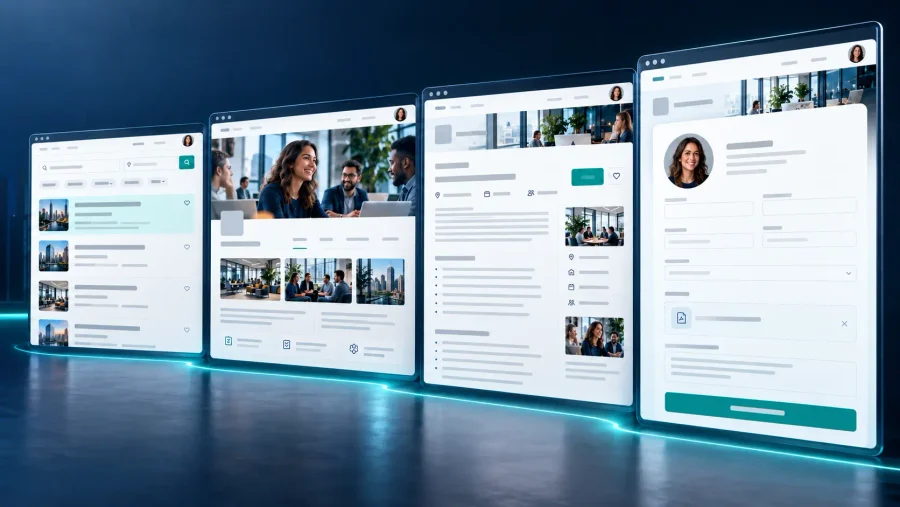
Visibility matters at the top of the funnel because candidates cannot consider opportunities they never encounter. Job boards, social media, referrals, paid advertising, organic search, recruiting videos, and direct outreach can all create the initial point of contact.
More reach, however, does not necessarily create better recruiting outcomes. A job can generate thousands of impressions and still fail if the title, location, compensation, or core message does not quickly establish relevance.
This becomes particularly important in high-volume hiring, where teams need enough applicant flow without overwhelming recruiters with large numbers of people who never matched the basic requirements. Clearer job positioning gives candidates more information before they enter the hiring process and can improve the quality of the pool reaching the ATS.
Once someone clicks, the company itself becomes part of the evaluation. Candidates begin looking for signals about culture, leadership, career development, stability, workplace expectations, and the employee experience.
That is where employer branding becomes part of hiring performance rather than a separate marketing exercise. LinkedIn Talent Solutions’ Career Pages guidance describes career content as a way to showcase company culture, values, and employee investment while developing a pipeline of qualified talent. LinkedIn also reports stronger application and InMail response behavior among people who have interacted with Career Pages.
The lesson is not that every company needs an elaborate employer-brand campaign. Candidates need credible evidence. If professional development is important, showing actual employee progression is stronger than simply saying the organization values growth. If flexibility is a benefit, explaining what that flexibility means provides more value than a generic claim about work-life balance.
Employer Research Turns Claims Into Evidence
Candidates rarely form an opinion about an employer from one page. They combine what the job says with information from career sites, reviews, social channels, employee profiles, videos, and conversations with recruiters.
That creates a risk when those touchpoints tell different stories. A polished job advertisement might emphasize a strong employee experience, while the company careers page contains outdated openings and almost no information about the workplace. Even when the role itself is legitimate, inconsistent information can create uncertainty.
A Branded Career Page can help centralize that employer story by combining current opportunities with company branding and candidate-facing content. The value is not simply having another place to list jobs; it is giving candidates a destination where the opportunity and the organization behind it make sense together.
Videos can serve a similar role. Our guide to recruitment marketing videos explains how employee stories, workplace footage, job previews, and leadership content can communicate information that is difficult to express through a traditional job description.
External channels matter as well because candidates use them to validate what the employer says about itself. LinkedIn’s employer-branding resources emphasize culture and employee experience, while Indeed’s employer pages give job seekers another place to evaluate company information alongside current opportunities. A strong recruitment marketing funnel acknowledges that candidates will research beyond the original job posting instead of assuming the employer controls every interaction.
Consistency does not require identical messaging across every channel. A social post can be conversational, a job description can be practical, and a career page can provide a broader employer story. What matters is that candidates do not encounter contradictions that force them to decide which version of the company is accurate.
Consideration Is About Removing Uncertainty
Interest can disappear even after candidates decide they like the organization. Sometimes the problem is simply that they cannot find enough practical information to make the next decision.
Compensation may be unclear. The schedule may not be described. The location may be ambiguous, or the candidate may not know whether the position is still available. Other candidates may be unsure how long the process will take, whether an assessment is required, or what the company expects before the first interview.
This is where the job page and the broader career experience should complement one another. The job posting should clearly describe the opportunity, while the career page should provide the context candidates need to understand the employer.
Better information also improves what happens after Apply. Candidates entering the pipeline with realistic expectations require less clarification from recruiters and are less likely to discover basic misalignment only after several hiring steps have already taken place.
For recruiting teams, that means candidate education before the application is not simply an employer-branding exercise. It can reduce wasted time later in the process.
Application Friction Can Undo Everything Above It
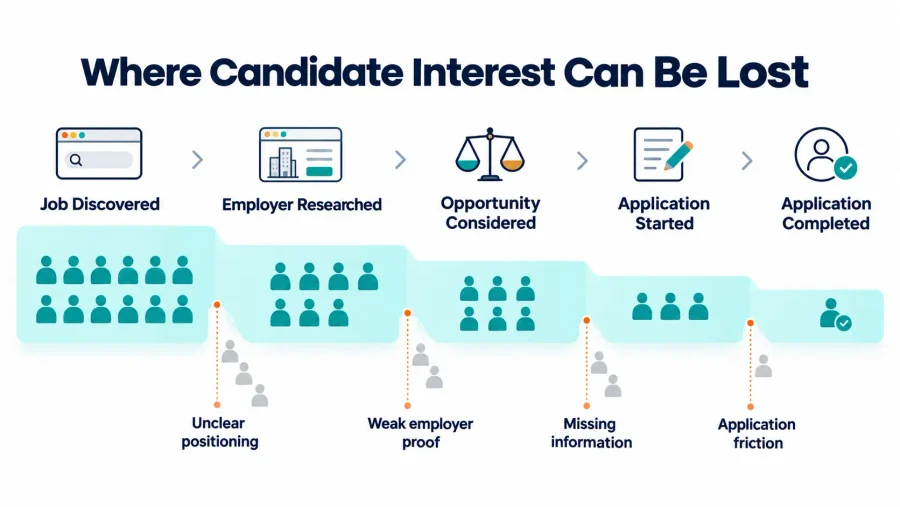
Once candidates decide to apply, the experience should become easier. Unfortunately, this is often where a strong recruitment marketing funnel breaks. Someone may spend time researching the company and become genuinely interested, only to encounter a lengthy mobile application, duplicate resume questions, unnecessary account creation, or several redirects between systems. Recruitment marketing successfully created intent, but the final experience failed to convert it.
Our guide to job application form best practices looks specifically at this problem. Discovered’s Application Forms guidance similarly recommends collecting only information relevant to the hiring decision, using multi-step forms where appropriate, and reviewing forms periodically to remove unnecessary questions.
A shorter application is not automatically a better application. Employers still need enough information to determine what should happen next. The goal is to balance candidate effort with the amount of information genuinely required at that stage.
| If candidates are leaving here… | Investigate this |
|---|---|
| Before opening the job | Visibility and distribution |
| After seeing the job | Title, compensation, location, positioning |
| During employer research | Career content, credibility, brand consistency |
| Before clicking Apply | Missing job details or unresolved questions |
| After starting the form | Application length, mobile UX, duplicate information |
This distinction helps teams improve the correct part of the funnel instead of simply purchasing more traffic for a process that is already losing qualified candidates.
Automation Helps Keep the Candidate Experience Current

Recruitment marketing becomes difficult to maintain when every channel requires separate manual updates. If an ATS and careers website operate independently, every new job, title change, location update, or closed position creates another piece of information someone must remember to update.
That process may be manageable with a few positions, but the risk increases quickly across multiple locations, recurring jobs, or high-volume recruiting environments. The result can be outdated positions, conflicting job information, and candidate-facing pages that no longer match what recruiters are actually hiring for.
Automation is valuable because it can reduce that operational drift. Discovered’s Branded Career Pages can display openings managed in the ATS through a hosted career page or embedded job feed, allowing candidate-facing job information to stay closer to the recruiting system where the roles are already being managed.
The broader principle also applies to job distribution, status changes, candidate communication, and other repeatable recruiting activities. As our Recruitment Automation Best Practices guide explains, predictable administrative work is usually a stronger candidate for automation than decisions requiring context or judgment.
Employer-brand content sits on the human side of that balance. Employee stories, workplace photography, leadership perspectives, and recruiting videos should still reflect real people and experiences. Automation should make it easier to keep the infrastructure current without making the employer story feel manufactured.
Measure Where Candidate Momentum Changes
Application volume tells teams what reached the bottom of the funnel, but it does not explain what happened before that point. Two jobs can produce the same number of completed applications while having completely different performance problems.
One may receive little traffic but convert a strong percentage of visitors. Another may attract significant attention and lose most candidates before they complete the form. Increasing sourcing spend would make sense for the first problem and could make the second one worse.
Recruitment marketing metrics are most useful when they help locate the point where candidate momentum changes.
| What you see | Likely area to review |
|---|---|
| Low impressions | Distribution, sponsorship, sourcing channels |
| High impressions but few clicks | Job title, location, compensation, positioning |
| Clicks but little employer engagement | Employer-brand content and credibility |
| Career-page traffic but few Apply clicks | Role information and candidate questions |
| Many starts but few completions | Application experience |
| Many applicants but few qualified candidates | Targeting, requirements, source quality |
This approach also improves how recruiting teams evaluate sources. A channel producing inexpensive applications is not necessarily efficient if very few candidates progress beyond initial screening. A source with lower volume may be more valuable if candidates consistently reach interviews, offers, and hires.
The recruitment marketing funnel therefore connects marketing activity with downstream hiring outcomes instead of evaluating the two separately.
Keep the Funnel Current
Companies change, and candidate-facing information changes with them. Benefits evolve, locations open or close, teams grow, job requirements shift, and employees featured in older content may leave the organization.
Maintaining the recruitment marketing funnel does not mean rebuilding the entire employer brand every month. It means identifying which information must remain current and deciding whether that maintenance should happen manually or automatically.
Job listings and statuses are natural candidates for automation because they change frequently and already exist inside recruiting systems. Employer-brand content should instead be reviewed periodically to ensure employee stories, photography, videos, benefits, and workplace information still reflect the organization candidates would actually join.
Recruiting teams should also periodically experience the funnel as candidates do. Opening a job from a phone, visiting the career page without internal knowledge, clicking Apply, and completing the application can reveal friction that internal users stop noticing because they already understand how everything works.
A Stronger Funnel Produces Better-Informed Applicants
Recruiting teams spend significant time improving what happens after applications arrive. Screening, assessments, scheduling, interviews, references, and offers all matter, but each depends on an earlier decision: the candidate first has to decide that entering the hiring process is worthwhile.
A strong recruitment marketing funnel supports that decision by connecting job discovery, employer research, practical role information, application design, and recruiting operations into a coherent experience. Technology can keep frequently changing information aligned, while employer-brand content gives candidates the human evidence they need to understand the organization.
The goal is not simply to increase application volume. A healthier outcome is that the people reaching the ATS understand the job more clearly, have a more realistic view of the employer, and have already made an informed decision about why they want to continue.
That gives recruiters a stronger starting point for everything that comes next.
Frequently Asked Questions
What is a recruitment marketing funnel?
A recruitment marketing funnel describes the journey people take before becoming applicants, typically moving through job discovery, interest, employer research, consideration, and application. Candidates may encounter those stages in different orders depending on how they discover the company.
How is recruitment marketing different from employer branding?
Employer branding describes how an organization is perceived as a workplace, while recruitment marketing involves communicating that story and specific opportunities through job boards, career pages, social media, videos, referrals, advertising, and other candidate-facing channels.
Where does a career page fit into the funnel?
A career page primarily supports employer research and consideration by giving candidates more information about the organization behind the job. LinkedIn Talent Solutions similarly positions career content as a way to showcase culture and build talent pipelines before candidates engage directly with recruiters.
How can automation improve recruitment marketing?
Automation can keep job listings synchronized, distribute openings, route candidates, and handle predictable communication. The strongest approach is to automate repetitive infrastructure while keeping employer-brand content and hiring decisions appropriately human.
What should companies measure?
Useful metrics include job impressions, clicks, career-page engagement, Apply-button clicks, application starts, completions, qualified applicant rates, interview progression, and source quality. Looking at several points in the journey makes it easier to identify where relevant candidates are being lost.
Content