



A recruiter rejects a candidate from an open position after determining that another applicant is a stronger fit. A few months later, that same person applies to a different opening, where a new recruiter reviews the resume, begins evaluating the application, and only later discovers that the candidate has already interacted with the organization.
That second application is not necessarily a problem. Candidates gain experience, availability changes, qualifications evolve, and someone who was not right for one position may be highly relevant for another. The real problem appears when the context behind the first hiring decision does not travel with the candidate.
As hiring volume increases, this becomes harder to manage. Candidate records begin to span multiple jobs, recruiters, locations, and hiring cycles. Without a consistent candidate disposition process, teams can repeatedly review the same applicant, forget why an earlier decision was made, leave outdated candidates sitting in active pipelines, or treat every previous rejection as if it carried the same meaning.
Candidate disposition gives hiring outcomes structure. Instead of recording only that someone left the process, it creates enough context to understand how they left, why the decision was made when appropriate, and whether that information should influence a future application.
A well-managed disposition process therefore does more than keep an ATS tidy. It preserves institutional knowledge so that future hiring decisions begin with the context the organization has already earned.
What Candidate Disposition Means in Practice

Candidate disposition is the process of documenting the outcome of a candidate’s participation in a hiring process. A candidate may be hired, rejected, withdrawn, unresponsive, unable to meet a required qualification, or removed from consideration for another documented reason.
Those outcomes may all end the candidate’s participation in one hiring cycle, but they do not necessarily mean the same thing for future recruiting.
Consider three candidates who all appear as Rejected in an ATS. The first reached the final interview but lost to someone with more relevant experience. The second withdrew because the schedule did not work with their availability. The third had a documented issue that the organization determined should affect future consideration.
The status may be the same, but the underlying decisions are very different. A future recruiter should probably reconsider the first two candidates when an appropriate opportunity appears. The third may require a different process depending on company policy and the circumstances behind the decision.
This is why candidate disposition should provide more context than a final status alone. It should help the next authorized person reviewing the record understand whether the previous outcome belonged to one requisition, reflected circumstances that could change, or represented a broader company-level decision.
Rejection, withdrawal, and blocking should not mean the same thing
The difference becomes clearer when the outcomes are compared directly.
| Candidate outcome | What it usually means | What should happen later |
|---|---|---|
| Rejected for one job | The candidate is not moving forward for that opening | Evaluate them normally if they apply to another relevant role |
| Candidate withdrew | The candidate chose to leave that hiring process | Review the reason and reconsider when circumstances change |
| Requirements not met | A qualification was missing at that point in time | Reassess if the candidate later meets the requirement |
| Company-level block | The company documented a broader restriction | Follow the organization’s established blocked-candidate process |
| Previously rejected but now relevant | The prior decision no longer determines current fit | Evaluate the candidate against today’s job requirements |
This distinction prevents recruiting teams from making two opposite mistakes. Without enough context, they may waste time repeatedly reconsidering someone whose company-level restriction is already documented. At the same time, an overly broad approach can permanently exclude candidates whose earlier rejection was specific to one position or moment in time.
Discovered makes this distinction explicit. Rejecting a candidate affects that individual job record, whereas blocking a person creates a company-level action that can affect future applications while the block remains active. knowledge-base.discovered.ai
Better Disposition Starts With Better Documentation
Candidate disposition becomes less useful when every recruiter documents decisions differently. One person may select Not Qualified, another may choose Other, and a third may leave the candidate in an interview stage indefinitely because they are unsure which outcome applies. Over time, the ATS becomes full of statuses without enough shared meaning behind them.
The solution is not necessarily to create more categories. In many organizations, a smaller set of clearly understood disposition reasons produces better data than dozens of overlapping labels. Recruiters should be able to select an outcome consistently and leave enough factual context for another authorized user to understand the decision later.
The quality of written notes matters just as much as the category. Candidate records can remain accessible long after the recruiter who created them has moved to another role or left the company, so subjective descriptions can create confusion.
For example, a note such as “bad attitude” provides very little useful information because it records an interpretation rather than the event behind it. A note explaining that the candidate ended an interview after learning that weekend availability was required gives the next reviewer a concrete piece of context without turning one interaction into a permanent label.
That approach is particularly important when the record may influence a future application. Candidate documentation should help another recruiter reconstruct what happened, not force them to guess what a previous employee meant.
Disposition data also becomes more useful for reporting when categories are consistent. Appcast describes candidate disposition data as downstream hiring information that shows how applicants progress through recruiting stages rather than measuring only top-of-funnel activity such as clicks or applications.
A recruiting team that consistently documents where and why candidates leave the process can eventually identify patterns that a simple Rejected count would never reveal.
Candidate History Should Follow the Candidate Across Hiring Cycles
One of the biggest weaknesses of a fragmented recruiting process is that important context often remains with the recruiter instead of the candidate record. The hiring manager remembers why someone was declined, a recruiter keeps the email conversation in their inbox, and another team member has interview notes in a separate location.
That arrangement works until the people involved change.
Months later, the same candidate may apply for another position. If the next recruiter sees only a resume and a previous Rejected label, they have no practical way to distinguish between someone who narrowly missed a previous opportunity and someone whose history requires a more careful review.
A centralized candidate history reduces that problem by keeping relevant activity, communication, evaluations, statuses, and decisions associated with the person rather than scattered across individual users and systems. This does not mean every internal discussion should become part of the permanent record. It means that information genuinely necessary for future hiring decisions should not depend on one employee’s memory.
This is especially important because repeat applicants are common and often valuable. A candidate who lacked enough experience for a senior accounting role may be a strong fit for a mid-level position six months later. Someone who did not hold a required license may obtain it. A candidate who withdrew because of schedule conflicts may later have different availability.
The previous application should therefore provide context rather than automatically determine the next outcome.
How repeat applicants can be handled
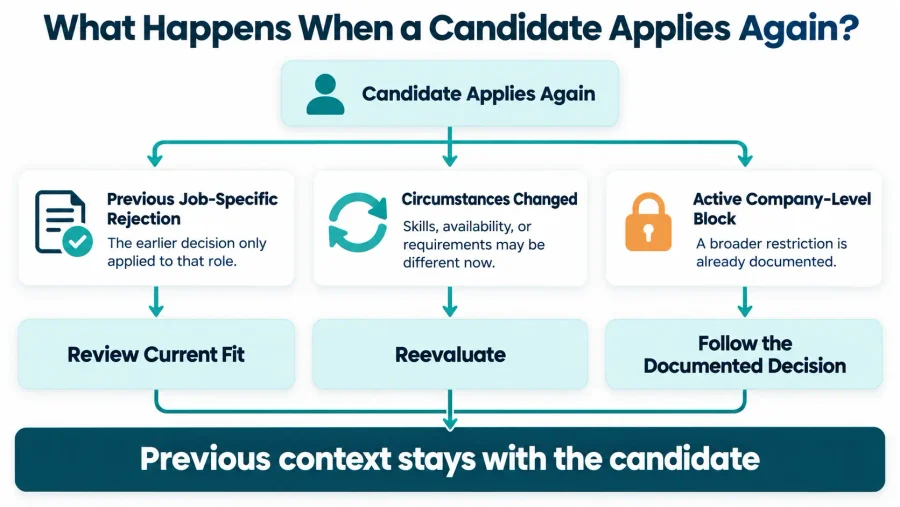
A useful workflow can separate repeat candidates into three broad paths:
| Previous context | New application | Recommended approach |
|---|---|---|
| Previous rejection was specific to one role | Candidate applies for a different job | Evaluate against the new job requirements |
| Circumstances may have changed | Candidate applies again later | Review the previous context and current fit |
| Active company-level restriction exists | Candidate applies to another opening | Follow the documented company-level process |
This is also where a visual infographic can help the article. Rather than adding another long list, I would show the candidate entering the ATS again and branching into these three paths, with the candidate’s previous history remaining attached underneath all three outcomes.
When Candidate Disposition Should Be Automated
Automation becomes valuable when the underlying decision is stable enough that repeating the same manual action adds no new judgment.
Suppose an organization has already made and documented a company-level decision that a particular candidate should not be reconsidered while that restriction remains active. If that person applies to five different jobs, requiring five recruiters to discover the same history and manually reach the same outcome creates unnecessary work and increases the chance that the decision will be applied inconsistently.
Discovered’s Candidate Blocking feature is designed for this situation. When an authorized user blocks a candidate, future applications associated with that candidate’s email address can be moved automatically to Rejected across the company’s jobs. The system also records who created the block, when it was created, and the reason behind it.
The automation works across several candidate-entry paths, including career pages, job boards, email applications, resume uploads, manual imports, and candidates copied or moved into another job. Existing records are not automatically rewritten; they keep their current status, while new matching applications follow the active block.
That distinction matters because useful automation should enforce a documented future rule without erasing the history that came before it.
The broader principle is the same one that applies throughout recruiting automation: repetitive administrative actions are good candidates for automation, while decisions that depend on changing circumstances should remain reviewable. A candidate who lacked a qualification two years ago may need a fresh evaluation today. A candidate whose active company-level restriction still applies should not require a recruiter to reconstruct the same decision from scratch.
This is why automation should follow the process rather than define it. Companies should establish what qualifies for a broader restriction, who has authority to make that decision, what documentation is required, who can reverse it, and how long it should remain active before allowing software to enforce the rule consistently.
Audit Trails Matter Because Hiring Decisions Can Change

Automating repeat actions creates another responsibility: the organization needs visibility into the decisions operating in the background.
A block that made sense when it was created may not always make sense indefinitely. Information may have been corrected, company policy may change, or circumstances surrounding the candidate may become different enough to justify another review.
A strong candidate-management process should therefore preserve both the current decision and the history behind it. Teams need to know who made the original decision, when it was made, why it was made, whether it is still active, and whether it has ever been reversed.
Discovered’s Blocked Candidates management area provides this type of oversight. Admins can review currently blocked candidates along with the reason, the user who created the block, the date, and the candidate’s records across the company. A separate History view records block and unblock activity over time so that changes remain visible rather than disappearing when the current state changes.
A simple audit table can make the operational value clearer:
| Audit information | Why it matters |
|---|---|
| Who made the decision | Establishes ownership and accountability |
| When it was made | Adds hiring-cycle and timing context |
| Why it was made | Prevents unexplained restrictions |
| Whether it is active | Shows what automation is currently enforcing |
| Whether it was reversed | Preserves the full decision history |
This type of history is valuable because an ATS should help authorized users understand how a decision evolved, not simply display the final state.
Periodic review becomes important for the same reason. Automation will continue enforcing a rule until someone changes it, so long-term candidate restrictions should remain active because the organization still intends them to remain active, not because nobody remembered to revisit them.
Discovered’s blocked-candidate management functionality gives Admin users a central place to review active restrictions and historical changes, making that kind of governance easier to maintain.
Candidate Disposition Can Reveal Problems Earlier in the Recruiting Funnel
Candidate disposition is often treated as pipeline cleanup, but consistent disposition data can also help recruiting teams understand why hiring performance looks the way it does.
Imagine an organization receives 1,000 applications and rejects 750 candidates. That number alone gives leadership very little information. The recruiting problem could be completely different depending on what happened inside those 750 outcomes.
If a large percentage of applicants lack a required license, the job advertisement may not communicate that requirement clearly enough. If candidates consistently withdraw after learning the schedule, the role may be positioned incorrectly. If one sourcing channel delivers high application volume but very few candidates progress to interviews, the recruiting team may need to reconsider how that channel is being used.
The same principle applies to repeat applicants. If recruiters repeatedly encounter the same previously rejected candidates across multiple jobs, there may be an opportunity to improve how candidate history is surfaced or how prior decisions are managed.
This is why disposition data should be viewed as part of recruiting analytics rather than an administrative afterthought. Appcast’s discussion of candidate disposition data emphasizes the value of understanding movement through stages such as Applied, Reviewed, Screened, Interviewed, Offered, and Hired rather than relying only on application counts.
A clean disposition process makes those downstream patterns easier to see because candidate outcomes are recorded consistently enough to be analyzed.
Recordkeeping Should Be Part of the Process
Candidate information also has recordkeeping implications, particularly when disposition decisions may be referenced later.
In the United States, the EEOC states that employers covered by federal anti-discrimination laws generally have employment-record retention requirements, with the applicable period depending on factors such as employer type and the kind of record involved. Employers should also preserve relevant records when a discrimination charge or related action is pending.
That does not mean every organization should retain every candidate record forever, nor does it create one universal retention schedule for every employer. It does mean that recruiting teams should follow an intentional records policy rather than allowing individual recruiters to delete, retain, or document candidate information according to personal preference.
Organizations should work with appropriate HR or legal counsel to define retention periods, access permissions, documentation standards, blocking policies, and any additional requirements that apply to their jurisdictions or workforce.
Candidate disposition supports that process by making hiring outcomes easier to understand and reconstruct, but it is not a substitute for a compliant recordkeeping policy.
A Cleaner Pipeline Is Really a Better Memory System
The most useful way to think about candidate disposition is not as a method for rejecting people more efficiently. It is a way for the recruiting organization to remember what happened.
A candidate who lost out to a stronger finalist may become valuable later. Someone who withdrew because of scheduling may return when circumstances change. Another applicant may have a documented company-level restriction that should prevent several different recruiters from repeating the same work.
Those outcomes deserve different treatment because the context behind them is different.
A thoughtful candidate disposition process preserves that context, gives future recruiters a clearer starting point, creates more reliable downstream recruiting data, and allows genuinely repeatable actions to be automated without turning every previous rejection into a permanent judgment.
When the process works well, recruiters do not need to reconstruct months of history every time a familiar candidate reappears. The candidate record can show what happened before, why it happened, and whether that information still matters today.
Frequently Asked Questions
What is candidate disposition?
Candidate disposition is the process of documenting the outcome of a candidate’s participation in a hiring process. It may include outcomes such as hired, rejected, withdrawn, no longer responsive, or another defined reason for leaving the pipeline.
Is candidate disposition the same as rejecting a candidate?
No. Rejection is one possible disposition. Candidate disposition is the broader practice of recording how the candidate’s participation in that hiring process ended and, when appropriate, preserving useful context about the outcome.
Should a rejected candidate automatically be prevented from applying again?
Usually not. Many rejection reasons are specific to a particular job or point in time. Candidates may gain experience, obtain qualifications, change availability, or become a better match for another position. A broader restriction should be treated as a separate company-level decision.
When can candidate disposition be automated?
Automation is most useful when the underlying decision is stable and future actions are predictable. Administrative routing, notifications, or handling of an active company-level restriction can often be automated, while situations involving new circumstances should receive appropriate human review.
Why should blocked candidates be reviewed periodically?
A block can continue influencing future applications until it is removed. Periodic review helps ensure that an active restriction still reflects the organization’s current decision rather than remaining in place only because nobody revisited it.
Why is candidate disposition useful for recruiting analytics?
Consistent disposition data helps teams understand why candidates leave the funnel. It can reveal patterns related to qualifications, job requirements, candidate withdrawals, sourcing quality, and other downstream hiring outcomes that application volume alone cannot explain.
Content