A staffing agency may fill an urgent specialty trade opening faster when it already has workers with the required experience who can accept the assignment. Hiring directly with software may move faster when your company already knows suitable candidates but loses time contacting them, collecting information, or getting a decision from the field. The construction staffing agency vs direct hire decision depends on where the delay occurs and how long you need the people.
The labor market makes both routes challenging. In the September 2026 AGC and NCCER workforce survey, 88% of firms with craft openings reported that those positions were as hard or harder to fill than a year earlier. That finding describes recruiting conditions, rather than proving that either staffing agencies or software produce faster starts.
For a specialty contractor, the useful question is whether the right combination of people can begin the planned work. Two additional helpers will not necessarily resolve a shortage of experienced installers, and an accepted offer does not establish that someone can reach the site for the required shift. Compare routes against the same assignment before deciding which deserves your next recruiting dollar.
Define the Service Before Comparing the Options
An agency arrangement can mean different things. The American Staffing Association distinguishes temporary staffing, temporary-to-hire, and placement services: a firm may assign its own employees, provide an assignment that could become permanent employment, or introduce candidates for employment with the client. Consequently, using an agency does not always mean giving up direct employment.
In this comparison, direct hiring means your company handles recruiting and hires employees itself, with software supporting the process. An applicant tracking system can help organize applicants and communication, but someone on your team still needs to define requirements, evaluate evidence, make decisions, and prepare the start. Buying software does not provide an available crew or outsource those responsibilities.
Hiring subcontractor crews is another arrangement. A business taking responsibility for an installation scope brings questions about supervision, deliverables, and coordination that differ from adding workers to your own crew. Specify which problem you are solving before asking providers for proposals, so an offer to supply individual workers is not mistaken for a commitment to complete the work.
Construction Staffing Agency vs Direct Hire Depends on the Delay
Start by checking whether you lack access to qualified people or lack the ability to move known candidates forward. If nobody in your current network can perform the required work, a trade staffing agency with relevant local relationships may expand your options. Its value depends on who is actually available for your assignment, rather than how large its database appears.
For example, consider a mechanical contractor facing an unexpected absence before a short installation phase. An agency that can confirm a suitable replacement’s experience, availability, and reporting arrangements may be useful. A provider still beginning its search faces many of the same uncertainties as your internal team, so ask what is confirmed and what remains a recruiting target.
A different contractor may have former applicants, employee referrals, and people who have expressed interest but never received a follow-up. That company has potential candidates to contact before starting another outside search. Our guide to hiring skilled trades without relying only on job boards discusses additional sourcing approaches; whichever channel you use, verify current interest and availability rather than treating an old profile as a ready worker.
Internal capacity matters just as much as the candidate source. If only one project manager can approve applicants and that person is unavailable, software will not remove the decision delay by itself. Define who reviews each role, what information they need, and who can act when the primary reviewer is on another site. Our hiring software for general contractors page shows how project managers and superintendents can review candidates in one pipeline.
Compare Both Routes Against the Same Crew Requirement
Give the agency and your internal recruiter the same assignment brief. Include the trade, work to be performed, required experience, reporting location, schedule, anticipated duration, and any qualifications that must be confirmed. Also identify the supervision available, because a crew with limited training capacity needs a different experience mix than a crew prepared to develop entry-level employees.
Use that brief to compare credible next steps. A shortlist, a tentative dispatch, and a confirmed start represent different levels of certainty. The table below helps identify what each route would need to establish for your actual opening.
| Assignment condition | What to verify with an agency | What to verify for direct hiring |
|---|---|---|
| Unexpected short coverage gap | A suitable worker can accept the defined assignment | A qualified contact can complete the remaining hiring steps in time |
| Repeated openings for the same trade | The provider can support recurring demand and continuity | Someone maintains candidate relationships between openings |
| Specialized work with limited supervision | The proposed worker has relevant experience for the tasks | Your assessment can distinguish relevant experience from a broad job title |
| Changing site or shift | The worker has confirmed the revised conditions | Applicants receive updates and reconfirm their availability |
| Tight field management capacity | Screening and coordination duties are clearly assigned | A reviewer can make decisions without an unattended queue |
Cost comparisons also need a common scope. Ask what an agency’s terms cover, including any applicable conversion conditions, and compare them with the work your company would retain when recruiting directly. For the internal route, account for recruiting time, advertising where needed, software, and ongoing employment responsibilities; a subscription fee alone is an incomplete comparison.
Avoid choosing a route solely because its first quote appears lower. A temporary coverage requirement and a continuing employee opening have different time horizons. Evaluate the arrangement against the work you expect to sustain, while confirming the actual terms rather than assuming a universal agency fee or software savings rate.
Set the Conditions for a Successful Start
Whichever route you choose, establish what must happen before the worker begins the assignment. A reporting time without a site contact, access instructions, or an agreed scope leaves avoidable uncertainty. The handoff should give the supervisor enough information to assign appropriate work and give the worker a clear understanding of what to expect.
Use a short confirmation checklist for each person joining the crew:
- Confirm the work they will perform and the experience or credentials relevant to it.
- Reconfirm the location, shift, expected duration, and practical travel arrangements.
- Identify who provides site access, required orientation, equipment, and task instructions.
- Assign a contact for changes, absences, and questions before the first shift.
For temporary staffing, coordination remains an employer responsibility. OSHA explains that staffing agencies and host employers share responsibility for temporary worker safety, with specific obligations depending on the circumstances, and recommends documenting their respective responsibilities in the contract. An agency assignment therefore still requires coordination about training, hazards, and workplace protections.
The job also needs to match what recruiting communicated. Our guide to hiring skilled workers for demanding jobs addresses how to explain real working conditions and requirements. Neither route can compensate for a worker discovering an unexpected shift, materially different duties, or missing support after arrival.
Build Direct Hiring Capacity Around Recurring Work
Direct hiring becomes more practical when the same trades are needed across successive projects. Instead of rebuilding the process whenever a foreman requests help, maintain role requirements and record where candidates stand. Our construction recruitment guide provides broader sourcing context for building that recurring effort.
Start with one trade that generates repeated openings and has a field reviewer available. Keep its application focused on information needed for the next decision, then agree on how the reviewer will receive and return feedback. This gives the company a manageable process to maintain before extending it across more locations or roles.
Discovered’s applicant tracking system supports candidate records, custom statuses, team notes, and communication within the platform. Those functions can help an office coordinator and field reviewer see the same applicant history and outstanding work. The employer still needs to validate qualifications, confirm availability, and decide whom to hire.
Automation is useful where the next action is predictable, such as sending an appropriate follow-up when a candidate reaches a defined stage. It should reflect the process the team can actually support. As our high-volume hiring guide explains, capacity problems arise when openings or applications exceed the team’s ability to review and respond consistently.
Track the interval between receiving an application and contacting the person, the time awaiting field feedback, and whether a confirmed hire arrives for the agreed start. These are proposed operational measures, not industry performance targets. Compare similar roles and assignments so a difficult specialist search is not judged against routine helper recruitment.
Use Agency Support Where It Adds Capacity
A combined approach can support changing workload. Your company might recruit recurring employee roles internally while using a specialist agency for an unexpected gap or a search it cannot currently staff. Define when outside support is triggered so it solves a specific capacity problem rather than becoming the automatic response to every vacancy.
For each request, ask the agency who is available, which requirements have been checked, what happens if the assignment changes, and who coordinates the start. Ask your internal team the equivalent questions about its candidates and remaining steps. This keeps the comparison focused on evidence rather than promises about universal hiring speed.
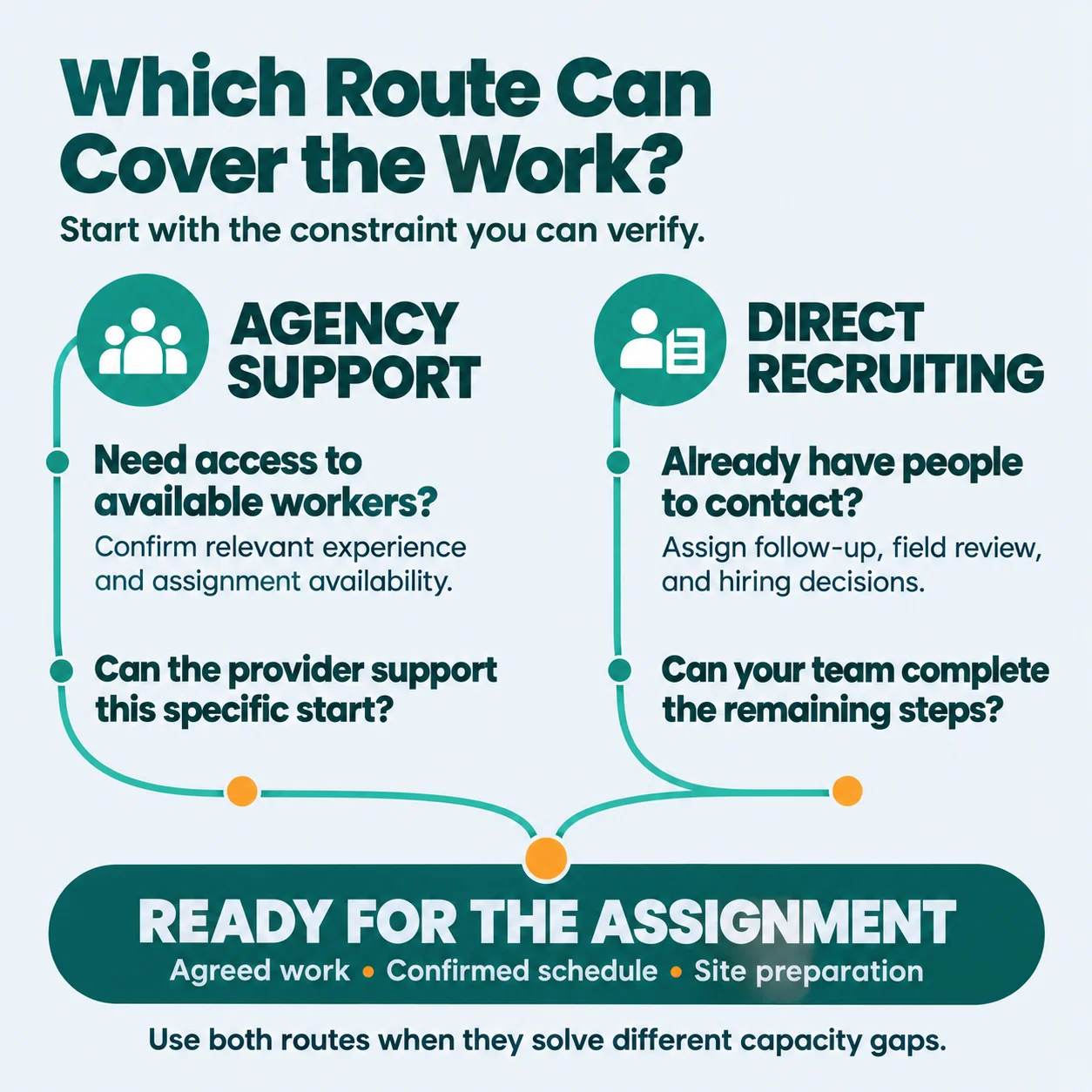
The construction staffing agency vs direct hire decision should follow the constraint you can verify. Agency support may help when access to suitable available workers is the problem; a maintained internal process may help when repeat hiring is slowed by missed communication and delayed decisions. If recurring crew recruitment is your priority, explore construction hiring software and evaluate it against one real opening, from first contact through the handoff to the supervisor.
Frequently Asked Questions
In a construction staffing agency vs direct hire comparison, which route is faster?
The faster route depends on qualified worker availability and the steps remaining before the assignment can begin. An agency with confirmed suitable workers may help an urgent gap, while an employer with interested candidates and prompt reviewers may move quickly through direct recruiting. Compare confirmed starts for similar assignments rather than assuming one model always wins.
Can an agency help with direct employment?
Yes. Placement services can introduce candidates who become employees of the client company, while temporary staffing and temporary-to-hire involve different arrangements. Ask which service is being proposed and review its terms before comparing it with recruiting internally.
Does hiring software replace a trade staffing agency?
Software supports the employer’s recruiting process and can reduce administrative friction, but it does not supply available workers. An employer still needs sourcing channels, reviewers, and capacity to manage hiring. Agency support may remain useful for assignments the company cannot cover through its own recruiting effort.
How should a specialty contractor test direct recruiting before expanding it?
Choose a recurring trade opening with a clear scope and a field reviewer who can participate. Record where time is spent, whether candidates meet the requirements, and whether confirmed starts occur as planned. Use those observations to decide what needs improvement before adding more roles to the process.
Content