In a small clinic, two roles keep the day moving: the medical assistant who rooms patients and the front-desk staff who answer the phones and check people in. When either seat is empty, the whole schedule slows down.
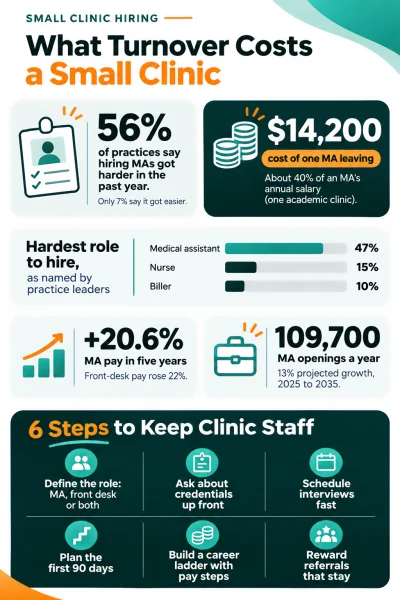
Filling those seats is getting harder. In a May 2026 MGMA Stat poll, 56% of medical practices said hiring medical assistants got harder over the past year, and only 7% said it got easier.
The short answer: small clinics win at hiring medical assistants and front-desk staff when they define the role clearly, screen for credentials and reliability, move faster than larger employers, and plan the first 90 days. This guide shows how.
Why Hiring Medical Assistants Is the Hardest Job in a Small Clinic
Practice leaders have ranked the MA as their hardest role to fill for years. In a 2025 MGMA Stat poll, 47% named medical assistants as the toughest hire, compared with 15% for nurses and 10% for billers.
Hospitals and Corporate Groups Can Outbid You
Independent practices are shrinking. Only 36.1% of medical practices were physician-owned in January 2026, down 48.5% since 2018, according to a Physicians Advocacy Institute report.
Health systems and corporate groups can offer higher hourly pay, sign-on bonuses, and formal career paths. MGMA notes that MAs often leave for “a few dollars more per hour” at a nearby hospital.
Pay Keeps Climbing
Small clinics also face steady wage growth. The 2026 MGMA DataDive report found median total compensation rose 20.6% over five years for medical assistants and 22% for front-desk and reception staff.
The Bureau of Labor Statistics (BLS) puts the median MA wage at $45,690 a year (May 2025). For receptionists in health care and social assistance, the BLS median was $19.00 an hour. Front-desk candidates also weigh offers from retail and customer service jobs.
Demand Outpaces the Pipeline
BLS projects MA employment to grow 13% from 2025 to 2035, with about 109,700 openings each year. Many new graduates hold a credential but little clinic experience, while small practices need people who can work on their own from week one.
What Turnover Costs a Small Clinic
Every vacancy costs more than the job ad. One study in the Journal of the American Board of Family Medicine estimated that each MA departure cost an academic family medicine center about $14,200, roughly 40% of an MA’s annual salary.
That center saw 59% MA turnover in a single year. Small clinics feel the same costs, even at lower turnover:
- Fewer patients roomed per hour while a position sits open.
- Overtime for the staff who cover the gap.
- Weeks of training before a new hire works independently.
- More scheduling, documentation, and billing errors from rushed onboarding.
- Practice manager hours spent recruiting instead of running the clinic.
Many practices end up improvising: 43% of medical groups hired alternative staff to cover MA vacancies in 2024, according to MGMA. For a broader look at the math, see our breakdown of the cost of employee turnover.
MA, Front Desk, or Both? Define the Role Before You Post
Medical assistants handle both administrative and clinical work, according to the BLS. That flexibility is why many small clinics hire a combined medical assistant and front-desk coordinator who can cover either side when someone is out.
Before you post, decide which duties the role really includes:
- Clinical: rooming patients, taking vital signs, recording medical histories, helping with exams, and collecting specimens.
- Front office: answering phones, scheduling appointments, checking patients in, updating records, and handling insurance paperwork.
- Out of scope: MAs do not diagnose, prescribe, or interpret test results. Delegated tasks such as injections depend on state rules and provider supervision, so check your state before you write the job description.
Credentials matter for compliance, too. Under CMS Promoting Interoperability guidance, only licensed professionals and credentialed medical assistants can enter medication, lab, and imaging orders through computerized order entry. The credential must come from an organization other than the employer.
How to Screen Medical Assistants and Front-Desk Candidates
A good screening process confirms the basics early and gets strong candidates to an interview before another employer hires them.
- Ask about credentials up front. Add knockout questions for certifications such as CMA, RMA, CCMA, or NCMA, and for any state requirements, so you do not interview people who cannot do the job.
- See communication skills early. One-way video interviews show how a front-desk or MA candidate speaks with patients before you spend time on a live interview.
- Use the same questions for everyone. Structured interviews make candidates easier to compare. Start with these receptionist interview questions for front-desk roles.
- Test for reliability and service. Pre-employment assessments help you check customer service skills, attention to detail, and dependability, not just experience.
- Move fast. Automated interview scheduling and candidate follow-up keep applicants engaged. MGMA reports that many leaders start recruiting about two months before an MA vacancy because they expect it to take that long.
How to Keep the Staff You Hire
Hiring is only half the job. These steps help new MAs and front-desk staff stay past the first 90 days:
- Plan the first 90 days. Give each new hire a role-specific checklist, a dedicated trainer, and check-ins at 30, 60, and 90 days.
- Build a career ladder. MGMA suggests tiered roles such as MA I, MA II, lead MA, and clinical coordinator, each with a defined pay step.
- Pay for certification. Covering an uncertified candidate’s exam, typically $150 to $400 according to MGMA, is often cheaper than waiting for a credentialed hire.
- Reward referrals that stay. MGMA reports that modest referral bonuses tied to a 6- or 12-month retention mark outperform untargeted advertising.
- Protect the front desk. Cross-train MAs and front-desk staff to share peak volume, and give receptionists de-escalation training and clear support from providers when patients are upset.
Choosing the right system matters as your clinic grows. See what to look for in a healthcare applicant tracking system, and how home care agencies are building a reliable caregiver pipeline.
Frequently Asked Questions
How hard is it to hire medical assistants right now?
Harder than a year ago for most practices: 56% of practices in a May 2026 MGMA poll said MA hiring got harder, and only 7% said it got easier. Medical assistants have ranked as the toughest staff role to fill for years.
How much does it cost when a medical assistant quits?
One study at an academic family medicine center put the cost at about $14,200 per departure, roughly 40% of an MA’s annual salary. Lost visits, overtime, and training time make up most of that cost.
Should a small clinic hire a medical assistant or a receptionist?
It depends on where the bottleneck is: MAs can cover both clinical and administrative work, while receptionists focus on phones, scheduling, and check-in. Many small clinics hire a combined MA and front-desk coordinator to cover both.
Do medical assistants need to be certified?
Not always, since many MAs enter with a certificate and some learn on the job. But only credentialed MAs can enter medication, lab, and imaging orders through computerized order entry under CMS rules, so many clinics prefer certified candidates.
How long does it take to hire a medical assistant?
Many practice leaders start recruiting about two months before an MA vacancy because they expect it to take that long, according to MGMA. Fast screening, scheduling, and follow-up help you reach strong candidates before other employers do.
How do you keep medical assistants from leaving?
Plan the first 90 days with a checklist, a trainer, and regular check-ins, and give MAs a visible career ladder with pay steps. Paying for certification and rewarding referrals that stay also help.
You Can’t Always Outbid the Hospital. You Can Out-Hire It.
Bigger employers will often pay more. Small clinics win by being faster, clearer, and better at keeping the people they hire. See how Discovered adapts to medical practice hiring, or book a demo to walk through your open MA and front-desk roles.
Content