A strong candidate applies at 10:17 a.m. Their experience fits the role, their availability works, and their application answers suggest they deserve a closer look.
The recruiter notices the application, but the owner is visiting another location. The hiring manager is handling an operational issue. Nobody wants to make a rushed decision, so the resume waits until everyone can reconnect.
Two days later, the team is ready to move. The candidate is already scheduling interviews elsewhere.
Learning how to hire faster is not about skipping evaluation or pushing people through the process before the evidence is ready. It is about removing the waiting time around decisions your team already knows how to make.
A faster hiring process responds while candidate interest is active, gets useful evidence to the right person, and prevents routine coordination from consuming the days between application and offer.
Why Is the Hiring Process So Slow?
Most hiring processes do not lose a week in one dramatic failure. They lose it through a series of small handoffs.
An application waits until someone has time to review it. The recruiter identifies a strong candidate but needs the hiring manager’s opinion. The manager sees the message after finishing the day’s operational work. The candidate then submits availability, but none of the proposed times work for the interview team.
Each delay may seem reasonable in isolation. Together, they create a process in which the candidate spends more time waiting than being evaluated.
The most common bottlenecks tend to appear in five places:
- Application review: Strong candidates remain mixed into a growing queue.
- First contact: The team waits until it can write the complete message instead of sending a timely next step.
- Hiring manager feedback: Resumes or notes are passed around without a clear response deadline.
- Interview scheduling: Availability moves through several emails before a time is confirmed.
- Final approval: Compensation, references, or offer documents begin only after the preferred candidate has already been selected.
If you want to improve your hiring process, measure the hours between these actions—not only the number of steps in the workflow.
What Slow Hiring Costs You
Candidates do not pause the rest of their job search while one employer organizes its internal process.
The 2024 iCIMS Talent Experience Report found that nearly 70% of job seekers expected the process from application to offer to take three weeks or less. When an employer’s workflow moves more slowly, qualified candidates have more time to continue interviewing, lose interest, or accept another opportunity.
Slow hiring also creates work inside the business. Managers continue covering the vacancy, recruiters spend additional time re-engaging candidates, and teams may need to reopen a search after a finalist withdraws.
The cost typically appears in three ways:
- Candidate drop-off increases. People stop responding when they do not understand whether the employer is still interested.
- The current team carries the vacancy longer. Operational responsibilities do not disappear while the position remains open.
- Recruiting work gets repeated. The team returns to sourcing, screening, and scheduling after losing a candidate who had already progressed.
Our guide to candidate drop-off in hiring examines how delayed communication, missed follow-up, and scheduling friction contribute to candidate ghosting.
The objective is not to pressure candidates into moving faster. It is to stop internal inactivity from becoming part of their experience.

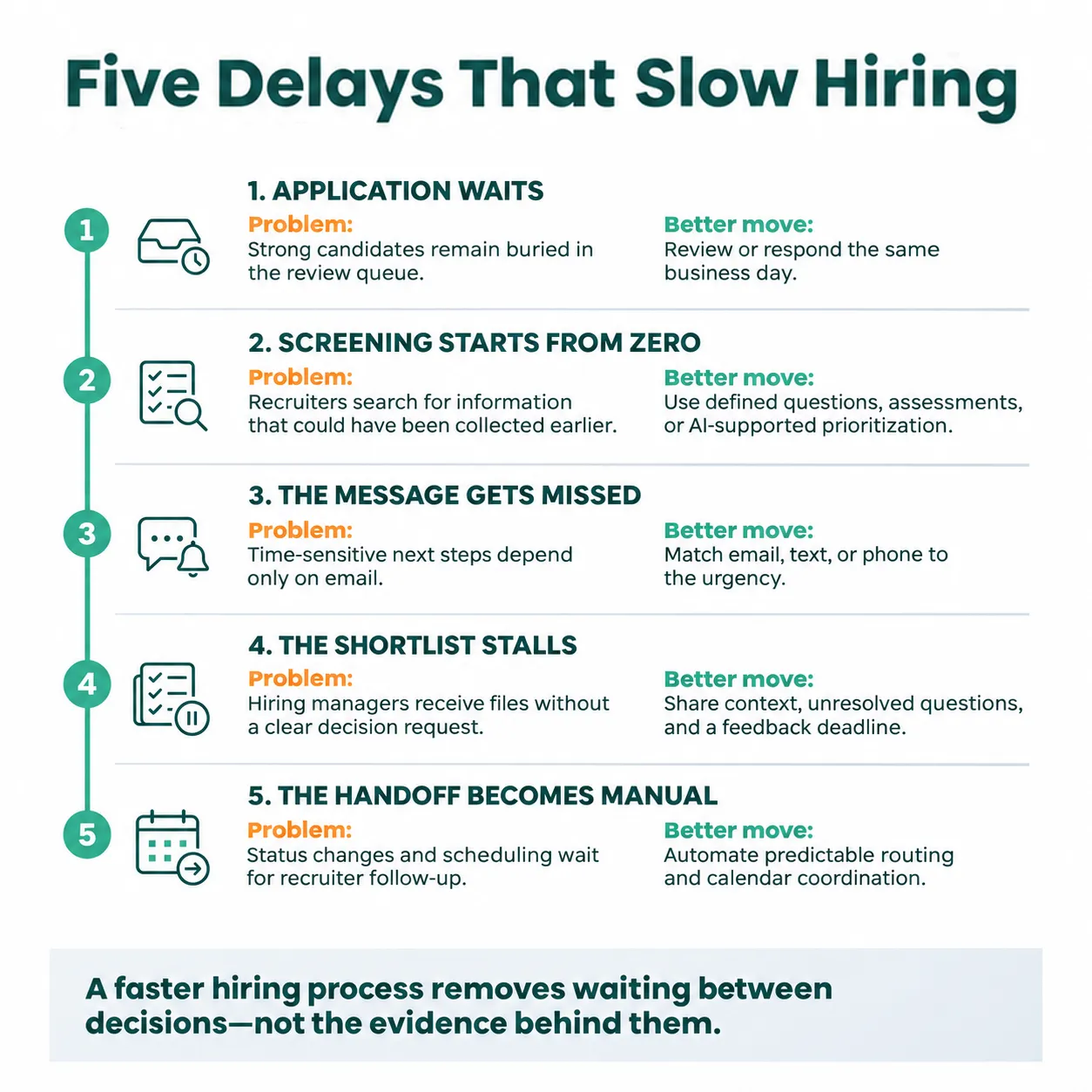
How to Reduce Time to Hire: Remove Five Common Delays
A team can often reduce time to hire without eliminating a single meaningful evaluation step. Start with the moments where the next action is already clear but still depends on someone remembering to perform it.
1. Respond While the Application Is Still Fresh
A same-day response does not need to contain a final screening decision.
It can confirm that the application arrived, ask one necessary question, invite the candidate to complete a defined task, or explain when they should expect the next update. The purpose is to show that the process is active and give the candidate a clear path forward.
Set a practical internal standard for promising applications. For example, every applicant meeting the initial requirements receives either a review, a question, or a next step before the end of the business day.
This is particularly important for owners and managers who do not spend the day inside an ATS. The response process should not depend on returning to one desk before the candidate hears from the company.
2. Collect the Evidence Needed for the Next Decision
Faster screening does not mean using more aggressive knockout rules.
It means defining what the recruiter actually needs to know before passing a candidate to the hiring manager. Screening questions can confirm practical requirements, assessments can evaluate selected job-related capabilities, and AI can help prioritize resumes against criteria the team has already approved.
Our guide to reducing time to hire with AI explains how AI-assisted review can shorten queues while keeping people accountable for candidate progression and final decisions.
The next stage should answer a question the previous one could not. Avoid making candidates repeat the same information through the application, screening call, assessment, and first interview.
3. Use the Channel That Fits the Urgency
Email works well for detailed information candidates may need to reference later. Text is often more useful when the person needs to notice a short, time-sensitive action, such as confirming availability or opening a scheduling link.
A fast hiring process does not send the same message through every channel. It uses each channel for a defined purpose and keeps the communication history connected to the candidate.
Automated SMS and calendar reminders can help teams send timely logistical updates without asking recruiters to monitor every upcoming task manually.
Automation should stop once the candidate responds or completes the action. More messages do not create more momentum when the system has already achieved its purpose.
4. Give the Hiring Manager a Shortlist, Not a New Research Project
Sending five attachments and asking, “What do you think?” transfers work without creating a decision.
A useful shortlist should tell the hiring manager:
- Why each candidate reached this stage.
- Which requirements they meet.
- What evidence is already available.
- Which question remains unresolved.
- What action the manager needs to take.
Set a response expectation before sharing the candidates. If the hiring manager reviews applicants between locations or operational responsibilities, make the information accessible without requiring them to reconstruct the candidate history from emails and files.
The recruiter’s role is not only finding candidates. It is making the next review easier to complete.
5. Automate the Handoffs and the Calendar
Some delays exist because nobody notices that a candidate completed the previous step.
When the workflow is predictable, automated candidate stage movement can route people after assessments, one-way interviews, screening questions, or other defined activities. The candidate reaches the correct review stage without waiting for someone to update the status manually.
Scheduling deserves the same treatment. Once the team has decided to interview someone, the candidate should be able to choose from approved availability without starting another email chain.
Cronofy’s candidate-expectations research found that 42% of respondents had left a recruiting process because interview scheduling took too long, while 57% preferred automated scheduling over lengthy back-and-forth communication. Interview scheduling automation can remove that coordination delay while preserving the live conversation itself.
A faster process does not necessarily contain fewer stages. It contains fewer inactive hours between them.
How to Hire Faster Without Lowering the Bar
Speed becomes risky when a team tries to gain it by removing useful evidence.
You do not recruit faster sustainably by replacing structured review with instinct, skipping candidate questions, or allowing one rating to make the entire decision. The objective is to make the existing standard easier to apply.
Three practices protect quality while the process accelerates.
Define the criteria before reviewing candidates
Recruiters and hiring managers should agree on what is required, preferred, and trainable before applications arrive. Otherwise, fast screening simply applies inconsistent expectations more quickly.
Evaluate candidates using the same evidence
An interview candidate scorecard gives interviewers shared, job-related criteria and creates a clearer basis for comparing candidates after the conversation.
Preserve the complete candidate context
A resume may show relevant experience, while an assessment, communication thread, work sample, or previous interview provides information the resume cannot. The person making the next decision should be able to review those pieces together.
A useful distinction is:
Move quickly on:
- Application acknowledgment
- Scheduling
- Reminders
- Status routing
- Sharing candidate information
Stay deliberate about:
- Changing the hiring criteria
- Comparing finalists
- Interpreting conflicting evidence
- Compensation exceptions
- Rejection or offer decisions
Efficiency should reduce administration around the judgment, not the care applied to the judgment itself.

Time to Hire vs. Time to Fill: Measure Your Speed
Teams often use time to hire and time to fill as though they mean the same thing. Establish one definition for each metric and apply it consistently.
Time-to-hire formula
Offer acceptance date − date the hired candidate entered the pipeline
This measures how quickly your process converts a known candidate into a hire.
Time-to-fill formula
Offer acceptance date − date the requisition was opened or approved
This includes the time required to launch the search and attract the eventual hire.
SHRM’s 2026 benchmarking report found a median time-to-fill of 39 calendar days for nonexecutive positions. The number provides useful context, but your most actionable metrics may be much smaller: application-to-first-response time, shortlist-to-manager-feedback time, and final-interview-to-offer time.
For an owner or location manager, tracking one or two operational handoffs can be more useful than comparing the company with a broad benchmark. Measure the point where candidates repeatedly wait, assign an owner, and review whether the delay improves.
Hire From Wherever You Are
A hiring system cannot help you hire faster if its useful information is only available when the right person returns to a computer.
The Discovered mobile app lets current customers use their existing account on iPhone or Android to review candidate profiles, resumes, application answers, assessments, interview videos, scorecards, references, attachments, and communication history. Users can appraise with Kingsley, add their own rating and notes, text, email or call candidates, assign assessments, change candidate statuses, search across jobs, and share candidate lists with reviewers through a PIN. Changes made in the app remain connected to Discovered on the web. Discovered.ai
That does not mean every hiring decision belongs on a phone.
The app is most useful when the candidate needs a timely response, the hiring manager needs to review an existing shortlist, or the team has already defined the condition that should start the next step. More consequential decisions can still wait for comparison, discussion, or approval.
The goal is to remove the desk as a bottleneck without turning mobility into rushed judgment.
Already using Discovered?
Download the app and sign in with your existing credentials:
Not using Discovered yet?
Book a Demo to see how candidate review, communication, collaboration, and workflow automation stay connected from web to mobile.
Hiring faster does not require being constantly available. It requires making the right evidence and next action available when a useful hiring moment appears.
Frequently Asked Questions
How long does it take to hire someone?
There is no universal hiring timeline. Role complexity, candidate supply, interview stages, approvals, and background requirements all influence the process. Establish your own baseline, then track where candidates spend time waiting rather than being evaluated.
How do you reduce time to hire?
Begin with application response, candidate screening, hiring-manager feedback, interview scheduling, and offer approval. Define clear ownership, automate predictable handoffs, and keep consequential decisions with the appropriate people.
What is the difference between time to hire and time to fill?
Time to hire generally starts when the eventual hire enters the candidate pipeline. Time to fill starts earlier, when the requisition is opened or approved. Both usually end when the offer is accepted, although organizations should document the definitions they use.
Can I review and contact candidates from my phone?
Yes. Current Discovered customers can use the mobile app on iPhone or Android with their existing login to review candidate information, communicate, add ratings or notes, share lists, assign assessments, and move candidates through established workflow stages.
Content