Have you ever prepared to interview a candidate only to discover that someone at your company had already interviewed them for another role?
The first application may have arrived through a job board using a personal email. Months later, the same person applies for another opening with a school, work, or updated address. The name looks familiar, but the ATS treats the records as two different people. That is how duplicate candidate profiles split one person’s history across separate records.
The second recruiter may not see the earlier interview notes. A hiring manager may repeat questions the candidate already answered. The team may send duplicate messages, overlook a previous assessment, or report two candidates when only one person exists.
The problem is not simply a messy database. It is that the next hiring decision begins without context the organization has already collected.
Case File: Elena Applied Twice
Elena first applied for a Service Coordinator position using her personal email address. During that process, the team collected:
- A resume and application.
- Screening-question answers.
- An initial phone-screen note.
- A completed skills assessment.
- Feedback explaining why another finalist was selected.
Eight months later, Elena applies for an Operations Lead opening. This time, she uses an email address associated with a professional certification program.
The second profile looks new.
A recruiter reviews the current resume, sends an introductory message, and schedules another screening call. During the conversation, Elena mentions that she has already spoken with the company.
Only then does the recruiter search more broadly and find the earlier record.
Nothing in the current application was incorrect. The candidate simply used another valid email address, and the hiring history became divided between two identities.
What the Split Record Cost the Team
The duplicate did not cause one dramatic system failure. It created several smaller problems.
The candidate repeated work
Elena received another introduction, answered similar questions, and had to explain that she had already interacted with the company.
The recruiter reviewed incomplete evidence
The current profile did not immediately show the earlier assessment, interview feedback, or communication history.
The hiring manager lacked useful context
The team could not easily distinguish what had already been evaluated from what still needed to be explored for the new role.
Reporting became less reliable
The database appeared to contain two candidates rather than one person with two applications.
A past finalist almost looked like a stranger
Instead of beginning with what the company already knew, the process restarted from the beginning.
SHRM now treats duplicate detection and pipeline cleanup as a distinct recruiting-data issue rather than a cosmetic administrative task. Its 2026 guidance specifically frames duplicate candidate records as information that needs to be identified and cleaned before recruiting teams can rely on the pipeline. Review SHRM’s duplicate-candidate cleanup guidance. shrm.org
Not Every Repeat Application Is a Duplicate
Before connecting records, the team needs to understand what actually happened.
Same job, same person, same email
This is normally a repeated application rather than a second identity. The new information should update the existing record without resetting the candidate’s current stage.
Different jobs, same person, same email
The candidate should retain separate applications for each job because each role has its own status, evaluation, and outcome. The records can still share a connected candidate identity and cross-job visibility.
Different emails, same person
This is the scenario that requires review. The candidate may have used personal, work, school, or updated contact information across different applications.
Similar name, different people
A similar name is only a clue. The team should not connect records until additional evidence supports that they represent the same individual.
Useful matching signals include:
- The same phone number.
- Overlapping email addresses.
- Matching employment history.
- The same location.
- A highly similar resume.
- A direct confirmation from the candidate.
- The same person appearing across related job applications.
The objective is not to connect profiles as quickly as possible. It is to connect them deliberately.
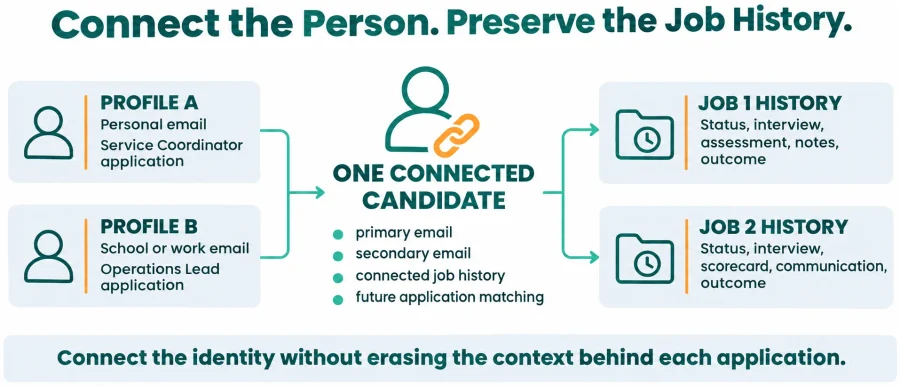
Connect the Person, Keep the Applications Separate
A candidate identity and a job application are related, but they are not the same record.
The identity answers:
- Who is this person?
- Which email addresses belong to them?
- Where else has the company encountered them?
Each application answers:
- Which job were they considering?
- What stage did they reach?
- What evidence was collected for that role?
- What decision was made?
- What communication belonged to that process?
This distinction matters because combining everything into one undifferentiated record can remove the context behind a decision.
A rejection from one job should not automatically become a rejection from every job. An assessment designed for one role may not evaluate the requirements of another. Interview feedback should remain connected to the position and criteria used at the time.
Our guide to candidate disposition explains why a previous outcome should provide context rather than automatically determine what happens in a later application.
The cleanest structure is therefore:
Connect across profiles
- Candidate identity.
- Current and previous email addresses.
- Visibility into related applications.
- Access to relevant cross-job history.
Preserve by job
- Status.
- Interview feedback.
- Scorecards.
- Assessments.
- Offers.
- Job-specific decisions.
Run a Five-Minute Duplicate Check
Before scheduling another interview or sending new outreach, use a short verification process.
1. Search more than the current email
Look for the candidate by name, phone number, alternate email, and recent employment.
2. Compare the records
Confirm that the profiles share enough identity evidence to represent the same person. Do not rely only on a similar name.
3. Review job-specific history
Check where the candidate applied, how far they progressed, and which evidence may still be relevant.
4. Choose the most useful primary email
Use the address most likely to remain current and accessible. Preserve the previous address as secondary contact information rather than deleting it.
5. Record the change
The team should be able to see that the profiles were connected, who made the change, and which identities or applications were affected.
This last step is important because recruiting records are not disposable notes. The EEOC’s recordkeeping requirements require covered private employers to retain application forms and other hiring records for defined periods, generally at least one year. Connecting duplicate identities should preserve hiring history rather than silently delete it. EEOC
Clean Candidate History Makes Rediscovery More Useful
A previous application does not only matter when the same person applies again.
The candidate may have been a strong finalist for another role, developed new experience since the earlier process, or remained relevant for an opening the company did not have at the time.
That history becomes useful only when the team can find it.
LinkedIn’s Recruiter System Connect guidance says complete past-applicant information from an ATS supports more seamless candidate rediscovery and gives recruiters a more holistic view of the hiring funnel. LinkedIn
A clean candidate database can help recruiters answer:
- Has this person already spoken with us?
- Which roles have they considered?
- What evidence did previous reviewers collect?
- Were they a strong finalist?
- Did the earlier decision depend on the role rather than the person?
- Could they fit the opening we have now?
A connected recruiting workflow makes that context more useful because each stage, note, interview, and next action remains tied to a clear job and owner.
The goal is not to keep every old candidate permanently active. It is to prevent useful talent history from becoming invisible because the person changed an email address.
How Discovered Connects the Records
Discovered automatically recognizes applications that use the same primary email address. When the same person appears under different emails, an Admin or Editor can use Connect to another profile to review likely matches and select the correct record.
Potential matches can be surfaced through signals such as the same phone number, email, or similar name. The user then selects the primary email and reviews which profiles will be affected before confirming the connection.
The records are connected rather than collapsed into one generic application:
- Each job retains its own status and history.
- The previous primary email remains available as a secondary address.
- Cross-job activity becomes visible from the connected profiles.
- Future applications using the selected primary email can match to the person.
- The change is recorded in the candidate timeline.
- The candidate does not receive an email or text about the internal connection.
The full process is documented in Connect Candidate Profiles. knowledge-base.discovered.ai
One Person Should Not Become a New Candidate Every Time
Duplicate candidate profiles are easy to dismiss as a database-cleanup problem. Their real cost appears when recruiters repeat work, hiring managers lose context, and candidates are asked to restart a relationship the company has already begun.
A stronger candidate record connects the person while preserving the individual history of every job.
That gives the next recruiter a better starting point. They can see what the organization already knows, identify what has changed, and focus the next conversation on the evidence that still matters.
The candidate may return with a new email, a new resume, or interest in a different job. Their history should not disappear with the old address.
Content