



A recruiter opens a candidate list on Monday morning and finds 75 people who need some form of follow-up. Some applied over the weekend. Others completed an assessment but have not scheduled an interview. A few strong candidates have already received an email but never responded.
The obvious solution seems to be more outreach. Send another email, make another call, add another reminder, and keep working down the list.
That approach can create a second problem. When every recruiter decides independently who to contact, which channel to use, and when to try again, candidates receive inconsistent communication while recruiters spend hours performing repetitive administrative work.
Candidate outreach automation should solve both problems. It should help hiring teams reach people while their interest is still active without turning recruiting communication into an endless sequence of automated messages.
The goal is not to contact candidates as often as possible. A stronger outreach strategy uses the right channel for the reason behind the message, automates predictable follow-up, responds to candidate behavior, and leaves important conversations with the people who should actually have them.
Candidate Outreach Automation Starts With the Reason for Contact
Before deciding whether to call, email, or text a candidate, the recruiting team should understand what it wants the person to do next.
A new applicant may need a brief acknowledgment and information about the next stage. A qualified candidate may need to schedule an interview. Someone who started but never completed an assessment may need a reminder. A finalist may need a conversation about an offer or a question that cannot be handled effectively through another template.
Those situations are all candidate outreach, but they should not produce identical communication.
Current Indeed guidance on candidate messaging distinguishes between channels based partly on the nature of the interaction. Email is useful when candidates need details they can review later, text can work well for short logistical updates or reminders, and calls are more appropriate when real-time clarification or a more personal conversation matters.
The decision should therefore begin with the message rather than the technology.
| Candidate need | Channel that may fit | Why |
|---|---|---|
| Application acknowledgment | Provides a clear written record and next steps | |
| Interview reminder | Text or email | Quick logistical information is easy to revisit |
| Scheduling problem | Phone or text | Real-time clarification can resolve friction quickly |
| Missing hiring task | Email, text, or automated call | Candidate needs a specific action |
| Compensation question | Phone | Context and questions can be handled immediately |
| Formal hiring update | Email with appropriate human follow-up | Candidate may need details they can reference |
| Late-stage sensitive conversation | Phone | More personal interaction is often appropriate |
This does not mean every organization needs the same channel rules. Candidate population, job type, hiring volume, geography, and communication preferences can all change what works. What matters is that channel selection becomes intentional rather than accidental.
Speed Matters When Candidate Interest Is Still Active
Candidate interest is not static. Someone who applies today may be interviewing elsewhere tomorrow. A sourced candidate who responds to a recruiter may be willing to talk now but much harder to reach after several days of silence. Indeed’s current employer guidance notes that timely candidate communication can help keep strong applicants engaged and reduce the risk that another opportunity moves faster.
That does not mean every application requires an immediate recruiter phone call. It means predictable next steps should not wait because someone forgot to send a message or update a spreadsheet. This is where automation creates useful speed.
An application can trigger acknowledgment automatically. A completed assessment can trigger the next communication. A candidate who has not scheduled after a defined amount of time can enter an appropriate follow-up sequence. The administrative action happens quickly without requiring the recruiter to continuously watch the pipeline.
The underlying workflow needs to be clear first. As we explain in our guide to building a connected recruiting workflow, automation becomes more effective when each stage already has a defined purpose, owner, and next action. When those conditions are unclear, faster communication simply exposes the same process confusion sooner.
More Channels Do Not Automatically Create Better Outreach
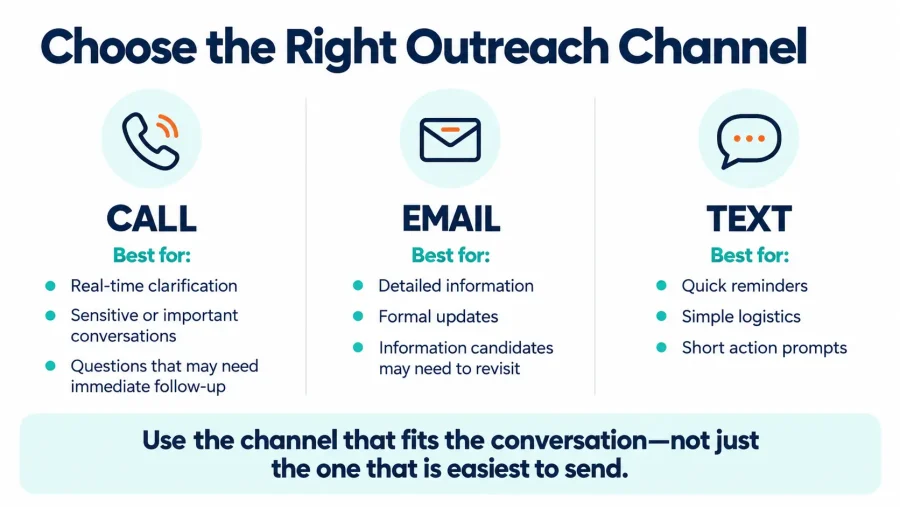
Email, text, phone calls, automated voice outreach, LinkedIn messages, and scheduling tools give recruiters more ways to contact candidates than ever before. Using all of them at the same time is not necessarily an improvement.
A candidate who receives an email at 9:00 a.m., a text at 9:10, a phone call at 9:20, and another reminder that afternoon may interpret the activity very differently from the recruiter who sees it as persistence.
Indeed specifically advises against overwhelming candidates through multiple simultaneous channels and recommends considering communication preference whenever possible. A better multichannel strategy uses escalation rather than duplication.
An email might deliver detailed information first. If the candidate does not respond and the action is time-sensitive, a text can make the request easier to notice. If the next step requires discussion or repeated digital outreach has not resolved the issue, a phone call may become appropriate.
The exact sequence can vary, but each new touchpoint should have a reason for existing. This principle also helps recruiting teams avoid one of the biggest risks of outreach automation: increasing activity without increasing useful conversations.
Automate the Follow-Up, Not the Relationship
Recruiters regularly perform communication tasks that require almost no new judgment. They confirm applications, send assessment links, remind candidates about incomplete steps, share scheduling instructions, and follow up when no response arrives.
Those are good candidates for automation because the condition and the appropriate next action can usually be defined in advance. The relationship itself is different. A candidate asking whether the organization can accommodate a different schedule is not simply another workflow trigger. Neither is someone concerned about compensation, uncertain about relocating, considering another offer, or asking a detailed question about the team.
Our guide to recruitment automation best practices makes this distinction central: predictable administrative actions can often run automatically, while conversations requiring judgment, empathy, exceptions, or interpretation should remain appropriately human.
The purpose of automation is therefore to preserve recruiter attention for the moments where that attention has value. If a recruiter no longer spends forty minutes manually dialing candidates who need the same scheduling reminder, that time can be used speaking with the candidate who actually answered and wants to understand the opportunity.
Candidate Behavior Should Change the Outreach
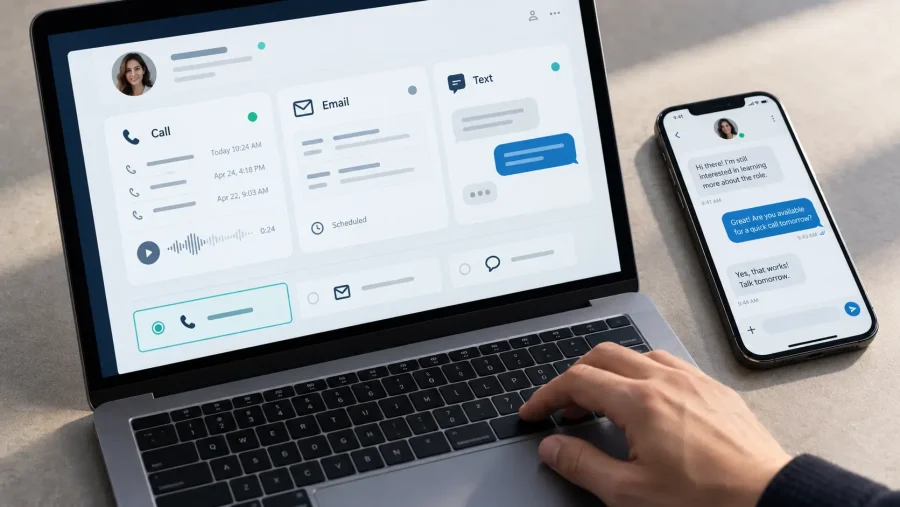
One of the weakest forms of automation is a sequence that continues regardless of what the candidate does. A candidate books an interview but still receives “Don’t forget to schedule” messages. Someone responds to a recruiter but receives the next automated follow-up because the sequence did not recognize the reply. Another candidate is moved out of consideration yet continues receiving outreach associated with the previous stage.
Those failures make the automation visible for the wrong reason. Strong candidate outreach automation needs stopping conditions. When the candidate completes the intended action, the associated outreach should stop. When they move to another stage, communication should reflect the new stage. When a person replies with a question or unusual circumstance, the workflow should make room for a human response rather than blindly continuing.
Discovered’s Automated Candidate Follow-Up Calls demonstrate this event-based approach: a call campaign can be connected to a specific candidate action, such as scheduling, and outreach stops once that action is completed.
The principle matters beyond any individual feature. Candidate communication should respond to what is actually happening rather than operate independently of the candidate.
Calls Have a Different Job Than Emails and Texts
Phone outreach remains useful precisely because it does something asynchronous channels do not: it creates the possibility of immediate conversation. That makes calling particularly valuable when a candidate’s response may generate another question.
A recruiter trying to clarify schedule availability can potentially resolve the issue in one conversation rather than several emails. A candidate who is unsure whether an opportunity matches their expectations can ask follow-up questions immediately. A finalist discussing compensation can explain concerns that may be difficult to interpret from a short message.
Indeed describes phone communication as especially useful for conversations where personal interaction or immediate clarification matters. That does not make calling the best channel for every interaction.
Candidates may be working, commuting, caring for family, or simply unable to answer an unexpected call. Detailed information may also be easier to provide in writing, and interview logistics are more useful when candidates can reference them later. Calls work best as part of a communication strategy rather than as a replacement for every other channel.
For high-volume recruiting, this distinction becomes particularly important. Technology can reduce the operational work surrounding calls, but recruiters still need to decide which candidate interactions actually benefit from a real-time conversation.
Scaling Outreach Requires Context, Not Just Volume
Bulk outreach becomes dangerous when scale removes the information that makes communication relevant. A recruiter calling fifty qualified candidates for the same role may benefit from eliminating manual dialing. That efficiency does not mean all fifty conversations should become identical.
The recruiter should still understand which job the person applied for, what information has already been collected, whether previous outreach occurred, and what the desired next action is. The same is true for automated email or text campaigns.
LinkedIn’s recruiting guidance consistently emphasizes personalization in candidate outreach. Its data shows that personalized InMail performs better than generic messages, reinforcing the broader point that automation should help teams deliver relevant communication efficiently rather than turn every candidate into another row in a list.
Centralized candidate context becomes especially valuable at scale. Discovered’s Candidate Communication tools keep email, SMS, internal notes, and related activity visible within the candidate record, which helps the next recruiter understand what has already happened before initiating another interaction.
That context helps prevent one of the least productive forms of outreach: contacting a candidate simply because the system says they are on a list while ignoring everything the candidate has already told the company.
Measure Conversations and Next Actions, Not Just Activity
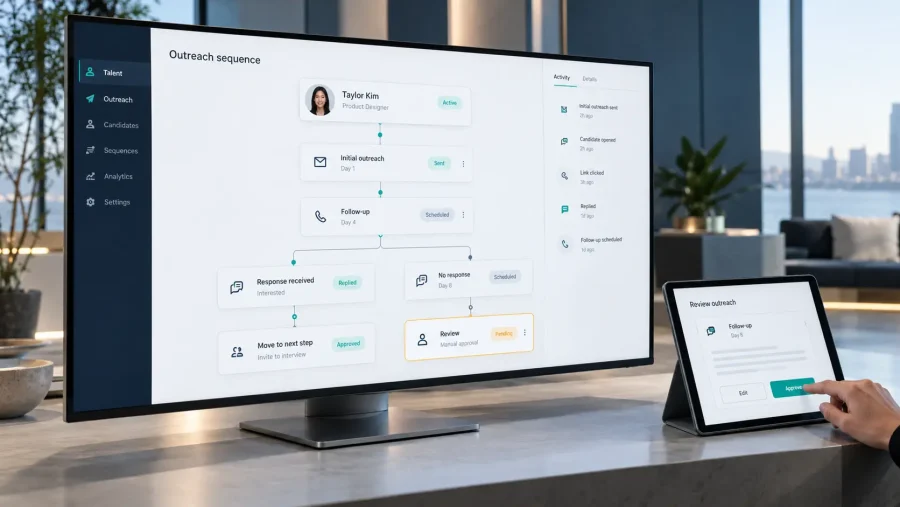
Outreach volume is easy to measure. A recruiting team can count calls placed, emails sent, texts delivered, follow-ups triggered, and total candidates contacted. Those numbers say very little about whether the outreach actually improved hiring. A better measurement strategy connects communication activity to candidate behavior.
If the goal of outreach is interview scheduling, the useful question is how many contacted candidates schedule. If recruiters are calling new applicants, connection rate and progression after the call matter more than total dial volume. If automated reminders are being used for assessments, completion after the reminder provides more information than message delivery alone.
A practical outreach dashboard could examine:
| Outreach objective | Useful measures |
|---|---|
| Start candidate conversations | Connection and response rate |
| Schedule interviews | Scheduling completion after outreach |
| Complete assessments | Completion after reminder |
| Re-engage inactive candidates | Re-engagement and progression rate |
| Improve recruiter efficiency | Time spent per successful contact |
| Compare channels | Response and conversion by phone, email, or text |
Call outcomes also need consistent definitions. If one recruiter marks an unanswered call as “follow-up,” another leaves it blank, and another records it as “no response,” reporting becomes difficult to trust. Standard dispositions make outreach data easier to compare and give future recruiters more useful context.
The goal is not to create another reporting burden. It is to learn which communication actually changes candidate behavior.
Build an Outreach System That Knows When to Stop
The best candidate outreach process does not maximize the number of messages a hiring team can send. It creates a predictable path from candidate → contact → response → next action.
Some steps on that path can happen automatically. Candidates can receive confirmations, reminders, scheduling prompts, and follow-up without requiring recruiters to perform the same administrative actions repeatedly.
Other moments deserve direct human attention. A real conversation can clarify interest, answer questions, resolve uncertainty, and help both sides decide whether moving forward makes sense.
Effective candidate outreach automation connects those two realities. Technology should make it easier to reach the right candidate, through the right channel, at the right moment. Candidate behavior should determine what happens next, communication history should remain visible to the team, and outreach should stop when it has accomplished its purpose.
The result is not simply more activity. It is fewer wasted touches and more opportunities for recruiters to have the conversations that actually move hiring forward.
Frequently Asked Questions
What is candidate outreach automation?
Candidate outreach automation uses predefined triggers, sequences, and communication tools to handle repeatable recruiting contact such as application confirmations, reminders, scheduling prompts, and follow-up.
Should recruiters call, email, or text candidates?
The appropriate channel depends on the message. Current Indeed candidate messaging guidance suggests email for detailed or formal information, text for short logistical communication, and calls when real-time clarification or more personal interaction is useful.
How many times should recruiters follow up?
There is no universal cadence that fits every role or candidate population. Teams should define a reasonable follow-up strategy based on the importance of the action, candidate stage, channel, and previous engagement rather than continuing outreach indefinitely.
Should candidate outreach be automated completely?
No. Predictable administrative communication is well suited to automation, but candidate questions, sensitive conversations, negotiation, unusual circumstances, and decisions requiring context should retain human involvement.
How can recruiting teams avoid overwhelming candidates?
Use each channel for a defined purpose, avoid sending the same message through several channels simultaneously, create stopping conditions, and allow candidate behavior to determine whether additional outreach is necessary.
How should candidate outreach performance be measured?
Measure the action the outreach was designed to influence, such as response, interview scheduling, assessment completion, re-engagement, or pipeline progression. Activity metrics such as total calls or emails are useful operationally but should not be treated as the final outcome.
Content