

You spent three weeks evaluating candidates for an open role. The finalist had the right titles on their resume, said the right things, came recommended by someone you trusted. You made the offer. Six months later the skills they claimed weren’t quite there, the experience turned out to be thinner than it sounded, and you’re managing a situation that costs more to fix than the hire itself. The data you based that decision on was exactly what the candidate wanted you to see — and nothing else.
That’s the information gap that data-driven hiring is built to close. Here’s what workforce intelligence actually looks like when it’s running inside a real hiring process, and what the Discovered and People Data Labs partnership makes available to growing businesses that have historically had to make do without it.
The Information Problem at the Center of Every Hire
Every candidate you evaluate controls most of the information you receive about them. The resume is self-curated — they include what makes them look good and leave out what doesn’t. The interview is designed to present the best version of themselves. References are people they already cleared. What you’re left with is a well-packaged version of someone that may or may not reflect how they’ll actually show up once they’re on your team.
The signal-to-noise problem has also gotten worse. US job postings now routinely attract anywhere from 32 to 200+ applications per role, and a growing share of those are AI-generated submissions that are difficult to distinguish on first pass. Nearly half of hiring managers report actively filtering out AI-written resumes — which means teams are spending more time on surface-level screening and less time on meaningful evaluation.
Average time-to-fill in the US has stretched to 63 to 68 days in recent periods, up from a historical average around 44. That’s the cost of a broken information environment — one that data-driven hiring is specifically designed to address.
Enterprise companies address this by running dedicated research on finalists — verifying work history through multiple channels, pulling workforce data from professional databases, mapping career patterns against the role requirements. Most growing businesses don’t have the resources to do that for every hire, which means they’re making $40,000 to $100,000+ decisions with a fraction of the information large recruiting departments rely on.
Most hiring decisions are made on the information the candidate chose to share. Workforce intelligence adds a verified data layer that candidates don’t control.
The gap shows up not during the hiring process but after it — when the real picture of who someone is at work starts to become clear. Most new hires take 8 to 26 weeks to reach full productivity, and that’s the window where the difference between who you thought you hired and who they actually are costs you the most. By then, the cost of being wrong is already compounding.
What People Data Labs Actually Brings to the Table
People Data Labs is one of the largest providers of structured workforce data. Their dataset aggregates professional information from multiple verified sources — not just self-reported profiles, but cross-referenced career data that reflects how candidates have actually moved through their professional lives: real work history, validated skills, career trajectory, education, and professional footprint.
That’s meaningfully different from running a LinkedIn search or pulling a standard background check. PDL’s data is structured and standardized at scale, which makes it usable for things most growing businesses haven’t had access to before — and it changes what data-driven hiring actually looks like in practice.
There’s also a research-backed case for why verified data matters more than self-reported credentials. Skills-based evaluation has roughly five times better predictive validity than educational criteria, and two and a half times better than prior job titles. Skill requirements for the average position have shifted about 25% since 2015, which means a candidate’s self-described background may not fully reflect what they can actually do in a role today. Current, verified data from an aggregated source closes that gap in a way that resume review alone can’t.
- Profile enrichment. Add verified professional context to a candidate’s application — skills, career history, and background drawn from sources beyond what they submitted.
- Career trajectory analysis. Understand how candidates with similar backgrounds have developed over time, and what that suggests about potential in the role you’re filling.
- Talent mapping. Get a picture of where candidates with the right skills and experience are concentrated before you’ve posted the role — so sourcing is based on where talent actually is, not just who finds your listing.
- Predictive hiring insights. AI-driven signals on candidate potential drawn from patterns in workforce data, not interview performance alone.
The Discovered and People Data Labs partnership brings this data into a platform built for companies hiring without a large recruiting department — so you get access to the same quality of workforce intelligence without needing a team to manage it.
How It Fits Inside Discovered

Workforce data is only useful when it’s accessible at the moment you actually need it. Most data tools fail in practice not because the data is bad, but because accessing it requires a separate step that gets skipped when you’re evaluating multiple candidates under time pressure.
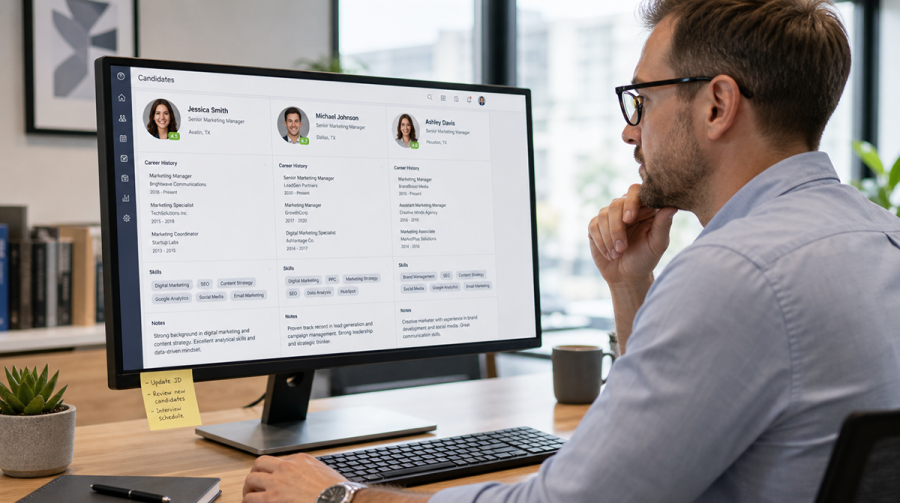
Inside Discovered, the People Data Labs enrichment sits alongside the rest of your candidate information — assessments, interview notes, reference results, skills scores. Your team sees a complete picture in one place, and the workforce intelligence is part of the decision rather than something someone has to remember to go find.
| Hiring Without Data vs. Hiring With Workforce Intelligence | ||
| Without Workforce Data | With Discovered + People Data Labs | |
| Candidate Information | Self-reported resume and interview performance | Enriched profiles from verified, multi-source workforce data |
| Skills Verification | Candidate’s word | Structured skills data cross-referenced across data sources |
| Career History | As presented on the resume | Validated work history and career trajectory patterns |
| Candidate Pool | Applicants who found your posting | Active and passive talent mapped against role requirements |
| Hiring Decision Basis | Gut feel and interview notes | AI-driven workforce intelligence integrated in your workflow |
| Post-Hire Surprises | Common — gaps appear weeks or months after the hire | Reduced — decisions backed by deeper candidate data |
That integration matters particularly for teams where the same person is managing the role and running the hiring process. The data is already there when you open a candidate’s record. You’re not building a separate workflow to access it.
Who Gets the Most Out of This
The businesses that benefit most from the Discovered + People Data Labs partnership tend to share a few things: they’re growing fast enough that bad hires carry real consequences, they don’t have a dedicated team to vet candidates manually, and they’ve been burned enough times by hires that looked right on paper to know that a more structured, data-driven hiring process is overdue.
CEOs and business owners making hiring calls directly
When you’re the one evaluating candidates while also running the business, you need information that’s already organized and actionable. Enriched profiles mean less time wondering whether someone’s listed experience is real and more time focused on whether they’re actually the right fit for the role.
HR teams managing multiple open positions at once
The more roles you’re filling simultaneously, the harder it is to do thorough manual research on every finalist. Having workforce intelligence integrated into the same platform where you’re tracking candidates means it gets used consistently across every hire — not just when someone has extra capacity.
Growing companies in construction, skilled trades, and field services
These industries tend to have thin margins for hiring mistakes. A wrong hire in a field supervisor seat, an estimator role, or a crew lead position has consequences that compound quickly. The data-driven hiring approach doesn’t eliminate uncertainty, but it meaningfully raises the quality of the information you’re working from before you commit.
Data-Driven Hiring as Part of a More Systematic Process
Getting better data on the candidates in your pipeline is one side of smarter hiring. Getting better data on where your job listings are performing is the other. For teams building a complete data-driven hiring process, Discovered’s partnership with AcquireROI handles the front-of-funnel side — which channels are producing qualified applicants and which are wasting spend. The People Data Labs partnership covers the evaluation side — who those candidates actually are once they’re in your pipeline.
Together they give you a hiring process that’s better informed at every stage. You can explore how these and other partnerships work at Discovered Partnerships.
Better Hiring Decisions Start With Better Information
When hiring decisions are based primarily on what candidates choose to share, the gaps in that picture don’t show up during the interview — they show up weeks or months after, when the real version of someone becomes clear. Data-driven hiring narrows that gap by adding verified workforce intelligence to the evaluation process, so you’re working from a more complete picture before you make the offer.
is built to do — bring the kind of workforce data that enterprise recruiting teams have relied on for years into a platform designed for growing businesses. If you’re tired of finding out too late that a hire wasn’t what it seemed, it’s worth taking a closer look.
See What Data-Driven Hiring Looks Like in Practice
Discovered and People Data Labs bring workforce intelligence into your hiring workflow — so every decision is backed by more than what a candidate chose to share.
Content