

Three months ago you hired someone who checked every box. Strong experience, solid references, performed well in the interview. Now they’re struggling to connect with the crew, two of your best people are quietly pulling back, and nothing’s obviously broken but nothing’s quite working either. What’s missing isn’t skills. It’s behavioral fit. A DISC assessment for teams is designed to surface exactly that — how different work styles will interact under real conditions, before you’ve already made the hire.
That’s the gap DISC was built to close. Here’s how it works, how to actually use it in hiring and team management, and what WorkStyles DISCovered looks like when it’s running inside a real crew.
Why Team Communication Breaks Down as You Grow
Small teams have an advantage: everyone can read each other. You know who needs more direction, who will just go figure it out, who needs to process before they respond. That tacit knowledge carries you through 5 people, maybe 15.
Past that, it falls apart. New hires bring different work styles. Crew leads who were great individual contributors struggle to manage people who think differently. Communication gaps get filled in with assumptions, and assumptions become conflict.
SHRM puts the average cost of miscommunication at $420,000 a year for a company with 100 employees. On top of that, replacing a single employee runs anywhere from 50% to 200% of their annual salary depending on the role. And Gallup’s 2025 data shows only 31% of American workers feel engaged — the lowest number since 2014. Most of that disengagement traces back to the same thing: people being put in situations that don’t match how they actually work.
None of this is fixed by working harder or hiring more carefully based on experience. It’s fixed by understanding the behavioral styles on your team, and that’s what a DISC assessment for teams is designed to do.
What a DISC Assessment for Teams Actually Measures
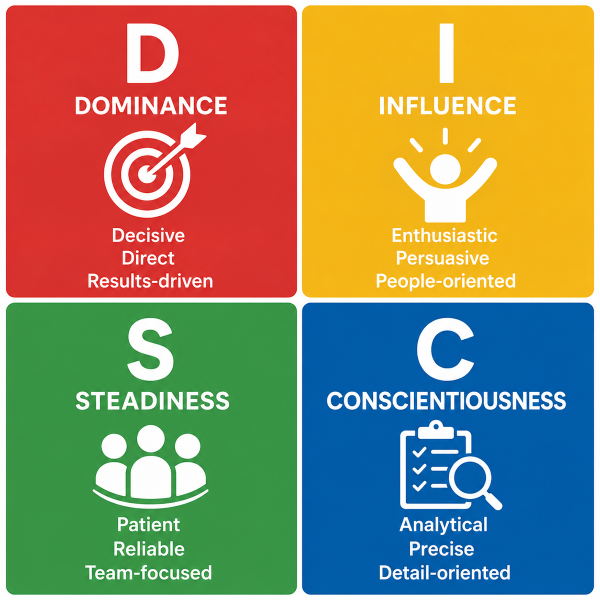
Unlike personality tests that try to put people in a box, DISC focuses on behavior — specifically how someone tends to show up at work. How they make decisions. How they communicate when things get stressful. Whether they push forward or pull back when the pace picks up. It’s narrower than a personality profile, and more directly useful when you’re managing a crew or building a team.
The model measures four dimensions:
| DISC Dimension | What It Evaluates | Why It Matters for Your Team |
| Dominance (D) | Assertiveness, decisiveness, task focus | Matches candidates to leadership or high-autonomy roles where speed and ownership matter |
| Influence (I) | Sociability, enthusiasm, communication style | Predicts fit for client-facing, sales, or team-building roles that run on relationships |
| Steadiness (S) | Patience, consistency, teamwork orientation | Supports stable, dependable contributions under sustained pressure and routine |
| Conscientiousness (C) | Detail orientation, structure, rule-following | Predicts reliability in compliance, technical, and quality-critical roles |
Each person lands somewhere across these four dimensions, usually with one or two that dominate. A high-D crew lead drives decisions fast and hates being micromanaged. A high-C estimator wants to review every number before signing off. A high-S field tech is your most dependable person under sustained pressure, but may avoid confrontation even when something’s wrong.
None of that is a character flaw — it’s just how different people are wired. The problem is when you don’t know that going in, and you end up reading someone’s hesitation as disengagement, or their directness as attitude, when it’s really just their style. Research on DISC behavioral styles and job performance shows that when people’s behavioral style matches what their role actually demands, both performance and retention go up. Which makes sense — people work better when they’re not constantly working against the grain.
How to Use a DISC Assessment for Teams Before You Hire
Most teams run DISC after the hire, during onboarding or a team workshop. That’s useful. But running a DISC assessment for teams during the hiring process gives you something more valuable: a decision filter before you make the offer.
Two candidates with the same experience and similar interview performance will show up very differently on a DISC profile. One is high-D and high-I: fast, relationship-driven, good at selling or leading, likely to push back on process. The other is high-S and high-C: steady, detail-oriented, great for technical or support roles, likely to need more structure and clarity to perform at their best.
Neither is wrong. But only one of those profiles fits the role you’re filling, and only one fits the team they’d be joining. The DISC assessment surfaces that before you’ve already offered the job.
Match the profile to the role
Before you post a job, think about what behavioral style actually succeeds in it. A field supervisor role in a fast-moving crew needs high-D or high-I. A quality control or estimating role needs high-C. A support dispatcher who has to stay calm while juggling calls needs high-S. Document that expectation, run the assessment on candidates, and compare.
Look at team balance, not just individual fit
If your existing crew is mostly high-S, adding another one might feel comfortable but won’t stretch the team. A high-D who’s also coachable might be exactly what you need to push growth. Looking at the behavioral spread across your team, and asking whether a new hire complements or duplicates what’s already there, is one of the smartest things you can do before making an offer.
How to Use a DISC Assessment for Teams After the Hire
The assessment’s value doesn’t end at the offer letter. In fact, the most practical application for most growing businesses is using DISC results to manage, coach, and develop the people already on your team.
Adapt how you communicate
A high-D doesn’t want a five-minute preamble before you get to the point. A high-C will get frustrated if you rush them to a decision without giving them time to review the data. Knowing your team’s DISC profiles changes how you run one-on-ones, how you give feedback, and how you frame difficult conversations. That’s not manipulation. It’s just communicating in a way that actually lands.
Coach to the profile, not the behavior
Underperformance is rarely as simple as someone not trying hard enough. A lot of the time, someone is genuinely working hard and still struggling because the role pulls in a direction that runs against how they’re wired. Having DISC data changes that conversation — instead of framing it as a performance issue, you can talk about the specific gap between what the role demands and what comes naturally to them, and work out how to bridge it.
Track development over time
Behavioral profiles aren’t fixed forever. People develop, especially when given targeted coaching. Retaking the DISC assessment after six to twelve months of structured development lets you see what’s actually changed, not just what someone tells you in a review. That data is more useful than gut feel for making promotion or team restructuring decisions.
WorkStyles DISCovered: A DISC Assessment for Teams Built Into Your Hiring Platform
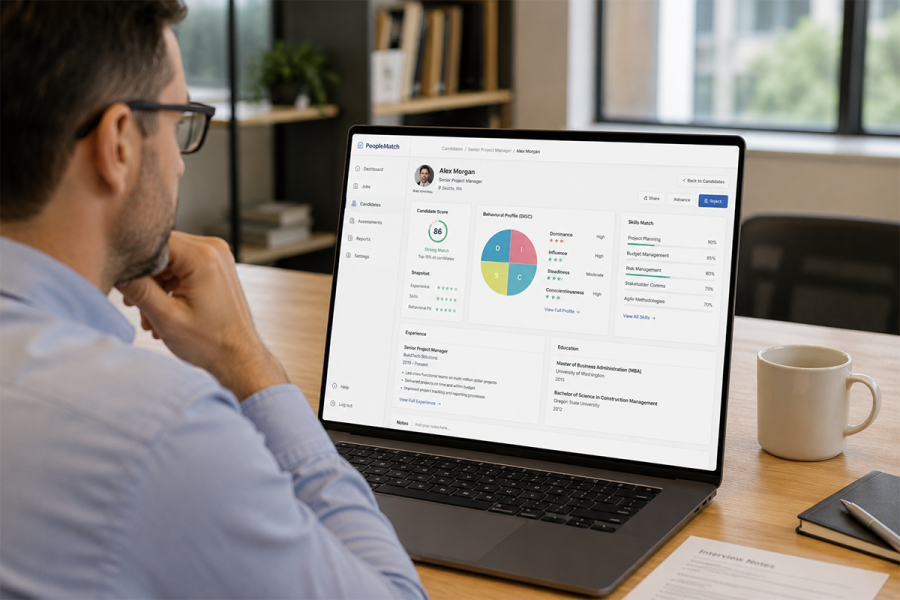
Most DISC tools hand you a standalone PDF and leave the rest to you — someone on your team has to read it, interpret it, and figure out how to factor it into a hiring decision that’s already happening in a different system. Discovered’s WorkStyles DISCovered Assessment is built into the hiring platform, so the behavioral data shows up where your team is already working.
Results appear directly inside each candidate’s scorecard in the Discovered platform. Your team sees skills, experience, and behavioral profile in one place, no tab-switching, no translating a separate document. That means the DISC data is part of the decision, not an afterthought.
Here’s what’s built in:
- Integrated candidate scorecards. DISC results appear in the same view as skills scores, reference results, and interview notes — so your hiring team is working from a complete picture, not piecing together data from different tabs.
- Team Dynamics View. Before you make an offer, you can see how the new candidate’s DISC profile sits against your existing team. Same style as everyone else? That’s worth knowing before day one.
- Coaching insights by profile. Each report includes specific behavioral notes: how this person handles stress, how they prefer feedback, where they’re likely to struggle. Managers get something they can actually use in their next one-on-one.
- Culture fit signals. Rather than guessing whether someone will mesh with your crew, you get a direct comparison between the candidate’s behavioral style and how your existing team operates.
- 15 minutes. Available in English and Spanish. Short enough that candidates actually complete it, and accessible to crews where English isn’t everyone’s first language.
The comparison below shows what changes when you bring a DISC assessment for teams into your process, versus hiring on interviews and experience alone:
| Hiring Without DISC | Hiring With a DISC Assessment for Teams |
| Gut feeling on culture fit | Behavioral data matched to your team’s actual style |
| Interview performance only | Communication style, stress response, and collaboration tendencies revealed |
| Hard to predict team dynamics | Team Dynamics View shows how the new hire fits with existing profiles |
| Coaching based on guesswork | Coaching insights specific to each person’s behavioral profile |
| Same process for every hire | Consistent, repeatable framework that scales as you grow |
The WorkStyles DISCovered Team Training Packages

Running the assessment gives you the data. Knowing what to do with it takes a bit more. That’s where the WorkStyles DISCovered team training packages come in. These are live sessions built around your team’s actual DISC results, not a generic workshop pulled from a template.
The facilitator works from your team’s real report. The conversations are grounded in what your specific group scored, where the tensions are, and what you can do about them.
| Package | Duration | Price | Best For |
| DISC Essentials | 1 hour | $250 | Teams that already know DISC and need a focused session on their current results |
| DISC Foundations | 2 hours | $450 | Teams new to DISC that have never had formal training before |
| DISC Deep Dive | 2 sessions, 1.5h each | $750 | Teams dealing with real operational tension or communication gaps that need deeper alignment |
If your team has never talked about work styles before, start with Foundations. If you’re dealing with a specific communication breakdown or a team that’s not gelling after a recent restructure, Deep Dive is designed for that. You can read more about how to pick the right approach in our guide on using a DISC-based hiring approach to protect culture as you scale.
In a study conducted with 61 IO Psychology students who took the WorkStyles DISCovered assessment, a majority described the experience as clear, fair, and accurate to their self-perception. Most found the feedback actionable for understanding how they work, communicate, and contribute to a team. For a deeper look at what that research found, read our breakdown of AI in recruitment and DISC-based personality feedback.
For the full assessment overview, sample report breakdowns, and information on using the Work Styles DISC for role and team fit evaluation, visit PreEmploymentAssessments.com.
Building Better Teams Starts with Understanding How People Work
If you’ve had the same communication issues cycling through your crew for years, a DISC assessment for teams won’t erase them overnight. But what it does do is give you and your managers a common way to talk about how people work — and that tends to change the conversations you were having before. Instead of ‘he’s just difficult’ or ‘she doesn’t seem motivated,’ you start working with actual information.
For growing businesses in construction, HVAC, field service, and skilled trades, that shift matters. Hiring conditions are rarely ideal — you’re making calls fast, with limited information, under pressure to fill a seat. The teams that hold together as they scale tend to be the ones that built some behavioral awareness into their process early, before the friction started costing them people.
Running an assessment with your team and using the results in your next hire is a low-investment starting point. The upside is that it compounds — every manager who understands their crew’s behavioral mix makes better calls over time, and the friction that used to show up as turnover or conflict starts to show up less.
Ready to Run a DISC Assessment for Teams? Book a free demo of the Discovered platform and see how the WorkStyles DISCovered Assessment works inside your hiring workflow, from candidate screening to live team training. Book a Free Demo at Discovered.ai.
Content