What happens when the strongest candidate has the wrong title, one year less experience than requested, and familiarity with a different software platform? Would your team recognize the evidence—or would the resume screening criteria push that person down the list before anyone looks closer?
AI can apply screening instructions quickly and consistently, but it cannot determine whether those instructions reflect the work. To see why that matters, we will evaluate three fictional candidates for one role, adjust the criteria, and review the same resumes again.
The Calibration Challenge
A regional service company is hiring an Operations Supervisor. The person will coordinate 12 employees, manage a high-volume schedule, respond to service escalations, and use a digital dispatch system.
The original job description asks for:
- Five years of supervisory experience.
- Previous work in the same industry.
- Advanced experience with the company’s scheduling platform.
Those requirements appear specific, but the team has not discussed why each one matters or whether it represents an essential qualification, a preference, or something the company can teach.
The candidates
Jordan has six years of experience with the title Operations Supervisor. Jordan worked in the same industry and used the exact scheduling platform named in the job description. The resume provides little information about team size, coaching, operational volume, or measurable results.
Marisol has four years as a Field Team Lead in a related service industry. She managed 15 employees, improved weekly scheduling, reduced missed appointments, and handled customer escalations. She used a comparable dispatch platform rather than the company’s preferred system.
Devon has ten years in operations and extensive experience with the requested software. Most of that background involved individual-contributor work, and the resume shows limited evidence of managing people or owning team performance.

Round One: Apply the Requirements Literally
Using the original filters, the ranking will probably look like this:
- Jordan: correct title, enough years, same industry, exact software.
- Devon: extensive experience and strong software familiarity.
- Marisol: one year short, different title, adjacent industry, different platform.
The shortlist follows the job description, but it does not necessarily reflect the work. Jordan looks familiar, while Marisol shows more direct evidence of leading a comparable team and improving the type of operation the new supervisor will manage.
The problem is not that years, industry, or software are irrelevant. The team has not decided whether they are essential requirements or imperfect substitutes for the capabilities it actually needs.
LinkedIn’s recruitment process guidance recommends separating essential skills from trainable ones before screening begins. That distinction prevents preferences from becoming automatic barriers simply because they appeared in a previous job description.
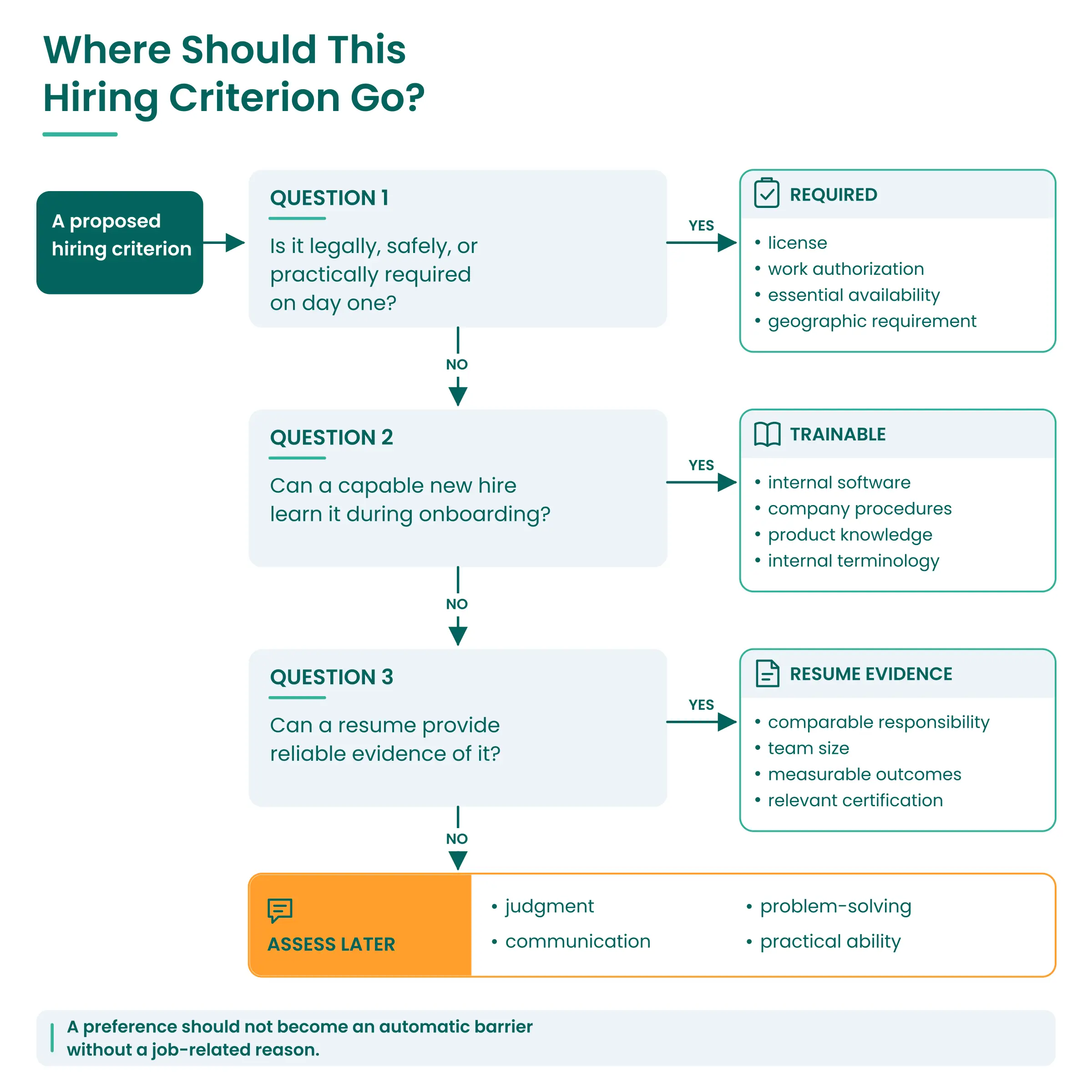
Rebuild the Criteria Around Four Questions
The team now gives each part of the review a clearer purpose.
1. What must already be true?
These are genuine eligibility requirements, such as a legally required license, work authorization, geographic availability, or the ability to work the required schedule.
A condition belongs here only when the candidate could not legally, safely, or practically perform the job without it.
2. What evidence should strengthen the match?
For this role, the resume should provide evidence of:
- Coordinating a team of comparable size.
- Managing a high-volume schedule.
- Coaching or supporting employees.
- Handling customer or operational escalations.
- Owning measurable performance outcomes.
The exact previous title is less important than comparable responsibility.
3. What can be taught after hire?
The company can train a capable supervisor on its internal platform, reporting procedures, service terminology, and organization-specific workflows.
Software familiarity may shorten onboarding, but it should not automatically outweigh stronger evidence of leadership and operational judgment.
4. What needs another evaluation method?
A resume cannot reliably show how someone prioritizes urgent problems, coaches an employee, communicates under pressure, or adapts when resources are limited.
Those capabilities should move into a work sample, assessment, or structured interview.
| Original filter | Better screening question |
| Five years as a supervisor | Has the candidate led work of comparable scope? |
| Same-industry experience | Which parts of the industry context are truly essential? |
| Exact software experience | Can the candidate manage complex scheduling systems? |
| Strong leadership | What resume evidence shows people responsibility and outcomes? |
| Excellent communication | Should this be evaluated later through a structured exercise? |
This approach is consistent with the structured resume review described by the U.S. Office of Personnel Management, where subject-matter experts interpret specialized experience using consistent criteria rather than relying only on keywords.
It also makes the process easier to justify. The EEOC’s guidance on employment selection procedures explains that screening practices may create legal concerns when they disproportionately exclude protected groups and cannot be supported as job-related and consistent with business necessity.
Round Two: Review the Same Resumes Again
The candidate information has not changed, but the shortlist now tells a different story.
- Jordan still receives credit for direct industry experience and platform familiarity. The rating becomes more cautious because the resume provides limited evidence of leadership scope or operational outcomes.
- Marisol moves higher because she led a larger team than the new role requires, improved scheduling, reduced missed appointments, and managed escalations. Her different title and software no longer erase those signals.
- Devon remains relevant because of operational tenure and technical familiarity, but the absence of people-management evidence becomes a clear question for later review.
The second round does not identify an automatic hire. It creates a stronger shortlist because the reason behind each position is visible and open to discussion.
That is the appropriate role for resume screening. It should help the team decide where to focus next rather than attempting to complete the entire hiring decision.
Run a 20-Minute Calibration Session
A short calibration session can expose unclear criteria before hundreds of applications arrive.
- Minutes 1–5: Define the work.
The hiring manager explains the responsibilities, outcomes, team scope, and genuine non-negotiables. - Minutes 6–10: Sort the criteria.
The recruiter separates essential requirements, preferences, trainable skills, and capabilities that need another evaluation. - Minutes 11–15: Test sample resumes.
Two reviewers independently score a conventional match, a transferable-skills candidate, and a partial match. - Minutes 16–20: Resolve disagreements.
The team identifies which instruction caused each difference and rewrites it before launching the job.
Disagreement is useful because it exposes assumptions the written criteria did not make visible.
This exercise is especially valuable when using AI Resume Screening. AI can organize and prioritize candidate evidence, but the hiring team still needs to determine whether the instructions reflect the job and whether an unexpected result comes from the resume or the criteria.
Know When the Resume Has Reached Its Limit
More detailed instructions cannot make a resume prove something it does not contain. A candidate can list spreadsheet expertise without demonstrating analytical skill. Someone can describe customer-service experience without showing how they would respond to a difficult situation. A management title may suggest authority without explaining how the person coaches employees or makes decisions.
When a capability requires demonstration, move it into another stage. A focused Custom Skill Test can evaluate realistic work, while Candidate Scorecards help interviewers review later evidence against shared criteria.
For the Operations Supervisor role, candidates could complete a scheduling scenario involving limited staff, urgent customer needs, and competing priorities. Their response would provide more meaningful evidence of judgment than another attempt to infer the same capability from a title.

Apply the Criteria in Discovered
Once the team agrees on the framework, the internal instructions can be added without turning the public job advertisement into a scoring document.
The Resume Scoring Criteria guide explains that Discovered separates scoring instructions from the internal job description. Teams can define must-have qualifications, preferred experience, and signals that should lower a score, then save those instructions as templates for similar roles.
When the criteria change, existing ratings do not update automatically. New applicants use the revised instructions, while candidates already in the pipeline need to be appraised again if the team wants the new criteria applied. Before comparing scores, confirm that the candidates were evaluated using the same version of the instructions.
Better Criteria Create a Better Starting Point
Resume screening criteria determine what the hiring team notices first. When those criteria are vague, reviewers fill the gaps with familiar titles, arbitrary experience thresholds, preferred industries, and personal assumptions.
A stronger process uses each hiring stage for the evidence it can provide:
- The resume establishes relevant background.
- Screening criteria prioritize job-related experience.
- A work sample verifies practical capability.
- A structured interview explores judgment and context.
- Human reviewers interpret exceptions and transferable skills.
AI can apply the agreed criteria consistently and help recruiters focus their attention. People remain responsible for questioning unexpected results and revising instructions that no longer reflect the job.
The goal is not a perfect score. It is a shortlist the team can understand, challenge, and improve.
Content