Construction ATS pricing depends on how the provider charges, which capabilities the plan includes, and what your team will use during the agreement. To understand the cost for your company, compare a written quote against a defined hiring scenario, including additional services and implementation work. A monthly subscription figure alone does not show the full commitment.
A contractor with one office administrator handling occasional openings has different needs from a growing firm involving several superintendents and project managers. The second company may need broader reviewer access and more simultaneous vacancies, even if the software’s core applicant tracking looks similar. Start with those differences before deciding which plan offers value. Our page on hiring software for general contractors shows how a team like that can share one process.
How Construction ATS Pricing Models Shape Your Budget
Hiring software commonly uses a combination of a billing unit, a feature tier, and usage conditions. The billing unit determines what the vendor counts, while the tier determines which capabilities you can access. A free entry plan or a trial describes how you begin using the service; it does not explain every cost you may face as hiring expands.
For contractors, the most useful distinction is between the people using the software, the size of the company, and the number of active openings. Those quantities can move independently. Adding a project manager to candidate reviews is different from opening another position, and neither necessarily means the company has hired another employee.
| Pricing basis | What the provider counts | What a contractor should clarify |
|---|---|---|
| Users or recruiter seats | Paid accounts or licensed recruiting users | Do foremen and hiring managers need paid seats, or is limited reviewer access included? |
| Company size | Employees within defined headcount bands | Who is counted, when is the count reviewed, and what happens during seasonal growth? |
| Active openings or capacity tiers | Jobs or candidate pools kept active at the same time | Does one posting support several hires, and how are locations or reopened jobs counted? |
| Custom agreement | An individually defined scope of software and services | Which capabilities, support, usage allowances, and implementation deliverables are included? |
Published vendor plans illustrate why definitions matter. Manatal’s pricing page lists per-user subscriptions alongside unlimited hiring-manager access, so a reviewer and a paid user are not necessarily the same thing. Workable’s plan selector uses employee-count bands, while Breezy’s entry plan limits the number of active positions or candidate pools. These are examples of different structures, not equivalent packages or recommendations for a particular contractor.
A limited entry plan can provide a useful way to learn a system, but evaluate it against the work you need to perform. Check access to existing candidate records, available automation, reviewer participation, and the conditions for upgrading. If the next project requires capabilities outside that plan, include the relevant upgrade in the comparison from the beginning.
What Belongs in the Total Cost
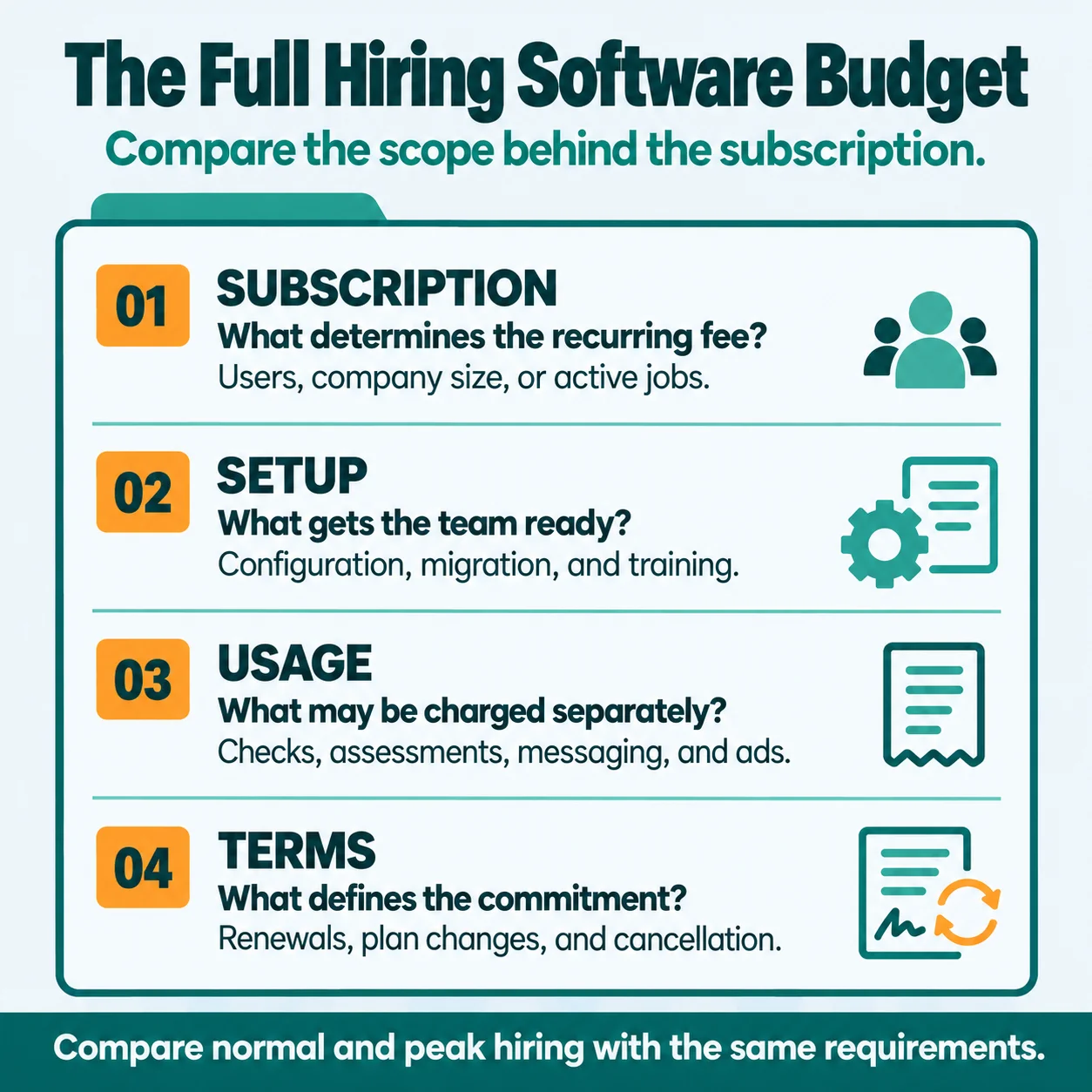
Separate the recurring subscription from setup work, usage charges, and advertising. This makes it easier to compare offers that package the same activities differently. It also prevents a cost paid to a separate provider from disappearing merely because the ATS offers an integration.
Implementation can include configuring stages, setting up calendars, creating message templates, importing records, and training the people who will use the process. Some of that work may be included in the agreement; some may be optional or performed by your own staff. Ask for the deliverables and responsibilities rather than assuming that “onboarding included” covers everything required to launch.

Usage-based services need their own assumptions. Assessments, background checks, messaging, or other services may have separate allowances or charges, depending on the vendor and plan. Confirm what counts as a billable event, whether credits expire, and what happens when the included amount is exhausted. An available integration does not establish that the connected service is included in the subscription.
Job advertising is another distinct budget. The ability to distribute an opening to a job board should not be treated as an allowance for sponsored visibility. Ask which advertising spend is separate, who controls it, and how the team will review its results alongside recruiting activity.
Your own time belongs in the evaluation as well. Estimate who will configure the system, maintain templates, train new reviewers, and manage candidate follow-up. Our discussion of technology adoption in construction explores why implementation needs to fit the way people work; purchasing access is only one part of adopting a tool.
Compare Quotes Against the Same Hiring Scenario
Give every provider the same description of your company and hiring process. Include the people who need recruiting access, the openings you expect to manage simultaneously, and the services you want to use. Ask for a normal hiring period and a busier project-start period so the comparison reflects how demand changes.
For an illustrative specialty contractor, the normal scenario might involve one recruiting administrator, three field reviewers, and two active openings. A project mobilization might require the same administrator, additional reviewers, and several roles advertised across different locations. These are planning examples, not customer results or assumptions about what a vendor will charge.
The questions change with the pricing model. A seat-based quote needs to distinguish paid recruiting accounts from included reviewer access. A headcount-based quote needs a definition of company size, while a capacity-based plan needs to explain how it counts openings. Record those answers beside each quote so an apparently lower subscription does not conceal a different scope.
Use a short sequence to organize the comparison:
- Define the hiring work. Specify users, openings, required tools, and implementation responsibilities for both scenarios.
- Request the complete commitment. Ask for subscription terms, additional services, setup charges, and any usage allowances in writing.
- Check the change points. Identify what changes when you add a reviewer, open more jobs, cross a headcount band, or renew the agreement.
Compare value against a specific operational problem, such as delayed candidate responses or repeated coordination between the office and field leaders. In AGC and Sage’s 2026 Construction Hiring and Business Outlook, 82% of firms reported difficulty filling hourly craft positions. That annual industry finding provides context for recruiting investment, but it does not establish what any software will save your company.
To estimate value, establish your own starting point. Record the administrative time involved in a representative opening and where candidates wait for the next action. After a manageable pilot, compare the same activities and definitions rather than assuming that every improvement in hiring was caused by the software. Avoid promising that the purchase will pay for itself on a project without a calculation your team can support.
Where Discovered Fits Into the Comparison
Discovered publishes Essentials, Unlimited, and Customized options. Essentials is presented as a free plan with unlimited users and entry-level hiring tools; Unlimited includes broader recruiting capabilities and an employee-count selector. Customized provides an individually quoted scope with additional services. Check the current Discovered pricing page for the applicable plan and company-size options.
The comparison also identifies background checks as carrying per-use charges and IntegrityFirst tests as an additional charge. Those distinctions matter when comparing an included integration with an included service. Confirm the tools, usage terms, implementation support, and separate charges relevant to your intended workflow before choosing a plan.
Use a practical demonstration to test whether the proposed scope fits your team. Our construction ATS guide explains how to assess the work behind a hiring process. For a pricing discussion, involve the people who will administer openings and the field leaders who will review candidates, then confirm that the quote covers their intended participation.
Confirm the Terms Before Choosing a Plan
Read the agreement alongside the feature comparison. Monthly billing, annual commitments, trials, and cancellation rights are separate terms, and a displayed monthly equivalent may not describe the actual payment schedule. Ask which document governs the purchase and clarify any difference between the proposal, checkout page, and agreement before proceeding.
Keep the final review focused on the terms that change the commitment:
- The billing unit, included access, and definition of any usage allowance.
- Setup deliverables, training responsibilities, and support included in the selected plan.
- Additional service charges and approval of separate job-advertising spend.
- Renewal, cancellation, plan changes, and the treatment of unused credits.
- How the team can access or export its records if it changes systems.
For context beyond construction, our guide to applicant tracking systems across industries explains how recruiting needs vary. Apply that perspective to your own priorities: a plan should cover the hiring activities your team will actually use. Capabilities that remain unused should not dominate the decision simply because they appear in a larger bundle.
Construction ATS pricing becomes easier to evaluate when every quote answers the same operational questions. Start with your users, hiring demand, and required services, then compare the full commitment and the work needed to put the system into practice. Explore Discovered’s construction hiring software for the industry context, or book a demo with your normal and peak hiring scenarios ready for discussion.
Frequently Asked Questions
What determines construction ATS pricing?
The provider’s billing basis, feature tier, usage conditions, and services determine the proposed cost. Contractors should also account for implementation responsibilities and separate advertising or screening charges when comparing the full commitment.
Does every foreman or superintendent need a paid account?
That depends on the vendor’s access model and what the person needs to do. Ask whether reviewing candidates, adding feedback, scheduling interviews, and managing openings require different permissions or paid licenses.
Are assessments and background checks included in an ATS subscription?
Inclusions vary by plan and provider, and an integration does not mean the connected service is included. Confirm assessment allowances, background-check charges, and any other usage-based terms against the written proposal.
How should a contractor budget for seasonal hiring?
Compare a normal period with a realistic peak period using the same required capabilities. Ask what changes when employee count, active jobs, reviewer participation, or service usage increases, and how the agreement handles a later reduction.
Content