Discovered is worth evaluating when your contracting business needs a shared process for reviewing applicants, gathering screening information, and following up with candidates. Its value depends on whether those capabilities address a recurring problem in your hiring process. This Discovered review for contractors explains what the platform offers, where setup and additional services enter the picture, and how to assess its fit.
A contractor filling several roles across active projects faces a different decision from an owner making an occasional replacement hire. Both may need better applicant tracking, but they may not need the same assessments, automation, or support. The useful question is which parts of the system your team would use consistently. If you run a general contractor, our page on hiring software for general contractors shows how Discovered is set up for project leaders and self-perform crews.
This review is published by Discovered and draws on its public product documentation, plan comparison, and a published contractor recruiting case. It distinguishes documented functionality from outcomes that depend on your team, candidates, and hiring conditions.
Where Discovered Fits in a Contractor’s Hiring Process
Consider a specialty contractor preparing for another project while recruiting continues for existing work. An office coordinator receives applications, a superintendent evaluates experience, and the owner approves the final hire. Problems arise when each person holds a different part of the candidate’s story and nobody knows whether the next step has happened.
Discovered’s combination of applicant tracking, screening tools, and communication features addresses that coordination problem. The platform gives a team a place to organize candidates and the information used to evaluate them. For a contractor, the practical benefit is having a process that can continue when responsibility moves between the office and the field.
That fit becomes easier to evaluate when you identify what currently breaks down:
- Applications arrive, but review stalls. The team needs clearer stages, ownership, and access to candidate information.
- Interviews depend heavily on first impressions. The team needs role criteria, structured questions, and relevant evidence.
- Candidates wait for updates. The team needs a consistent approach to reminders and follow-up.
- Several people influence the decision. The team needs a shared record of feedback and unresolved questions.
These are reasons to examine a hiring platform, rather than proof that any particular tool will solve the problem automatically. Our guide to a construction applicant tracking system explains the broader distinction between organizing the process and improving the decisions made within it.
What Changes When Hiring Information Comes Together
The value of a combined system is easiest to understand through the work it supports. A contractor does not need another place to store applications if supervisors still cannot find the information they need. The system becomes useful when application details, evaluation, and communication contribute to the same decision.
Reviewing Applicants With More Context
Discovered includes applicant tracking, candidate scorecards, interview guides, and assessment tools. These capabilities can support a more structured review than comparing resumes alone. A superintendent can examine the candidate’s background alongside feedback collected during earlier steps, then identify what still needs to be discussed.
For example, commercial installation experience may justify an interview, but it does not establish availability for a particular schedule or experience with the equipment your crew uses. The team still needs to define those requirements and ask appropriate questions. Software helps organize the evidence; the employer determines whether it answers the job’s requirements.
Discovered also documents candidate search across internal records and external sources, including natural language queries and filters. That can be relevant when you want to revisit previous applicants instead of starting every search from scratch. Coverage and relevance should be tested against the trades and locations you actually hire for, rather than assumed from a broad sourcing claim.
Giving Follow-Up a Repeatable Structure
Discovered’s follow-up tools support sequences tied to candidate stages or activity. Teams can configure timing, messages, channels, and stopping rules, then monitor communication from the candidate record. The practical application is a reminder or update that follows an agreed process instead of depending on somebody remembering to send it.
For a contractor, the content matters as much as the trigger. An interview reminder should contain accurate arrival instructions and a useful contact, while an assessment reminder should explain what the candidate needs to complete. Automation can send those messages consistently, but it cannot resolve an incorrect location or answer every candidate question without human involvement.
The Conditions and Limits Worth Understanding
A useful review should explain the work and conditions behind the features. Some considerations are documented plan restrictions, while others concern how your team implements the system. Treating both as part of the decision gives you a more realistic picture of ownership.
Setup is part of using automation. Someone needs to define hiring stages, prepare messages, choose timing, and decide when a sequence should stop. Those choices should reflect your process, including what happens when an applicant replies, a role closes, or an interview changes.
That does not establish that Discovered is difficult to use. It means the team needs to assign responsibility for configuration and ongoing review. A contractor with limited administrative capacity should evaluate the available implementation support alongside the software.
A plan’s name does not describe every service charge. The published comparison identifies Checkr background checks as a per-use charge and IntegrityFirst tests as an additional charge across plans. When comparing scope, distinguish access to an integration from the cost of the service delivered through it.
An integration still needs to match your systems. Discovered’s payroll automation documentation describes transferring new-hire information through webhooks or Zapier to providers that accept API-based data input. If that handoff matters to your business, ask which fields can be transferred, what configuration is required, and who will maintain the connection. The existence of an integration approach does not demonstrate that every payroll workflow is ready to use immediately.
Screening tools have a defined role in the decision. An assessment can provide additional information, but it does not replace a job-specific evaluation. The EEOC’s guidance on employment tests and selection procedures explains that employers must ensure their selection procedures comply with applicable nondiscrimination requirements. Choose tools appropriate to the role and examine how the results will be used.
The same distinction applies to safety. Hiring information may help you investigate relevant experience, but it does not replace workplace instruction or hazard controls. OSHA’s education and training guidance emphasizes the knowledge and skills workers and supervisors need to recognize hazards and perform work safely.

What the Contractor Case Study Demonstrates
The published Contractor Staffing Solutions case study provides a construction-related example of Discovered supporting recruiting work. The engagement connected client requirements, applicant tracking, assessments, and contractor feedback within a shared process. It illustrates how a recruiting service used the platform while serving residential contractor clients.
The case reports 529 placements and a 91% hiring success rate, described as hires who performed well. These are internal client results, and the published account does not specify the reporting period or detailed criteria used to define success. They should be read as outcomes reported for that engagement, rather than a forecast for another company.
The more transferable lesson concerns the process behind the recommendation. Recruiters clarified what each client needed, organized candidate information, and involved contractors in the final decision. Discovered supported those activities, while the recruiting team and clients supplied the role knowledge and judgment.
This also defines the comparison’s limits. A recruiting service working across multiple clients has different resources and responsibilities from a contractor managing hiring internally. Use the case to identify capabilities worth demonstrating, then test them against your own staffing model.
How to Evaluate the Plans Without Buying Unnecessary Scope
Discovered’s published plans distinguish between Essentials, Unlimited, and Customized. Essentials offers a free ATS with unlimited users and introductory assessment credits. Unlimited expands the available hiring tools and includes a dedicated hiring coach and implementor, while Customized adds services such as fractional talent acquisition support and customized onboarding.
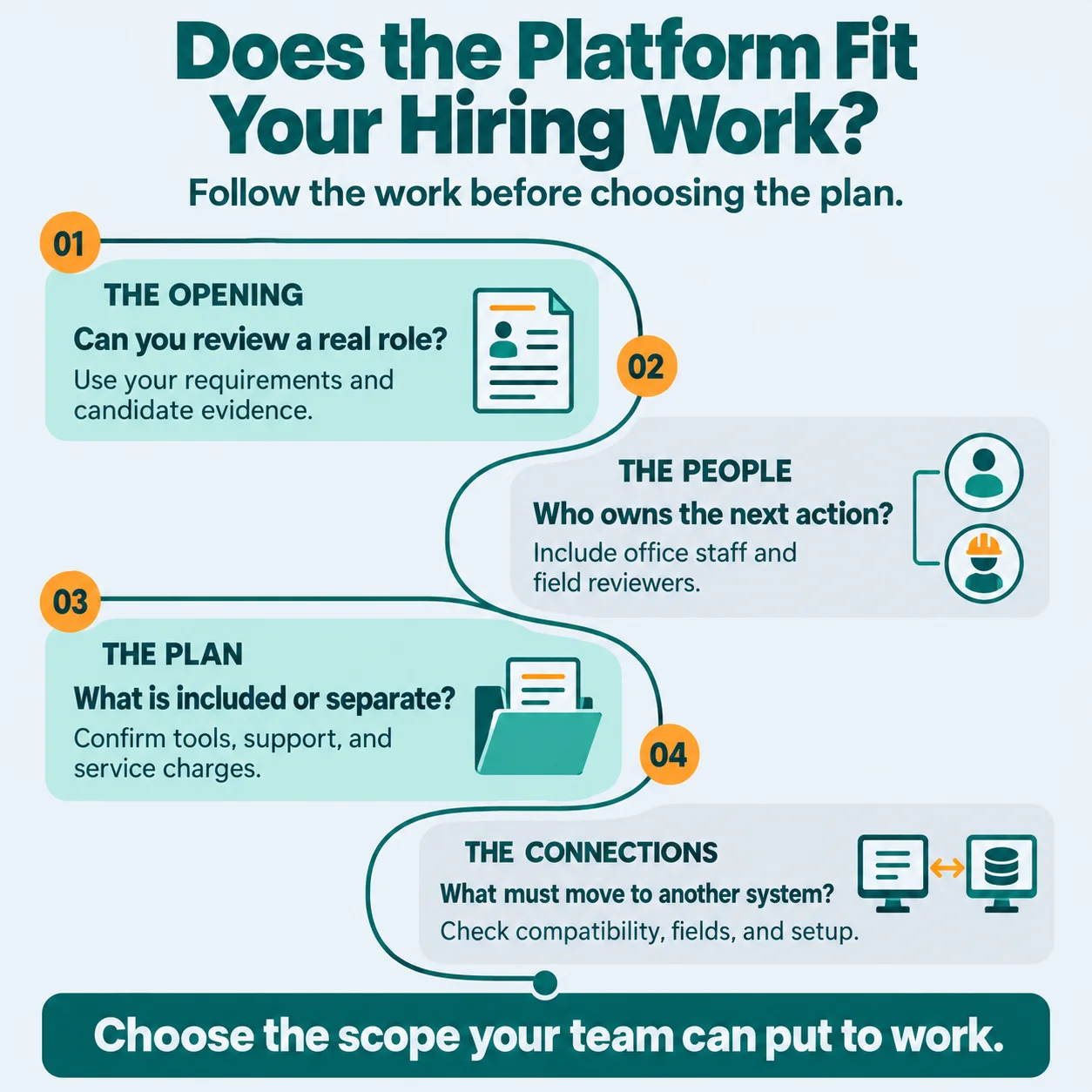
The right comparison starts with the work your team needs to perform. A company mainly organizing applicants should examine a different scope from one implementing assessments, SMS communication, automated follow-up, and broader recruiting support. Check the current Discovered pricing and plan comparison for inclusions and separately charged services before choosing.
A demonstration is more useful when you bring a realistic opening instead of requesting a general feature tour. Ask the team to work through these three situations:
- Review a candidate for your actual role. Use the requirements for a laborer, superintendent, estimator, or other opening. Examine what the reviewer can see and where feedback is recorded.
- Handle a change during the process. Move an interview, correct an instruction, or stop an unnecessary reminder. Confirm how the responsible person manages the change.
- Complete the next handoff. Show what reaches another reviewer or a connected system, including any configuration needed.
These checks help reveal whether the process suits your team’s habits. A feature may be available and still need changes to templates, ownership, or training before it works well in your business.
Discovered Review for Contractors: Making the Decision
Discovered deserves a closer look when hiring involves repeated coordination between office staff, field leaders, and decision-makers. Its combination of tracking, evaluation tools, communication, and support may be useful when your current process repeatedly loses information or leaves follow-up unfinished. The decision should rest on those recurring needs and the scope your team will use.
You may need a narrower solution if your immediate requirement is limited to organizing applications. Conversely, a business seeking extensive payroll or HR functionality should validate the exact workflow rather than assume a hiring platform covers every requirement. Our overview of applicant tracking systems for different industries offers broader context for comparing workflows and organizational needs.
The conclusion of this Discovered review for contractors is practical: evaluate the platform with a real vacancy, the people who will use it, and the conditions that usually interrupt your process. Start with the capabilities described on our construction hiring software page, then book a demo to examine your requirements, plan scope, and implementation questions together.
Frequently Asked Questions
What should a Discovered review for contractors evaluate?
It should examine how the platform supports your actual hiring process, including applicant review, screening information, follow-up, and collaboration. Plan differences, additional services, implementation responsibilities, and compatibility with existing systems also belong in the evaluation.
Does Discovered offer a free applicant tracking system?
Yes. The published Essentials plan includes a free ATS and unlimited users, along with a defined introductory assessment allowance and other listed tools. Review its current scope before assuming that features advertised elsewhere on the site are included in that plan.
Are background checks and IntegrityFirst included without additional charges?
The published plan comparison lists Checkr background checks as a per-use charge and IntegrityFirst tests as an additional charge across plans. Ask how those services would be billed for your intended use before finalizing your selection.
Can Discovered connect hiring information to payroll?
Discovered documents payroll data transfers using webhooks or Zapier with providers that accept API-based data input. Compatibility, field mapping, configuration, and responsibility for maintaining the connection should be confirmed for your specific provider.
Does Discovered guarantee better hires or fewer no-shows?
The availability of assessments, communication tools, and automation does not establish a guaranteed outcome for a particular contractor. Results depend on factors such as role requirements, candidate availability, implementation, and how the team evaluates and follows up with applicants.
Content