New crew members may leave within their first 90 days because the job differs from what they expected, the schedule or travel proves unworkable, or they do not receive the support needed to succeed. Pay, crew relationships, and opportunities to learn can also influence the decision. Reducing construction employee turnover starts with understanding which of those problems your new hires actually encounter.
A general contractor can recruit someone with relevant experience and still lose that person after a few weeks. The first shifts expose the difference between the hiring conversation and the work; the following weeks reveal whether guidance and learning opportunities are available. Looking at what changed before someone quit helps you decide what to screen for next time and what the company needs to deliver differently.
Why Construction Employee Turnover Starts So Early
The 2026 AGC and NCCER Workforce Survey national results address this problem directly. Among 801 respondents answering why new field employees leave within 90 days, 69% cited a mismatch between expectations and job reality, 51% cited physical demands, and 37% cited travel or schedule requirements. These are employers’ explanations, not findings from interviews with workers who quit.
The survey also shows why the percentages need context. Of the 813 respondents answering the early-turnover question, 17% reported no turnover, meaning approximately 83% reported some. That describes how widespread early turnover was among respondents; it does not mean 83% of new workers quit.
The Job Is Different From the One They Accepted
The gap can begin with a job advertisement that describes a trade but leaves out the working arrangement. A candidate hears local work and assumes a manageable commute, while the contractor expects movement between sites across a wider service area. Both may believe the arrangement was clear until the first reassignment exposes the difference.
Hours create similar problems. An early start, changing overtime expectations, or uncertainty about the next project can become difficult to sustain, even when the worker enjoys the trade. Explain what is known, what varies, and how changes are communicated rather than presenting today’s assignment as a permanent condition.
The physical routine can also differ from previous work. Someone accustomed to short repair visits may not expect repeated material handling across a full shift or extended work outdoors. Describe the actual tasks and conditions, along with training and protective measures, so the candidate can evaluate the work accurately. Treat a concern as something to clarify, rather than evidence that the person lacks motivation.
Pay and benefits deserve the same precision. A worker can accept the stated rate but misunderstand the classification, expected hours, or when a benefit becomes available. Review the actual terms together, and make sure the supervisor’s explanation matches the office’s. Our construction recruitment guide provides broader context for setting requirements before attracting applicants.

The Crew Does Not Give Them a Workable Start
A new hire may arrive prepared to work but find that nobody owns the introduction. They receive an assignment without enough explanation, are unsure whom to ask, and get corrected only after making a mistake. In that situation, the problem to investigate is whether the worker had a fair opportunity to learn the job.
Crew relationships also deserve attention. Dismissive responses, inconsistent instructions, or ridicule for asking questions can make an otherwise suitable position feel unworkable. Ask what happened on the crew and how concerns were handled before concluding that the worker could not handle construction.
Safety orientation is part of that start. OSHA’s education and training guidance calls for explaining hazards, reporting procedures, emergency actions, and whom to contact, using language and a literacy level workers understand. A signature on an orientation form is not evidence that a new hire knows how to raise a concern during the shift.
The Starting Level and the Learning Path Do Not Match
Someone hired as experienced may be comfortable with one type of project but unfamiliar with your methods or equipment. An entry-level hire may be willing to learn but placed under a supervisor expecting independent work immediately. Clarify which tasks the person can already perform and which tasks require instruction instead of treating a broad job title as a complete skills description.
Progress matters after the immediate adjustment, too. NCCER’s 2025–26 research on craft training, drawing on more than 1,400 craftworkers and nearly 200 employers, examines training alongside productivity, safety, and retention. For a new employee, a practical next step might be learning one additional task with feedback; it does not have to begin with a promise of rapid promotion.
These scenarios are starting points for investigation, not a diagnosis of every resignation. A competing offer or a personal change may also explain a departure. Your team needs the worker’s account and the circumstances of the assignment to understand what it could reasonably have changed.
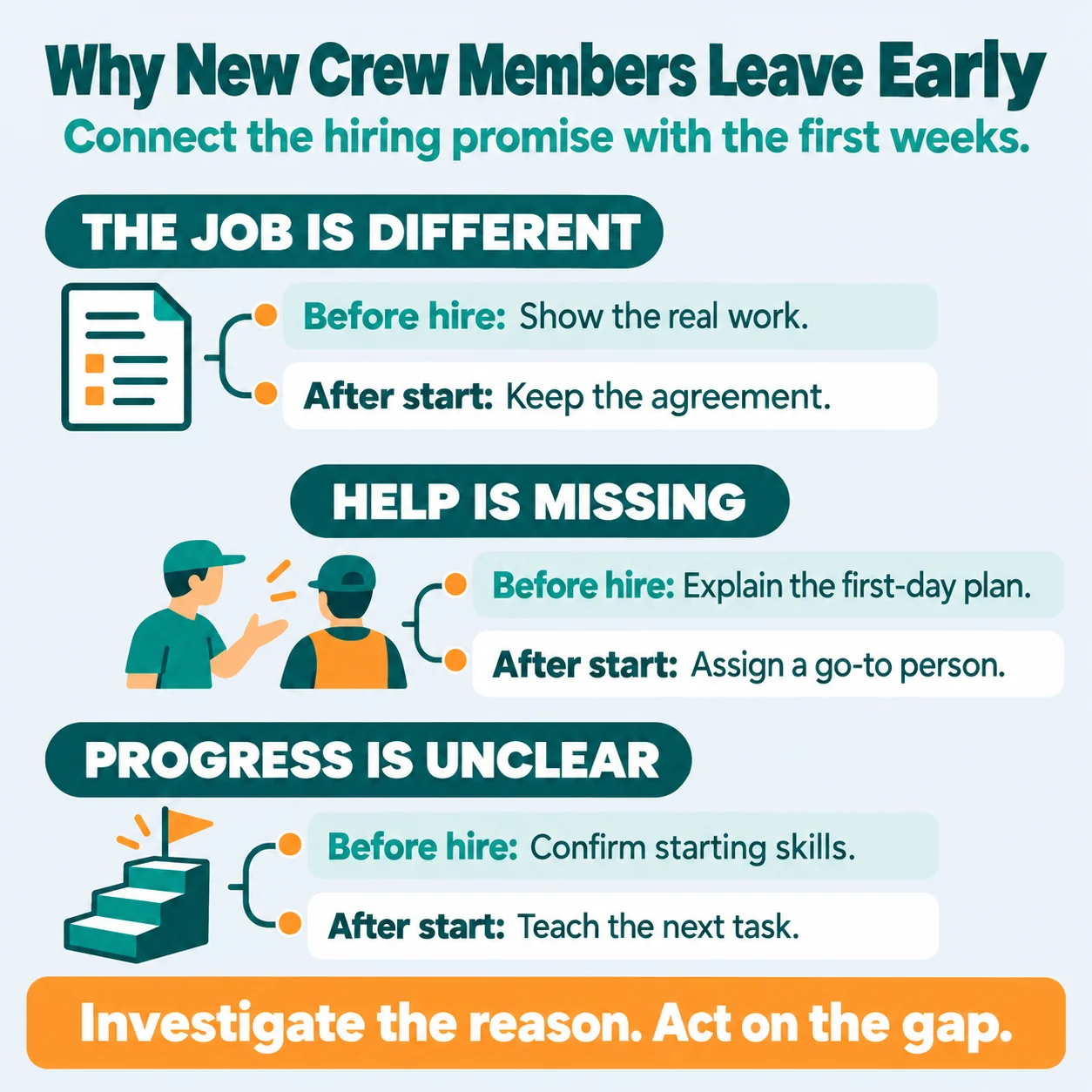
What to Screen For Before You Hire
Screening should establish whether the candidate understands the actual job and has the starting qualifications it requires. It also gives the candidate information to decide whether the arrangement works for them. A more demanding interview is not automatically a more useful one.
Connect each screening step to a reason someone might leave early. Travel and schedule questions test whether the arrangement is workable, while task-specific questions establish whether the starting level matches the assignment. Discussing how the person learned unfamiliar work can help identify the instruction they will need; it does not excuse the company from providing that instruction.
Describe the essential tasks, work locations, schedule, and training arrangement before asking for agreement. Then use specific follow-up questions rather than asking whether someone is dependable or comfortable with hard work. For example:
- Schedule and location: “This opening starts at 6 a.m. at the assigned site, with locations changing within the area we described. Can you meet those requirements, and what needs clarification?”
- Relevant experience: “Which of these tasks have you performed independently, and which would require instruction?”
- Pay and work expectations: “We have reviewed the classification, pay terms, expected hours, and benefit timing. What differs from what you understood or expected?”
- Response to uncertainty: “Tell me about a time you received an unfamiliar assignment. How did you get the information you needed?”
- Expectations: “What would you need to understand about this position before deciding whether to accept it?”
Evaluate the answers against the role, not assumptions about age, family circumstances, appearance, or personality. Our construction laborer interview questions can help you develop a role-specific conversation, with questions selected for the work you actually need performed.
Record what the answer establishes and what remains unresolved. “Has done similar work” is less useful than knowing which tasks the candidate performed, under what supervision, and what training is still needed. If the worker expects steady hours or a particular location that you cannot commit to, resolve that difference before the offer rather than treating acceptance as proof of understanding.
Where an assessment is appropriate, choose it for a defined job requirement and consider its results alongside other evidence. The EEOC’s guidance on employment tests and selection procedures explains employers’ responsibilities when selection methods could exclude protected groups. Relevant testing can inform a decision, but a score does not establish that someone will remain for 90 days.
Discovered’s pre-employment assessment tools cover areas such as skills, aptitude, and work styles. Use an appropriate instrument to investigate a specific requirement rather than turning an assessment into a general prediction of loyalty. The interview should still resolve practical questions about the assignment.
Make the First Weeks Match the Hiring Conversation
The transition from recruiting to supervision is where the agreement needs to become everyday practice. Give the receiving supervisor a concise summary of the role, confirmed experience, and training needs. That summary should describe what the employee can do and what support the company agreed to provide.
A useful sequence of early conversations can be simple:
- Before the first shift, confirm the arrival plan. Provide the correct location, start time, contact, and instructions for entering the site. Confirm who will receive the new employee and explain the first assignment.
- During the first week, check the actual experience. Ask what differs from the hiring conversation and whether instructions and support are clear. Address the answer with the responsible supervisor instead of recording it without follow-up.
- Around days 30, 60, and 90, review work and expectations. Discuss progress, remaining training, schedule changes, and any difficulty continuing in the role. These are suggested checkpoints, not a reason to delay a conversation when a concern appears earlier.
An illustrative example shows the difference. If a new laborer says the changing job locations are becoming difficult, revisit the arrangement and the notice the employee receives. Another assessment will not explain whether the company changed the assignment after acceptance or whether a clearly disclosed requirement is no longer workable.

Use Early Departures to Find the Pattern
Start with a consistent definition of the outcome. If you want to understand voluntary quits within 90 days, keep those separate from layoffs, planned project completions, dismissals, and candidates who never started. Combining them into a single number can conceal very different problems.
Compare groups of actual starters whose full 90-day follow-up dates have passed. Divide the number who voluntarily quit within that window by the number who started in the group, then multiply by 100. Include everyone who started in that denominator, even if they later left; excluding departures would distort the result.
For example, in a hypothetical group of 20 starters, three voluntary quits within 90 days produce a 15% early voluntary quit rate. If another employee was laid off, record that separately. The example demonstrates a calculation, not an industry benchmark or a target for your company.
Connect each departure with the worker’s stated reason, days employed, assigned crew, and relevant changes to the job. Ask, “What differed from what you expected?” and “What could we have addressed sooner?” Record an unknown reason as unknown when someone does not respond, rather than assigning a convenient explanation.
Patterns should guide investigation, not automatic blame. Several exits from one crew may justify examining supervision, but that crew may also have a difficult location or a changing schedule. Our guide to the cost of employee turnover explains why replacement work belongs in the broader business discussion; your own records should establish the costs and causes in your operation.
Keep Hiring Information Useful After the Offer
An organized record helps prevent the employer from losing what it learned during selection. Discovered supports applicant tracking and candidate evaluation tools; your team can use the relevant hiring information to prepare a supervisor handoff. Check how information will be shared with authorized participants rather than assuming that hiring records automatically reach every post-hire system. General contractors can see how this works across project teams on our hiring software for general contractors page.
Our guide to a construction applicant tracking system explains how that organization supports the process. Keep responsibility for first-week conversations and employee follow-up explicit, whether you manage them through an existing HR system, a supervisor routine, or another agreed method.
To understand why new crew members quit in the first 90 days, compare what they accepted with what happened before they left. Use those findings to clarify requirements and evaluate relevant experience before the next hire, while correcting gaps in the first weeks of work. Reducing construction employee turnover requires both sides of that effort; explore our construction hiring software if your team needs a more consistent way to organize selection.
Frequently Asked Questions
Why do new construction workers quit within 90 days?
Possible reasons include unexpected job conditions, difficult travel or schedules, insufficient support, pay misunderstandings, or a mismatch between skills and assignments. Ask the worker and review the circumstances rather than assuming every early exit reflects poor motivation.
What is a normal first-90-day construction turnover rate?
The survey discussed here does not establish a single target for every contractor. Compare equivalent groups in your own business and keep voluntary quits separate from other departures, accounting for differences in roles, project conditions, and hiring arrangements.
Can assessments prevent early construction employee turnover?
Relevant assessments can add evidence about defined job requirements, but they cannot guarantee retention. They also cannot resolve differences between promised and actual conditions or replace effective supervision and training.
When should supervisors check in with a new crew member?
Start during the first week and respond sooner if a concern arises. Reviews around days 30, 60, and 90 can provide a useful routine, with attention to expectations, support, progress, and whether the assignment remains workable.
Content