Would you ask an employee referral the same must-have questions as someone who applied through a job board? Most hiring teams would answer yes. Their candidate records often tell a different story.
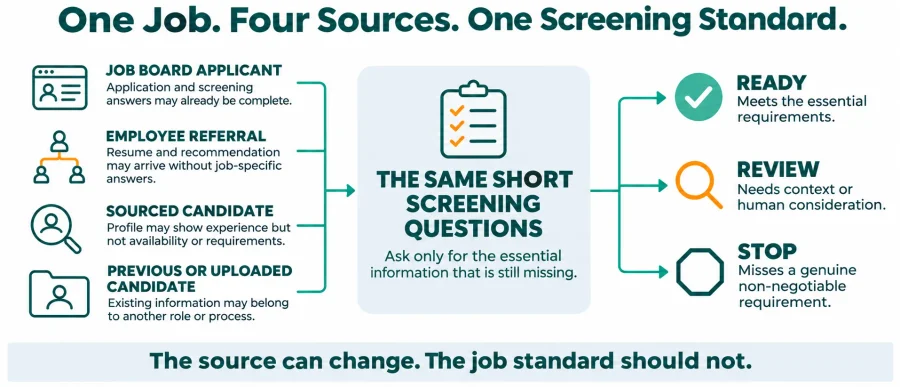
A job-board applicant may already have answered questions about schedule, location, licensing, or work authorization. A referred candidate may arrive with only a resume and a recommendation. A sourced candidate may have a profile but no application, while someone copied from a previous job may bring information collected for a different role.
All four people can appear inside the same hiring pipeline even though the team knows something different about each one.
A consistent candidate screening process closes that gap. It gives every candidate the same opportunity to confirm the job’s essential requirements without making people repeat information they already submitted or complete an unnecessarily long application.
Four Candidates, One Job, Four Different Records
Imagine a company hiring a field operations coordinator.
The team receives four candidates in one week:
Taylor — Job-board applicant
Taylor applied through an integrated job board and already answered the job’s screening questions. The profile includes availability, location, and license information.
Marcus — Employee referral
A current employee emailed Marcus’s resume to the recruiter. The recommendation is strong, but the team has not confirmed whether Marcus can work the required Saturday rotation.
Priya — Sourced candidate
A recruiter found Priya while searching for experienced candidates and added her directly to the job. Her background looks relevant, but she has not confirmed location or schedule requirements.
Jordan — Previous applicant
Jordan interviewed for another opening six months ago and has now been copied into this job. The existing profile contains useful history, but the original application questions were written for a different position.
The candidates may all deserve consideration. They should not move forward based on four different information standards.
That inconsistency can create two opposite problems. A qualified referral may receive an interview before a basic mismatch is discovered, while a job-board applicant faces more scrutiny simply because the application collected more information.
Build the Process in Two Layers
A consistent process does not require every candidate to complete the same long form. It requires the team to separate the information everyone must provide from the context that varies by source.
Layer 1: The same essential questions
Every candidate should answer the short set of questions needed to determine whether the next stage is practical.
Depending on the role, this may include:
- A legally required license or certification.
- Availability for the actual shift.
- Ability to work at the required location.
- Work authorization where appropriate.
- One job-specific condition that can be confirmed clearly.
Indeed recommends using a focused set of approximately three to five screener questions and distinguishing true requirements from preferred qualifications. Too many or overly complex questions can create unnecessary candidate friction. Indeed’s employer guidance on screener questions also notes that questions should focus on the work and practical requirements rather than credentials alone.
Layer 2: Source-specific context
The recruiter can then review the information that came with the candidate:
- Referral notes.
- Resume and application history.
- Sourcing profile.
- Previous communication.
- Prior assessments or interviews.
- Information from another opening.
This context can enrich the review, but it should not replace the same essential qualification check used for everyone else.
Consistency does not mean ignoring how the person entered the process. It means avoiding a different hiring standard for each source.
Decide What Belongs in the Short Screening Step
Not every question should be asked before the interview.
A useful screening request answers one of three needs.
Ask now: Is the next stage practical?
These questions confirm requirements that could prevent the person from performing the job.
Examples include:
- “Do you hold the required state license?”
- “Are you available for the listed shift?”
- “Can you work at the specified location?”
- “Are you authorized to work in the United States?”
The EEOC’s guidance on pre-employment inquiries states that information requested during hiring should generally be limited to what is essential for determining whether someone is qualified. Questions that expose protected characteristics or are unrelated to the job should be avoided.

Review in context: Would this strengthen the match?
A preference should help the team prioritize rather than automatically eliminate candidates.
Examples include:
- Experience in a related industry.
- Familiarity with one software platform.
- A preferred number of years in a similar role.
- Experience with a particular customer type.
Our guide to resume screening criteria explains why familiar titles, arbitrary experience thresholds, and exact software matches can become weak proxies for the work itself.
Assess later: Does the capability require evidence?
Some questions are too complex for a short form.
Communication, judgment, technical execution, leadership, and problem-solving may require a work sample, interview, or structured evaluation. A Custom Skill Test can provide more useful evidence than asking candidates to describe a practical ability in one short text box.
The screening step should confirm what can be confirmed quickly. It should not attempt to complete the entire hiring decision.
Use One Standard Without Repeating Work
Consistency does not mean asking a candidate to answer the same question twice.
Before sending anything, review what is already available. Taylor, the job-board applicant, should not receive another request for questions already completed. Marcus and Priya need the missing answers, while Jordan may need a fresh set because the earlier questions belonged to another role.
A well-designed job application form follows the same principle: collect what is useful for the next decision and avoid duplicate fields that create effort without adding information.
This produces a simple rule:
Same standard, only missing information.
The candidate source may change the route into the pipeline. It should not change the essential information required before the interview.
Route the Answer, Not Just the Candidate
Collecting answers is only useful when the team has decided what each result should trigger.
A practical routing model has three outcomes.
Ready
The candidate meets the essential requirements. The profile moves into recruiter review, assessment, or interview scheduling.
Review
The candidate misses a preference, provides an answer that needs context, or has transferable experience that should receive human consideration.
Stop
The candidate does not meet a genuine legal, safety, availability, or practical requirement.
Automatic rejection deserves particular care. A “no” answer should only end the process when the team has intentionally defined the condition as a true dealbreaker and is comfortable applying it consistently.
Our guide to recruitment automation best practices explains why automation is best used for predictable routing while exceptions and consequential hiring decisions retain appropriate human oversight.

Run a Cross-Source Screening Audit
Choose one active job and inspect five candidate records from different sources.
Ask:
- Did every candidate receive the same essential questions?
- Are some candidates being asked for information others already provided?
- Does each dealbreaker represent a true requirement?
- Are preferences being treated as automatic barriers?
- Are practical skills being evaluated somewhere more appropriate?
- Does completing the questions trigger a clear next step?
The audit often reveals that the problem is not the quality of the questions. It is that only some candidates were ever asked.
How Discovered Closes the Source Gap
Discovered allows teams to add Send Screening Questions to a workflow status. Any candidate entering that status can receive a personalized link through email or text and answer the job’s existing questions on a short Application Questions page.
Candidates who already answered are marked complete rather than asked again. Recruiters can see whether answers are outstanding, completed, or contain a designated dealbreaker response, while conditional routing can move completed candidates toward the next stage. Message sequences can also stop automatically once the candidate submits the answers.
The feature does not create another set of questions to maintain. It uses the same questions connected to the job, regardless of whether the candidate came from a job board, referral, resume upload, sourcing activity, or another pipeline.
One Job Should Have One Screening Standard
A referral may arrive with trust. A sourced candidate may arrive with a strong profile. A job-board applicant may arrive with more complete information.
Those differences provide context, but they should not create different qualification standards.
A consistent candidate screening process asks every person for the same essential information, preserves what they already submitted, and routes the result according to a job-related rule.
The objective is not to make every candidate journey identical. It is to make sure the team is comparing people with the information needed to make the next decision fairly and efficiently.
Content