AI candidate experience improves when technology helps applicants understand the process, complete useful steps, and receive timely responses. AI can help recruiters draft clearer communication and organize candidate information, while automation handles predictable tasks such as confirmations and scheduling. Those capabilities become valuable to candidates when the hiring team uses them to remove uncertainty and remains available when questions require a person.
Consider an applicant who completes an assessment on a Friday evening. An immediate acknowledgment is helpful, but it does not explain whether anyone will review the results or when the next update will arrive. A better process provides that context, assigns responsibility for the review, and makes it easy to ask for help. Improving the journey starts with those decisions before adding more technology.
What AI Candidate Experience Actually Means
Candidate experience is the impression applicants form through their interactions with an employer, from exploring a role to receiving a decision. AI can influence that impression directly through an automated conversation or indirectly by helping recruiters prepare messages and review information. Its value depends on what changes for the person applying, including whether instructions become clearer and questions receive useful answers.
It helps to distinguish three layers of hiring technology. An applicant tracking system stores applications and organizes progress. Rules-based automation sends or triggers an action when a defined condition is met, such as sending a booking invitation after a status change. AI interprets or generates information, such as producing a draft message from supplied context. A scheduling link does not need to use AI to improve the experience.
This distinction matters when evaluating a solution. If candidates cannot find an available interview time, the immediate need may be better scheduling configuration. If recruiters struggle to write clear updates consistently, AI-assisted drafting may help, provided someone checks the wording and facts. Choosing the capability that addresses the actual obstacle is more useful than adding AI to every stage.
Remove Friction Across the Hiring Journey
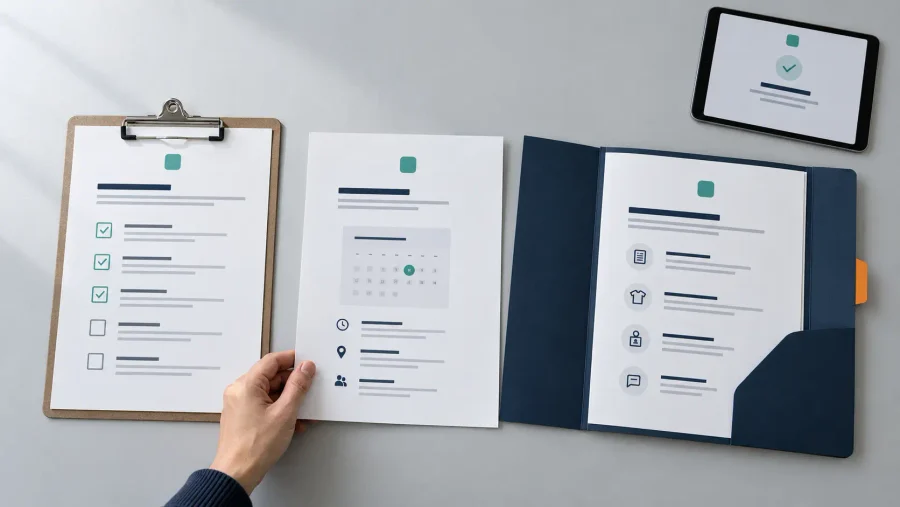
Start with the moments that require effort from candidates without giving them useful information in return. Re-entering resume details, completing unexplained assessments, or waiting for a scheduling reply can make the process harder to navigate. Map those moments from the applicant’s perspective and identify what each person needs to know or do next.
Recent research shows why that attention matters. In its October 2026 Future of Hiring Candidate Report, Greenhouse reported that 45% of U.S. respondents who interviewed cited employer ghosting among their complaints. The release reports U.S. findings from 1,200 respondents within a larger international survey. This vendor-sponsored, self-reported research describes candidate perceptions; it does not establish that AI caused or resolved the problem.
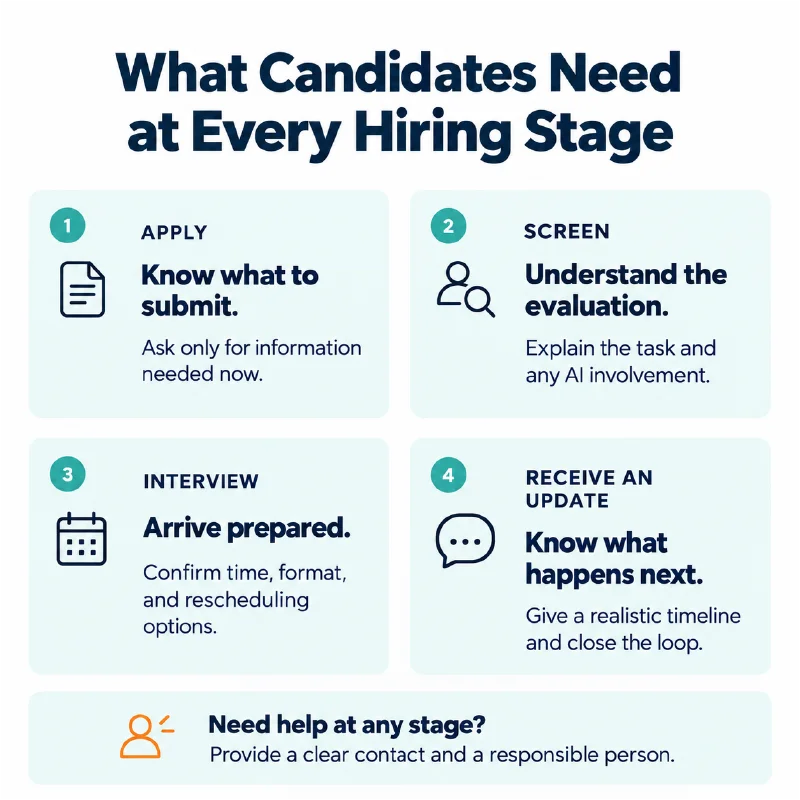
During application, remove unnecessary questions before considering additional technology. Ask for information needed at that stage and explain the purpose of any extra task. Our guide to custom job application form best practices explores how form design can reduce avoidable effort without removing information needed for evaluation.
During screening, candidates need to understand what participation involves. Explain the expected time commitment, the kind of work being assessed, and how to request assistance. AI may help organize information for the hiring team, but an internal summary does not improve the experience unless it supports a clearer or more responsive process.
During scheduling, make the invitation usable. Include the interview format, time zone, expected duration, preparation instructions, and a contact for problems. A link with no workable openings simply transfers coordination work to the applicant. Our recommendations for reducing interview no-shows explain how preparation and practical logistics can support attendance.
| Candidate obstacle | Useful technology support | Human responsibility |
|---|---|---|
| Repeated application questions | Structured forms and reusable candidate information where supported | Remove fields that are unnecessary at this stage |
| Unclear screening instructions | AI-assisted drafts reviewed against the actual process | Explain purpose, requirements, and available assistance |
| Scheduling delays | Booking links, calendar availability, and reminders | Maintain usable slots and resolve exceptions |
| Conflicting follow-up messages | Shared communication history and stage-based workflows | Check context and stop irrelevant outreach |
| Silence after an interview | Update reminders and approved message templates | Own the decision timeline and communicate changes |
The comparison also helps prevent overbuying. Some problems require better writing or clearer ownership rather than a new tool. Test whether the proposed change removes an obstacle for candidates before expanding it across the hiring process.
Design Human Handoffs Before You Automate
A useful workflow defines when automation should stop and who takes responsibility next. A candidate who asks about an accommodation, compensation, or a schedule conflict needs an answer that reflects the situation. Repeated reminders to complete the original task will not resolve the question and may make the employer appear inattentive.
Define the handoff in operational terms. Assign someone to monitor replies, specify how unresolved questions are escalated, and set an internal expectation for responding. Review whether a completed task, a withdrawal, or a change in stage should end a sequence. Our guide to candidate outreach automation develops this connection between candidate behavior and relevant follow-up.
For a hypothetical example, a service technician applies between shifts and receives an interview invitation. None of the available appointments fits their work schedule, so they reply asking for an alternative. The acknowledgment has already done its job; the next useful action is for a recruiter to review availability and respond. Sending another invitation without addressing the reply adds activity while leaving the obstacle in place.
Shared context makes these handoffs easier. Discovered’s candidate communication tools bring emails, texts, notes, and activity into a candidate record and support AI-generated messages and sequences. Those capabilities can help a recruiter see what has already happened before responding. The team still needs to verify any generated wording and decide what the candidate actually needs.
Similarly, Discovered’s automated interview scheduling supports booking links, calendar coordination, reminders, and status-triggered invitations. These are practical ways to reduce administrative waiting. Their effectiveness still depends on available appointments, accurate instructions, and a clear route to assistance when the standard options do not work.

Protect Trust With Transparency and Accessibility
Transparency should answer a candidate’s practical questions before participation. If AI evaluates interview responses, explain that use, what information the evaluation considers, and how people review the output. Describe the process accurately rather than offering broad assurances that the technology is fair or objective. Only promise a review or support option that the organization can actually provide.
The same October 2026 Greenhouse research found that 49% wanted to know a human would review their AI interview responses. It also reported that 70% of respondents who had taken an AI interview said it let them demonstrate their skills well. Together, these findings suggest room for positive experiences alongside expectations of accountability; they do not prove that one interview format is superior.
Accessibility also belongs in process design. The Department of Justice’s guidance on AI and disability discrimination in hiring, published in 2022, explains how hiring technologies can exclude qualified people with disabilities and why accommodations matter. Employers should provide a clear way to request assistance and consider whether a tool measures relevant job skills or introduces barriers unrelated to the work.
Before adopting an assessment, ask what information it evaluates, what limitations are documented, and how candidates can raise problems. Avoid assuming that a recorded interview includes facial analysis or that an AI summary represents a complete assessment. The employer needs to understand the actual implementation and ensure its instructions match it.
Privacy explanations should be equally specific. Tell candidates where to find the applicable privacy notice and avoid collecting information without a defined purpose. Keep sensitive questions and accommodation requests within the appropriate review process, and prevent generated messages from revealing internal notes or making unsupported promises about decisions.
Measure the Experience Beyond Hiring Speed
A shorter hiring process can still leave applicants confused. Measure whether candidates complete meaningful steps, receive promised updates, and get help when needed. Combine operational records with feedback from people who progress, withdraw, and are rejected; surveying only new hires leaves important experiences out of view.
External benchmarks provide context when their scope is clear. Employ’s Hiring Benchmarks Report announcement, published in January 2026, reports that application-to-initial-screening time averaged 7.2 days in 2025 across its analyzed customer data. The report draws on 6,640 customers using Employ platforms. That is a historical vendor-dataset benchmark, not a universal target or evidence that automation produced the result.
For an individual hiring team, stage-level measures are often more actionable than a single overall number. If applicants wait mostly before the first review, adding interview reminders addresses a different part of the journey. If interview attendance improves but withdrawal rises after assessments, investigate the assessment burden and instructions before expanding automation.
| Metric | How to define it | What to investigate |
|---|---|---|
| Application completion | Submitted applications divided by recorded application starts | Required fields, repeated entry, device usability |
| Time to first meaningful response | Elapsed time from application to a response explaining a next step or decision | Review queues, ownership, missing updates |
| Interview show rate | Attended interviews divided by scheduled interviews, using a consistent cancellation policy | Availability, instructions, reminders, rescheduling |
| Update reliability | Candidates receiving a promised update by its stated deadline divided by candidates due that update | Overdue decisions and broken handoffs |
| Candidate satisfaction | The same survey question and scale at a defined stage, reported with response rate | Clarity, support, fairness concerns, response bias |
Use consistent definitions before comparing periods. For time to hire, document the starting event and measure through offer acceptance; time from offer delivery to acceptance is a separate interval. Compare similar roles and locations, and review changes in applicant volume or labor-market conditions before attributing an improvement to AI.
Run a focused pilot around one problem, such as unclear post-assessment updates. Establish a baseline, change the workflow, and review both operational outcomes and candidate comments. Check message accuracy and exceptions as well as completion rates. Expand only after the team understands what improved and what still requires attention.
Build a Clearer Hiring Journey With AI
A stronger AI candidate experience gives applicants useful information and a reliable next step while preserving opportunities to ask questions. The foundation is a process with clear responsibilities, appropriate evaluation criteria, accessible participation, and honest communication. Technology supports that foundation when it reduces effort and helps people respond with better context.
Start with one recurring source of uncertainty and define the experience you want candidates to have instead. Then choose the combination of process changes, automation, and AI assistance that supports it. To explore how Discovered can connect candidate communication and interview coordination within your hiring process, book a demo with our team.
Frequently Asked Questions
What is AI candidate experience?
AI candidate experience describes how artificial intelligence affects an applicant’s interactions with an employer during hiring. It includes direct interactions with AI and indirect effects, such as clearer recruiter communication or faster review of information, while depending on how the employer designs and manages the process.
Does automated interview scheduling require AI?
Automated scheduling can operate through calendar availability and predefined workflow rules without AI. AI may help draft the invitation, but usable appointments, accurate instructions, and support for scheduling problems remain separate requirements.
Should AI make the final hiring decision?
Hiring teams should retain accountable human review of consequential decisions and understand the limitations of any AI output they use. A reviewer needs the relevant evidence and authority to question a recommendation rather than simply approve a score.
How can employers tell whether the experience is improving?
Track stage-level measures such as completion, response timing, attendance, and update reliability alongside candidate feedback. Compare similar groups over time and examine withdrawals and rejected applicants as well as successful hires to identify gaps that an overall hiring-speed metric can miss.
Content